There is some feuding in the letters to editor page of the Sunday Star Times today between Lindsay Mitchell and Susan St John about whether employers pocket some of the Working for Families tax credit by reducing the wages they offer.
I have contracted-out my reply on the economic incidence of in-work tax credits to a former ANU economics professor who is now an Australian Labour Party federal MP.
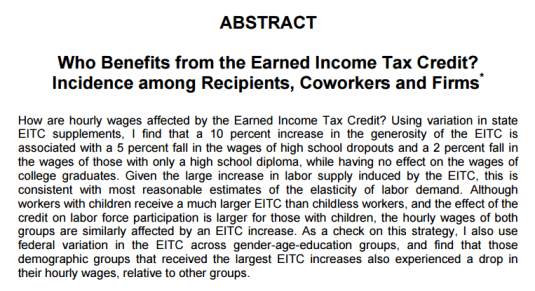
There is general agreement such as summarised by the Economist that a significant part of family tax credits goes into the pockets of employers:
An analysis of the EITC published in 2010 by Andrew Leigh of the Australian National University found that most of the benefit of the credit went to workers. Not all of it did though: a 10% increase in the credit was associated with a 5% dip in wages of high-school dropouts. By the same token, a study conducted the following year by Mr Rothstein found that for each dollar spent on tax credits, existing workers’ income rose by $0.73 (although $0.09 of this was because they chose to work more). Employers gained $0.36, as they spent less on wages.
Economists at Britain’s National Institute of Economic and Social Research are conducting a similar study of the British system of tax credits. Childless workers become eligible for the credits at the age of 25. By comparing wages either side of this threshold, they have been able to estimate how much the credits are depressing wages. Their preliminary (and unpublished) results suggest that, of the 76p an hour the government forks out in tax credits for someone on the minimum wage, 72-79% goes to workers.
In work tax credits increases labour supply, which depresses wages except where wages are pressing up against a binding minimum wage. Steve Landsberg has pointed out a paradoxe of a binding minimum wage when there is an earned income tax credit:
If you increase the EITC in a market with an effective minimum wage, you’ll get a whole lot more workers competing for the same limited number of jobs, and this competition must continue until all of the benefits have either been dissipated or transferred to employers, who are now able to demand harder work and offer fewer perquisites.
 Utopia, you are standing in it!
Recent Comments