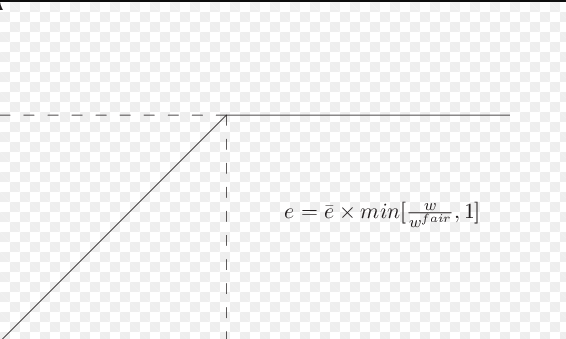
Living wage advocates make much of the demoralising effects of pay inequality on workplace productivity. In common with the efficiency wage hypothesis, this is another example of what Nozick (1974) called normative sociology; the study of what the causes of social problems ought to be. Again, living wage activists misconstrue what the fair-wage effort hypothesis was seeking to explain.
The fair-wage effort hypothesis aimed to fill gaps in the efficiency wage hypothesis by explaining why unemployment is so much higher among the lower skilled (Akerlof and Yellen 1988, 1990). Under the fair-wage effort hypothesis, workers slack off if paid less than they think they deserve:
The motivation for the fair wage-effort hypothesis is a simple observation concerning human behavior: when people do not get what they deserve, they try to get even (Akerlof and Yellen 1990, p. 256).
Lazear (1989, 1991) contends that employers too may want greater pay equity to temper over-competitiveness in teams. If pay and promotions in a team are linked to the relative performance of its members, large pay differentials may undermine co-operation and might encourage sabotage:
Very large pay spreads induce high effort, but they also create a work environment in the firm that is not very pleasant… individuals who are competing with one another can either seek to outperform others, or they can contribute to the failure of others. Such incentives can result in collusion (Dye, 1984) or in sabotage (Lazear, 1989). Thus, pay structure must strike a balance between providing incentives for effort and reducing the adverse consequences associated with this kind of industrial politics (Lazear and Shaw 2007, p. 95).
Lazear’s (1989, 1991) theory about the industrial politics arising from pay inequality stressed how sizable rewards to individual members of a team could lead to a lack of team play and lower team output. If the prizes were smaller for superior relative performance, the pay rise after a promotion or the annual performance bonus, there may be more teamwork (Lazear 1989, 1991). Akerlof and Yellen (1990) were correct in their insight that their hypothesis about fair-wage effort applies more to workers on lower wages with fewer chances of moving up promotion ladders and pay scales.
The fair-wage effort hypothesis is but another Keynesian macroeconomic theory of unemployment:
The hypothesis explains the existence of unemployment. Unemployment occurs when the fair wage w* exceeds the market-clearing wage. With natural specifications of the determination of w*, this hypothesis may explain why skill and unemployment are negatively correlated. In addition, it potentially explains wage differentials and labor market segmentation (Akerlof and Yellen 1990, p. 256).
The fair-wage effort hypothesis was developed as a descendant of the efficiency wage hypothesis because the latter cannot explain why wages are high for everyone working in high-paid industries:
All workers in better-paid industries tend to receive positive wage premia. That is, the wages of secretaries and engineers are highly correlated across industries. Ease of supervision and the magnitude of turnover costs might well be correlated across industries for a given occupation explaining, for example, why, say, skilled machinery operators receive positive wage premia in most industries. But there is no obvious reason why, say, secretaries, should be harder to supervise in the chemical industry where pay is high, than in the apparel industry where pay is low (Akerlof and Yellen 1988, p. 44).
The efficiency wage hypothesis also offered “no natural explanation” for why unemployment rates [JC1] are much higher among the lower-skilled (Akerlof and Yellen 1990). Skilled workers are probably more difficult to monitor than the unskilled so their unemployment rates should be higher than for the low-skilled as a worker discipline device but the contrary is the case (Akerlof and Yellen 1990).
The fair-wage effort hypothesis aimed to fill gaps in the efficiency wage theory of unemployment by explaining why low skilled unemployment is much higher both in recessions and in better times. Living wage activists must accept that their demands for workplace pay equity increase low-skilled unemployment under a Keynesian theory which they embrace with considerable enthusiasm.
If high wages are paid to the more skilled to attract the best applicants, demands for pay equity by their less skilled co-workers could price some of them out of the market leading to unemployment (Akerlof and Yellen 1988, 1990). In addition, pay equity norms are unlikely to respond quickly enough to fluctuations in aggregate demand so wages can be too high in recessions causing mass unemployment of the low skilled (Akerlof and Yellen 1988, 1990; Summers 1988). The unemployed cannot successfully offer to work for less than existing workers do in a recession because they cannot make a credible commitment to eschew fairness considerations once hired (Akerlof 2002).
An important premise of New Keynesian macroeconomics is demands for pay equity come at a price. At a price that is high enough for the efficiency wage and fair-wage effort hypotheses to be put as a comprehensive New Keynesian explanations of involuntary mass unemployment (Gordon 1990).
Both the efficiency wage hypothesis and the fair-wage effort hypothesis are attempts to flesh out a theory of extensive labour market dysfunction leading to mass unemployment. Living wage activists are using Keynesian theories of why wages are too high to argue for even higher wages.
 Utopia, you are standing in it!
Recent Comments