Following the election result some pundits have suggested that English votes for English laws might be an obstacle to the government, given its reliance on support from non-English MPs, whilst others have suggested the procedures might provide the government with an enhanced English majority. In this post Daniel Gover and Michael Kenny explain that neither of these possibilities is likely to occur. However, the territorial balance of the new Commons could cause the West Lothian question to come back to the fore – though not solely in relation to England.
Amidst the swirl of punditry and opinion unleashed by this month’s general election result, attention has once again turned to the ‘English votes for English laws’ reform (otherwise known as ‘EVEL’) recently introduced in the House of Commons. EVEL aimed to address concerns about the capacity of MPs from outside England to exercise a determining vote on England-only legislative matters…
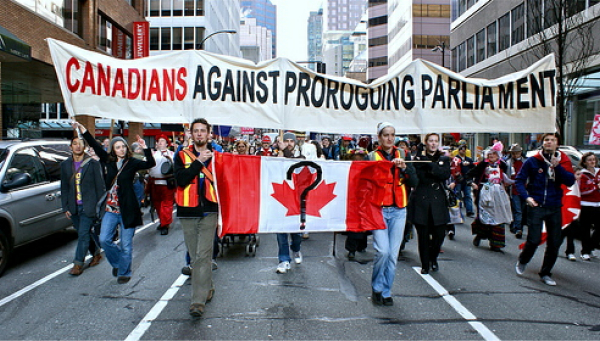
I first prepared this piece in March, when the government first announced its discussion paper on reforming the Standing Orders but before the opposition filibustered the Procedure and House Affairs Committee. In any event, I had always focussed on the proposed reforms surrounding prorogation and not on the reforms to Question Period.
When you think of hyperinflation countries like post-war Germany and Zimbabwe come to mind. However Bolivia in the 1980’s seems to have been a forgotten example. Below is a very good video about the hyperinflation in Bolivia from the PBS Commanding Heights series. I use it teaching the impact of hyperinflation on an economy and policies that to try and control its impact. Some of the main issues from the video are:
Inflation reached 23,500%
7 out of 10 Bolivians live in poverty – the poor get hurt by inflation
Inflation averaged 1% every 10 minutes
One of the causes of the inflation was government finances – they just printed money and didn’t collect taxes
How do you stop a hyperinflation or an inflation? Gradualist steps don’t work and as Jeff Sachs said: “All this gradualist stuff just doesn’t work. When it really gets out of control you’ve got to…
Hezbollah terror flag at front of Al Quds Day parade in London
We came we saw we conquered! While the Hezbollah Al Quds Day terror parade was allowed to take place on Sunday 18th June in the heart of London’s West End a group of 20 to 30 pro-Israel activists stepped out into the road to block the march no sooner than after it had just started.
The 300 or so Hezbollah supporters looked frustrated and bemused after expecting their usual easy ride shouting their slogans calling for Israel’s destruction.
Anti-semites will continue to block us from their anti-Israel meetings and have us thrown out of their anti-Israel events by making up accusations that we “disrupt” but they can’t stop us taking it to them on the streets of London.
As soon as the Iranian-regime inspired terror parade had set off down Portland Place from the…
Back in 2014, I wrote a column asking my leftist friends two very serious questions. And I often repeat these questions when debating proponents of bigger government.
Can you name a nation that became rich with statist policies?
Can you name a nation that with interventionism and big government that is out-performing a similar nation with free markets and small government?
I’ve yet to receive a good answer to either question. Many leftists point to certain European welfare states, but I debunk that claim by pointing out that those nations became rich when government was very small (about 10 percent of GDP, about one-half the size of the current Hong Kong and Singapore public sectors).
Others point to rapid growth in China, but that’s rather silly since improvements in that country’s economy are the result of partial liberalization. In any event, it’s not that difficult to have rapid growth…
The British did not develop India because that would made it a worthwhile prize for another to steal. Rome face no serious rivals so we could take a long-term view on investing in colonies.
A prosperous colony is an attractive colony to conquer so imperial army and navy resources would have deployed to defending it. Prosperous locals and locally recruited troops can switch loyalties.
An empire full of prosperous colonies makes you an attractive target for other European powers to gang up on and divide the spoils. This may explain why some colonial powers had mixed feelings about developing their colonies. Robert Lucas observed that:
Stagnation at income levels slightly above subsistence is the state of traditional agricultural societies anywhere and any time. But neither did the modern imperialisms—the British included—alter or improve incomes for more than small elites and some European settlers and administrators…
The main economic event of the late 20th century was this diffusion of the Industrial Revolution to non-European societies (begun in Japan half a century earlier), a diffusion that will surely continue throughout the 21st century. A central question is why it did not begin much earlier, during the colonial period, at the same time that the Industrial Revolution was spreading throughout Europe.
France lost its once vast North American colonies through wars. Many colonies changed hands after the countless European wars as part of peace settlements.
Australia was first colonised in 1788 as a penal colony. Very expensive to do, but the British did fill-up the only valuable part – Sydney harbour – with 60,000 mainly riffraff and low life.
This penal colony for a number of decades made the only valuable part of Australia more unattractive to other European powers to conquer. Doug Allen explains:
In the case of Australia, the hypothesis might appear silly. How much reduction in the first-best value to a continent can come from 60,000 convicts?
However, one must keep in mind that the only value of Australia at the end of the eighteenth century was from Sydney Harbour, Norfolk Island, and a few other strategic locations.
On these margins, the convicts could lower the value considerably … After the War of 1812 Britain realized the strategic significance of Bermuda and subsequently established a penal colony there.
Deirdre McCloskey pointed out that by the middle of the 19th century, British traded with India with few opportunities for exploitation. What was the price of that?
The cost of protecting the Empire devolved almost entirely on the British people. (A century earlier the British had likewise paid for the defense of the first empire, in what is now the United States; the colonials refused to pay as little as a small tax on tea for imperial defense.)
British taxpayers 1877-1948 paid for the half of naval expenditure that was for imperial defense, a by no means negligible part of total British national income each year. They paid for the Boer War. They paid for the imperial portions of World Wars I and especially II. They paid for protection of Jamaican sugar in the 18th century and protection for British engineering firms in India in the 19th. They paid and paid and paid.
What were the vaunted benefits to the British people? Essentially nothing of material worth. Bananas on their kitchen tables that they would have got anyway by free trade. Employment for unemployable twits from minor public schools. The joy of seeing a quarter of the land area on world maps and globes printed in red. Economically, it did not matter. Public education mattered a great deal more to British economic growth, as did a tradition of industrial and financial innovation, and a free society in which to prosper…
Rich countries are rich mainly because of what they do at home, not because of foreign trade, foreign investment, foreign empire, past or present.
Why Evolution is True is a blog written by Jerry Coyne, centered on evolution and biology but also dealing with diverse topics like politics, culture, and cats.
In Hume’s spirit, I will attempt to serve as an ambassador from my world of economics, and help in “finding topics of conversation fit for the entertainment of rational creatures.”
“We do not believe any group of men adequate enough or wise enough to operate without scrutiny or without criticism. We know that the only way to avoid error is to detect it, that the only way to detect it is to be free to inquire. We know that in secrecy error undetected will flourish and subvert”. - J Robert Oppenheimer.


 Following the election result some pundits have suggested that English votes for English laws might be an obstacle to the government, given its reliance on support from non-English MPs, whilst others have suggested the procedures might provide the government with an enhanced English majority. In this post Daniel Gover and Michael Kenny explain that neither of these possibilities is likely to occur. However, the territorial balance of the new Commons could cause the West Lothian question to come back to the fore – though not solely in relation to England.


 Utopia, you are standing in it!
Recent Comments