Another job taken by robots
22 Jul 2017 Leave a comment
in economic history, industrial organisation, labour supply, survivor principle Tags: creative destruction, technological unemployment
The Middle East’s cold war, explained
22 Jul 2017 Leave a comment
in defence economics, International law Tags: Middle-East politics
California is handling climate change all wrong – Bjorn Lomborg
22 Jul 2017 Leave a comment
in economics
July 20 1969 Apollo 11 Lands On The Moon
21 Jul 2017 3 Comments
in economics

I was 12 years old when Apollo 11 landed on the moon. The Apollo project captivated me. I remember staying up to watch the coverage of the landing, and the moon walk. It still gets to me whenever I watch this.
This documentary titled, Failure Is Not An Option, documents the events of the space program from Mercury through Apollo. Of course I’m biased but the whole thing is really good. If you want to just watch the part about Apollo 11 move to 53:43 on the video. The story is told through the eyes of the flight controllers. It is fascinating.
Here is the flight directors audio loop synced up with the video of the landing taken from the LEM.
I doubt we could ever do something like this again. We are so risk averse today we wouldn’t take the chance. For the guys who pulled this off, failure…
View original post 10 more words
NZ more homeless than Mexico? @MaxRashbrooke @EricCrampton @tslumley
21 Jul 2017 Leave a comment
in politics - New Zealand, population economics, poverty and inequality Tags: homelessness
https://twitter.com/MPD_NZ/status/887960123259277312

Source: OECD Affordable Housing Database – http://oe.cd/ahd OECD – Social Policy Division – Directorate of Employment, Labour and Social Affairs Last updated on 21/02/2017 HC3.1 HOMELESS POPULATION via http://www.oecd.org/social/affordable-housing-database.htm
Why there are twice as many solar jobs as coal jobs
21 Jul 2017 Leave a comment
in energy economics, environmental economics, industrial organisation, politics - USA, survivor principle Tags: Big Solar, solar power
I would like to buy a gramophone – Not The Nine O’Clock News
21 Jul 2017 Leave a comment
in Music, television
Daniella Lock: Questions Regarding Judicial Deference in R (Campaign Against Arms Trade) v Secretary of State for International Trade
20 Jul 2017 Leave a comment
in economics

 Last week, the High Court rejected a claim for judicial review, brought by the NGO ‘Campaign Against the Arms Trade’ against the Secretary of State for International Trade, regarding the exporting of arms to Saudi Arabia. The judges presiding over the case were Lord Justice Burnett and Mr Justice Haddon-Cave. It is argued here that there are several important questions to be asked about the approach to judicial deference taken in this case. They relate to the ‘behind-the-scenes’ role that deference may have played in the judges’ approach to complex factual material in this case, and the extent to which further clarity, as to the treatment of such material in future cases, may be desirable.
Background
The central issue in the case was whether the Secretary of State for International Trade is obliged by law to suspend extent licenses to export arms to Saudi Arabia as well as to cease…
View original post 3,453 more words
North Korea: Come For The Surfing, Stay For The Beatings
20 Jul 2017 Leave a comment
in economics

 North Korea’s tourism agency is launching a campaign to attract tourists with promises of surfing (and curiously rice planting) despite its murder of Otto Warmbier, 22, who was enticed to North Korea as a tourist and then arrested when he stole a hotel propaganda poster. He was tortured and return to his family years later in a coma (only to die shortly after his return).
View original post 107 more words
John Cleese vs Extremism
20 Jul 2017 Leave a comment
in economics of media and culture Tags: political correctness
Debt repayment does not rule out tax cuts
20 Jul 2017 Leave a comment
in budget deficits, politics - New Zealand, public economics
The case for a tax cut is a distinct issue from repaying the recent large budget deficits and balancing the budget over the business cycle.
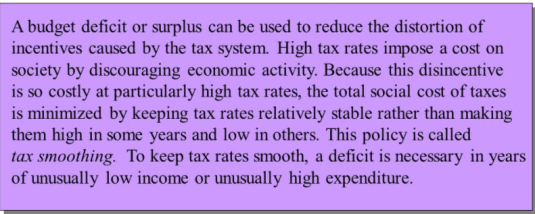
Ministers of Finance should pay more attention to the concept of tax smoothing. Unless something special is happening, income tax rates should be similar from one year to another. We should keep tax rates fairly smooth by borrowing during recessions and emergencies.
Instead, the Government not indexing the income tax thresholds for inflation collected $2.1 billion in extra revenue since 2008 according to Parliamentary Library calculations. Raising the income tax rate thresholds is becoming more pressing. Income growth is starting to push many ordinary taxpayers uncomfortably close to the next threshold and a much higher marginal tax rate. For example, 30% rather than the 17.5% income tax rate many taxpayers face.
New Zealand is already left behind on company tax rates; ours is currently 28%. The Australian company tax rate may drop to 25%; the British company tax rate is going down to 17% by 2020.
Large public deficits have their place
Prudent public debt management dictates that governments run temporary budget deficits in recessions and other emergencies such as the Canterbury earthquake and repay that debt as better times return. Recessions and natural disasters are infrequent so this extra debt should be paid down at a measured speed, not a frantic pace at the expense of other tax policy goals.
An increase in the budget deficit smooths over these bad times and avoids taxes going up and down like a Jack-in-the-Box over the business cycle. Who raises taxes in a recession?
Beware of foul-weather fiscal conservatives
After the start of the recession in 2009, foul weather fiscal conservatives wanted to do just that. The same usual suspects who always advocate bigger government argued for higher taxes rather than running a larger budget deficit, which New Zealand did. Imagine the massive income tax rises required every recession and in the last recession in particular if the large budget deficits were not run?
The large public debt from the temporary budget deficits that smoothed over the last recession is no special or additional reason to postpone income tax cuts. A sound long-term fiscal strategy has tax rates at levels that make up on the deficits in bad times with surpluses in the good times. Slowly repaying debts accumulated in a recession is a routine part of prudent public debt management.
There is room for tax cuts
Every budget allocates about $1.5 billion for new policy proposals that can be adopted without the Treasury thinking that they might harm long-term fiscal stability.
New Zealand budget allows for up to $1.5 billion on new policies every year. If this new spending was justified despite the large public debt from the recent recession, some tax cuts are too. They could start with raising the income tax rate thresholds to make up for past inflation.
 Utopia, you are standing in it!
Recent Comments