Tarun Khaitan: A Constitution Protection Clause for the Great Repeal Bill?
19 Jul 2017 Leave a comment
in economics

 Scope: Extensive provisions for Henry VIII powers in the European Union (Withdrawal) Bill 2017 (hereinafter, the “Repeal Bill”) have become predictably controversial. These powers are mainly found in clauses 7 (‘dealing with deficiencies arising from withdrawal’), 8 (‘complying with international obligations’) and 9 (‘implementing the withdrawal agreement’). The scope of the power in clause 7 is the broadest, allowing Ministers to enact any provision that Parliament could make to remedy ‘any failure … to operate effectively’ or ‘any other deficiency’, remove ‘redundant or substantially redundant’ laws, remove provisions no longer ‘appropriate to retain’. The use of such vague and broad terms fail to reassure that ‘technical’ amendments alone will fall within the scope of these powers. The likelihood that these powers will be used by a minority Government to sneak in policy changes is high, especially at a time when Parliament will have an extremely heavy workload.
Limitations:…
View original post 1,364 more words
Why is there a humanitarian crisis in Gaza?
19 Jul 2017 Leave a comment
in defence economics, development economics, growth disasters Tags: Gaza Stip, Middle-East politics
What happens when you eat some Dad’s Army style food rationing?
19 Jul 2017 Leave a comment
in television Tags: Dad's army
The 1940s UK Kitchen shows how time consuming housework was
19 Jul 2017 Leave a comment
in defence economics, economic history, gender, labour economics, labour supply Tags: engines of liberation, household production, World War II
Henry VIII Clauses
19 Jul 2017 Leave a comment
in economics

H is for the Henry VIII Clause, a nickname given to a provision in an Act of Parliament that delegates to a minister the power to modify the Act itself, or other Acts of Parliament. The delegation by Parliament of various powers to ministers – ‘delegated legislation’ or ‘secondary legislation’ – became common during the late nineteenth and early twentieth century; indeed the increasing complexity of government business meant that it was unavoidable. For many, however, it was associated with the growth in a powerful and unaccountable bureaucracy, and the Henry VIII clause, apparently conferring a sovereign legislative authority on the government itself, was both symbolic of that growth and a dangerous step towards eroding the ability of Parliament to rein it in.
The tag seems first to have been referred to in a parliamentary debate by Lloyd George in the highly controversial National Insurance Bill in 1911. The nickname…
View original post 2,230 more words
Jack Simson Caird: The European Union (Withdrawal) Bill: Constitutional Change and Legal Continuity
18 Jul 2017 Leave a comment
in economics
 Cross-posted with the Constitution Unit blog.
Nine months after Theresa May first announced that there would be a ‘Great Repeal Bill’, and three and a half months after triggering Article 50, the European Union (Withdrawal) Bill (EUW Bill) was published on 13 July 2017. The Bill is a complex mixture of constitutional change and legal continuity. This post highlights some of its main elements.
Constitutional change
The EUW Bill repeals the European Communities Act 1972 (ECA) (clause 1). The ECA provides the “conduit pipe” through which EU law flows into the UK, and represents a central component of the UK’s current constitutional architecture. The key provisions of the EUW Bill replace the ECA with a new constitutional framework. The main constitutional changes in the EUW Bill include:
- the creation of a new distinct body of law known as “retained EU law”;
- broadly-framed delegated powers for Government to…
View original post 1,515 more words
Eligibility for Parliament
18 Jul 2017 Leave a comment
in economics

Mohammad Sarwar’s recent decision to renounce British citizenship in order to take office as Governor of Punjab province in his native Pakistan is another remarkable step in the career of a man who was the first Muslim Member of Parliament, and the first to take the oaths on the Koran. References to Mr Sarwar’s renunciation of his British citizenship suggests that he did not rely on the fact, but it is a little known point of British nationality law that members of Commonwealth countries who have the right of residence in the UK are eligible for election to the Commons – currently under section 18 of the Electoral Administration Act 2006.
That provision ultimately derives from the ancient principle of British citizenship, that those born within the dominions (including colonies) of the monarch have rights of citizenship, including eligibility for parliament. Traditionally, people who were naturalised subjects, however (naturalization was…
View original post 576 more words
Reviewing BBC News website portrayal of Israel and the Palestinians in Q2 2017 – part one
18 Jul 2017 Leave a comment
in economics

Between April 1st and June 30th 2017, a total of seventy reports with content relating to Israel and/or the Palestinians appeared on the BBC News website’s Middle East page, one of which was carried over from the previous quarter.
Some of the reports were produced by other departments (e.g. BBC Technology) or appeared on other pages of the website (e.g. ‘UK’ or ‘US & Canada’) but were also posted on the Middle East page.
Although the Israeli security services recorded 356 terror attacks during the second quarter of 2017 (see ‘related articles’ below), just three of those attacks received coverage on the BBC News website.
(The dates in brackets represent the period of time in which a report was available to visitors to the website’s Middle East page.)
Israeli killed in West Bank car-ramming attack (6/4/17 to 10/4/17) discussed here
View original post 176 more words
Badge of honour: blocked by Morgan on Twitter and now Facebook @top_nz
18 Jul 2017 Leave a comment
in applied price theory, politics - New Zealand, public economics
Cannot comment on Gareth Morgan’s Facebook page anymore. Can’t handle the truth. I wrote an extensive critique of his universal basic income but he does not want to discuss the evidence or the logical flaws of his policy proposal. The only people who lose out from his universal basic income are those for whom the modern welfare state was founded to protect.

What set Gareth Morgan off on his Facebook page was when I commented pointing out that the optimal rate of tax on income from capital to zero. All I said was “optimal tax theory including that pioneered by Stiglitz and Merrlees, economists of impeccable left-wing credentials, show that taxes on the income from capital should be low because the deadweight social costs of taxes on capital are very high”. His response was anti-intellectualism.
Banned from r/ProtectAndServe
18 Jul 2017 Leave a comment
in discrimination, economics of bureaucracy, economics of crime, politics - USA
The American police subreddit did not want to know that there were a few bad apples in their rank ranks despite the overall good news about the use of lethal force.

Blacks are not shot dead out of proportion but there are more incidents of excessive force which is nonlethal. Racists are cowards. There is excessive force under the colour of authority but they chicken out when there are real consequences and serious investigations.
Quickly stopped watching because Einstein was so unlikeable
18 Jul 2017 Leave a comment
in television
The guy just used everybody around him despite the fact they cut him a lot of slack because of his talent.
Back when I was to evict a drug addict from a rented house and throw him out on the street
18 Jul 2017 Leave a comment
in applied welfare economics, poverty and inequality, urban economics
While feuding with strangers on Facebook, I remembered I sat on the student housing committee as Treasurer of the Tasmanian University Union.

The committee worked very well because when students were defaulting on their rent or otherwise would be difficult, it was common for a member of the committee should know them. They could comment on whether the student was short of money or spending their money on alcohol or drugs often with them at the pub on Friday night. Several of us lived at university colleges so we knew lots of people. I told the committee to come down hard on one defaulting tenant because I knew he was wealthy and he just did not want to pay. He was just trying to on because he did not like to pay bills. We had the same problem with him paying the student club fees at my college.
I had a rather sleepless weekend because on Monday morning it was going to be the job of the committee to go around together and evict a student who refuse to pay his rent and refused to communicate with the housing officer, who was a professional housing officer. On Monday morning, I was greatly relieved to hear that he got in contact so he was not going to be evicted. I was one of several who knew of his drug habit.
My brother-in-law was a youth housing officer at the office of emergency housing in an Australian state. To do his job properly he had to face the world as it is.
He said that the clients he dealt with, the teenagers and so forth, would never be taken in by a private landlord because they do not pay their rent, damage the place and invite all their mates over for parties. He believed everyone should have a house, but he did not pretend they are all model tenants.
How many bank robbers remember to wear a mask and have a getaway car?
18 Jul 2017 Leave a comment
in economics
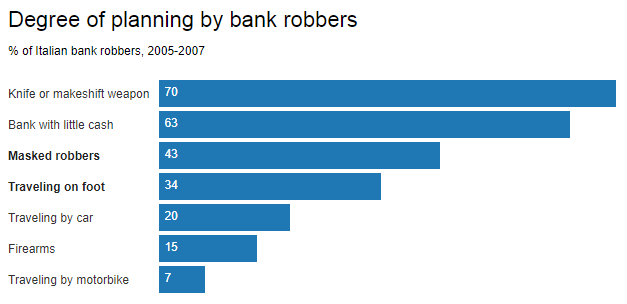
Most bank robbers on top of bank robbery being armed robbery but beyond that a good majority do not even have a getaway car or a mask.
 Utopia, you are standing in it!
Recent Comments