Mario Rizzo on Austrian Business Cycle Theory

Lars Christensen's avatarThe Market Monetarist

Mario Rizzo has an excellent post on Austrian Business Cycle Theory (ABCT). I think Mario do a good job explaining what ABCT is and what it is not.

At the centre of Mario’s discussion is that monetary policy is not neutral, but that the important think is not inflation, but rather “relative inflation”. Here is Mario:

The Austrian theory rests, not on a catalyzing effect of core inflation or headline inflation, but on changes inrelative prices that cause resources to be allocated in ultimately unsustainable ways. The Great Depression was not preceded by much inflation because productivity improvements allowed for increases in bank credit without increasing (by much) the price level. Hayek said repeatedly that the price level aggregate can hide the distortions basic to the cycle.

This point is especially important in the early stages of recovery when there is so much unused capacity and previous investment pessimism…

View original post 619 more words

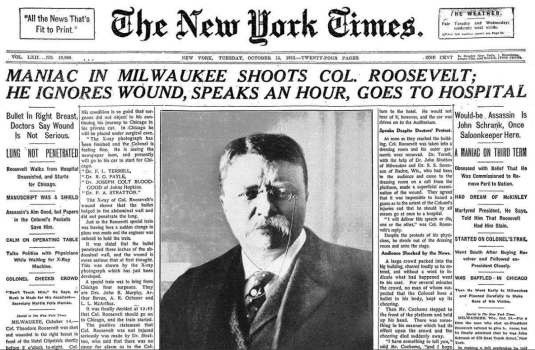
It took more than a bullet to stop Teddy Roosevelt

Image

Lorenzo and Horwitz debate Austrian economics

Lars Christensen's avatarThe Market Monetarist

Back in April our friend Lorenzo did a interesting post on Austrian theory. That has now triggered a response from Steve Horwitz who defends the Austrian position. It is excellent stuff. It is a debate between two clever debaters and I have very strong sympathies for both gentlemen. However, I don’t have time today to go through the entire debate, but I will strongly recommend to my readers to take a look at this very interesting debate.

See here:

Lorenzo: About Austrian Economics

Steve’s response: Thoughts on Lorenzo on Austrian Economics

Lorenzo’s feedback to Steve: Response to Dr. Horwitz’s thoughts

Again, this is excellent stuff. Read it! We can all become more clever by debates like this. Thanks guys.

View original post

Steve, George and Bryan debate Austrian economics and empirics

Lars Christensen's avatarThe Market Monetarist

I am a huge fan of Cato-Unbound.org. Here you find good insightful and intellectual debates amount classical liberal, libertarian and conservative scholars on a number of topics. The quality of the pieces on Cato Unbound is always very high. That is also the case for the latest “debate”. As always there is a “Lead Essay” and a number of “Response Essays”. This time the topic is “Theory and Practice in the Austrian School”.

The lead essay is written by Steve Hortwiz and the response essays are by George Selgin and Bryan Caplan.

Fundamentally Steve’s claim is that Austrian method – praxeology – is not as strict anti-empirical as it is often said to be. In his essay “The Empirics of Austrian Economics” Steve makes an heroic attempt to argue that there is no real conflict between praxeology and empirical studies. Everybody who know me would know that I have…

View original post 436 more words

The Nuremberg Trials: Perceptions and Prejudice?

kellyhignett's avatarThe View East

The end of World War II saw the establishment of the first International War Crimes Trial in the German city of Nuremberg, with the formation of an International Military Tribunal to oversee the trial and conviction of surviving members of the Nazi power structure. The Nuremberg Trials have had a lasting legacy; leading to the creation of the ‘Nuremberg Principles’ of 1950, heavily influencing the development of international criminal law (particularly in relation to Human Rights), and acting as a model for contemporary war crimes trials. The Nuremberg Trials have been the subject of extensive historical research in the intervening years and War Crimes Trials of former Nazi criminals remain a topical issue today, as demonstrated by the recent trial of 91 year old former concentration camp guard, John Demjanjuk. In May 2011 a German court convicted Demjanjuk of acting as an accessory to murder in relation to the 28,069 who died…

View original post 2,622 more words

#OTD The Armistice of Brest-Litovsk I THE GREAT WAR

#OTD USSR broke up

Andrew Jackson: Most Terrifying Man Ever Elected President

Bryan Caplan on why the minimum wage increase must kill jobs

1. The literature on the effect of low-skilled immigration on native wages.  A strong consensus finds that large increases in low-skilled immigration have little effect on low-skilled native wages.  David Card himself is a major contributor here, most famously for his study of the Mariel boatlift.  These results imply a highly elastic demand curve for low-skilled labor, which in turn implies a large disemployment effect of the minimum wage.

This consensus among immigration researchers is so strong that George Borjas titled his dissenting paper “The Labor Demand Curve Is Downward Sloping.”  If this were a paper on the minimum wage, readers would assume Borjas was arguing that the labor demand curve is downward-sloping rather than vertical.  Since he’s writing about immigration, however, he’s actually claiming the labor demand curve is downward-sloping rather than horizontal!

2. The literature on the effect of European labor market regulation. Most economists who study European labor markets admit that strict labor market regulations are an important cause of high long-term unemployment.  When I ask random European economists, they tell me, “The economics is clear; the problem is politics,” meaning that European governments are afraid to embrace the deregulation they know they need to restore full employment.  To be fair, high minimum wages are only one facet of European labor market regulation.  But if you find that one kind of regulation that raises labor costs reduces employment, the reasonable inference to draw is that any regulation that raises labor costs has similar effects – including, of course, the minimum wage.

3. The literature on the effects of price controls in general.  There are vast empirical literatures studying the effects of price controls of housing (rent control), agriculture (price supports), energy (oil and gas price controls), banking (Regulation Q) etc.  Each of these literatures bolsters the textbook story about the effect of price controls – and therefore ipso facto bolsters the textbook story about the effect of price controls in the labor market. 

If you object, “Evidence on rent control is only relevant for housing markets, not labor markets,” I’ll retort, “In that case, evidence on the minimum wage in New Jersey and Pennsylvania in the 1990s is only relevant for those two states during that decade.”  My point: If you can’t generalize empirical results from one market to another, you can’t generalize empirical results from one state to another, or one era to another.  And if that’s what you think, empirical work is a waste of time.

4. The literature on Keynesian macroeconomics.  If you’re even mildly Keynesian, you know that downward nominal wage rigidity occasionally leads to lots of involuntary unemployment.  If, like most Keynesians, you think that your view is backed by overwhelming empirical evidence, I have a challenge for you: Explain why market-driven downward nominal wage rigidity leads to unemployment without implying that a government-imposed minimum wage leads to unemployment.  The challenge is tough because the whole point of the minimum wage is to intensify what Keynesians correctly see as the fundamental cause of unemployment: The failure of nominal wages to fall until the market clears.

From http://econlog.econlib.org/archives/2013/03/the_vice_of_sel.html

Image

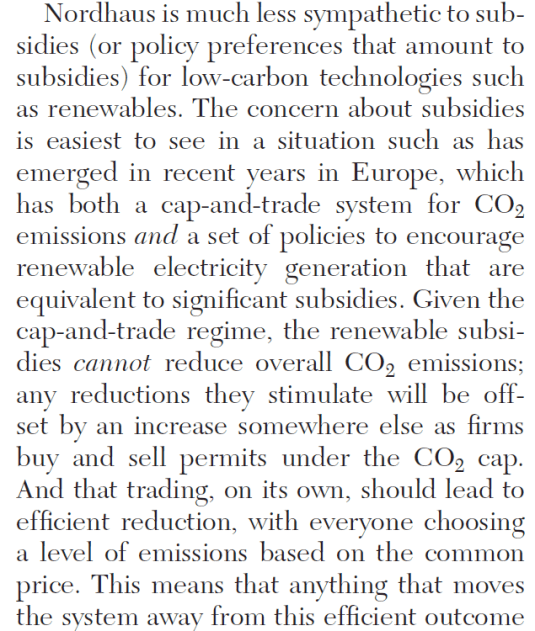
Renewable energy subsidies are pointless under cap and trade

Source: Jaffe, Adam B., and Suzi Kerr. 2015. “The Science, Economics, and Politics of Global Climate Change: A Review of The Climate Casino by William Nordhaus.” Journal of Economic Literature, 53(1): 79-91.

The Battle of Hastings and the Birth of the English Language (1066)

10 Old School Celebrity Scandals That Would’ve Broken the Internet

Study shows wind turbines killed 600,000 bats last year

Jon Haidt on intersectionality and identity politics

whyevolutionistrue's avatarWhy Evolution Is True

City Journal has published the text of a recent talk  (the Wriston lecture at the Manhattan Institute; video below) given by social psychologist Jonathan Haidt, “The age of outrage: what the current political climate is doing to our country and our universities”.

Here’s one except:

Let us contrast King’s identity politics with the version taught in universities today. There is a new variant that has swept through the academy in the last five years. It is called intersectionality. The term and concept were presented in a 1989 essay by Kimberlé Crenshaw, a law professor at UCLA, who made the very reasonable point that a black woman’s experience in America is not captured by the summation of the black experience and the female experience. She analyzed a legal case in which black women were victims of discrimination at General Motors, even when the company could show that it hired…

View original post 469 more words

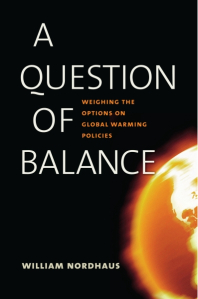
A Question of Balance by William Nordhaus

kvams's avatarKvams

Before I went into summer mode, I finished William Nordhaus’s book A Question of Balance (read short excerpt). The book’s subtitle is Weighing the Options on Global Warming Policies. The book is somewhere inbetween a popular account of the economics of climate change and a technical report on Nordhaus’s (and his team of research assistants’s, one might add) analysis of different approaches to mitigate global warming. A lot of details are saved for the actual technical reports available online. (Note: Details have been updated since the book was published [2008]). Nordhaus still goes through and explains the main equations of the famous DICE model (Dynamic Integrated model of Climate and the Economy), such that most economists could use his online computer code to verify results and further play around with the model.

Before the technicalities, however, Nordhaus provides a ‘Summary for the Concerned Citizen’ (slightly pompous…

View original post 610 more words

Previous Older Entries Next Newer Entries

Bassett, Brash & Hide

Celebrating humanity's flourishing through the spread of capitalism and the rule of law

Truth on the Market

Scholarly commentary on law, economics, and more

The Undercover Historian

Beatrice Cherrier's blog

Matua Kahurangi

Celebrating humanity's flourishing through the spread of capitalism and the rule of law

Temple of Sociology

Celebrating humanity's flourishing through the spread of capitalism and the rule of law

Velvet Glove, Iron Fist

Celebrating humanity's flourishing through the spread of capitalism and the rule of law

Why Evolution Is True

Why Evolution is True is a blog written by Jerry Coyne, centered on evolution and biology but also dealing with diverse topics like politics, culture, and cats.

Down to Earth Kiwi

Celebrating humanity's flourishing through the spread of capitalism and the rule of law

NoTricksZone

Celebrating humanity's flourishing through the spread of capitalism and the rule of law

Homepaddock

A rural perspective with a blue tint by Ele Ludemann

Kiwiblog

DPF's Kiwiblog - Fomenting Happy Mischief since 2003

The Dangerous Economist

Celebrating humanity's flourishing through the spread of capitalism and the rule of law

Watts Up With That?

The world's most viewed site on global warming and climate change

The Logical Place

Tim Harding's writings on rationality, informal logic and skepticism

Doc's Books

A window into Doc Freiberger's library

The Risk-Monger

Let's examine hard decisions!

Uneasy Money

Commentary on monetary policy in the spirit of R. G. Hawtrey

Barrie Saunders

Thoughts on public policy and the media

Liberty Scott

Celebrating humanity's flourishing through the spread of capitalism and the rule of law

Point of Order

Politics and the economy

James Bowden's Blog

A blog (primarily) on Canadian and Commonwealth political history and institutions

Science Matters

Reading between the lines, and underneath the hype.

Peter Winsley

Economics, and such stuff as dreams are made on

A Venerable Puzzle

"The British constitution has always been puzzling, and always will be." --Queen Elizabeth II

The Antiplanner

Celebrating humanity's flourishing through the spread of capitalism and the rule of law

Bet On It

Celebrating humanity's flourishing through the spread of capitalism and the rule of law

History of Sorts

WORLD WAR II, MUSIC, HISTORY, HOLOCAUST

Roger Pielke Jr.

Undisciplined scholar, recovering academic

Offsetting Behaviour

Celebrating humanity's flourishing through the spread of capitalism and the rule of law

JONATHAN TURLEY

Res ipsa loquitur - The thing itself speaks

Conversable Economist

Celebrating humanity's flourishing through the spread of capitalism and the rule of law

The Victorian Commons

Researching the House of Commons, 1832-1868

The History of Parliament

Articles and research from the History of Parliament Trust

Books & Boots

Reflections on books and art

Legal History Miscellany

Posts on the History of Law, Crime, and Justice

Sex, Drugs and Economics

Celebrating humanity's flourishing through the spread of capitalism and the rule of law

European Royal History

Exploring the Monarchs of Europe

Tallbloke's Talkshop

Cutting edge science you can dice with

Marginal REVOLUTION

Small Steps Toward A Much Better World

NOT A LOT OF PEOPLE KNOW THAT

“We do not believe any group of men adequate enough or wise enough to operate without scrutiny or without criticism. We know that the only way to avoid error is to detect it, that the only way to detect it is to be free to inquire. We know that in secrecy error undetected will flourish and subvert”. - J Robert Oppenheimer.

STOP THESE THINGS

The truth about the great wind power fraud - we're not here to debate the wind industry, we're here to destroy it.

Lindsay Mitchell

Celebrating humanity's flourishing through the spread of capitalism and the rule of law

Alt-M

Celebrating humanity's flourishing through the spread of capitalism and the rule of law

croaking cassandra

Economics, public policy, monetary policy, financial regulation, with a New Zealand perspective

The Grumpy Economist

Celebrating humanity's flourishing through the spread of capitalism and the rule of law

International Liberty

Restraining Government in America and Around the World