The first part of my three-part critique of the Council of Trade Unions submission to the Parliamentary Select Committee will focus on inequality. Part 2 will be about union bargaining power. Part 3 will be about employment protection regulation.
The unions make a series of claims about trends in inequality such as on page 5 of its submission that
Since deregulation began apace in the 1980s, New Zealand has become a starkly more unequal society.
Incorrect. For the period since the middle of the 1990s, inequality in New Zealand has been stable. Brian Perry of the Ministry of Social Development in his annual review of trends in household incomes in New Zealand for 1982 to 2016 said that:
There is no evidence of any sustained rising or falling trend in BHC (before housing cost) household income inequality over the last two decades using the Gini and top 1% share measures… Incomes after deducting housing costs (AHC incomes) are more unequal than BHC incomes, as housing costs make up a higher proportion of the household budget for lower income households than they do for higher income households. AHC income inequality was also a little higher from 2011 to 2016 compared with the mid 2000s and earlier.
Veteran left-wing economist Brian Easton is equally deflating of the claims of his colleagues as to the rich getting rich and the poor getting poorer:
Those committed to the egalitarian society – which was once New Zealanders’ pride – need to ask why their concerns have so little effect. A possible explanation is that, despite the rhetoric, the rise in income inequality occurred over 20 years ago, largely as a result of Rogernomics and Ruthanasia. I know many want to believe economic inequality is still rising in New Zealand, but the careful statistical work I have done shows little change in the distribution of market incomes in the last thirty years, and the big changes in after-tax incomes were about a quarter of a century ago.
This is not to contradict the findings of Piketty and all. The evidence is that the surge in top incomes and wealth has occurred where there has been a sophisticated financial sector such as in Britain and the US. Ours is plain vanilla; the top incomes it pays contribute to overall inequality but they do not seem to have been increasing faster than average – or not enough to show in the data.
To skewer the left even further, Easton pointed out in a different article that the spike in inequality in the late 1980s in New Zealand was a statistical illusion brought on by the introduction of dividend imputation in the company tax system.
Thus, the taxpayer’s recorded income went up even though there was no actual change in their market income. To get consistency over time the estimates treat the grossing-up of these dividends as the substantial tax break that it was, rather than an increase in market income; that is, the imputation income is omitted. Alvaredo et al. do not make this adjustment, which results in their series showing an artificial increase in income share in the late 1990s from a change in measurement, rather than from any fundamental change.
Brian Easton adjusted the top income share database put together by Piketty and others for New Zealand for the introduction of dividend imputation. This encouraged companies to distribute more dividends.
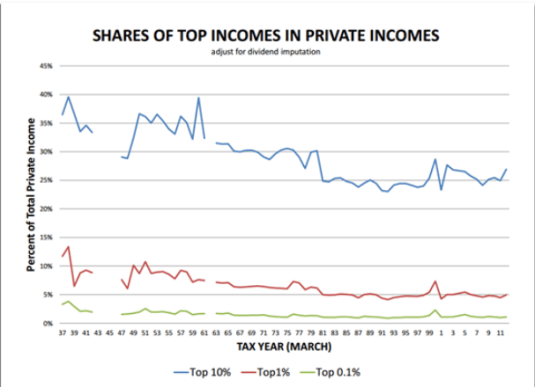
Once this measurement error was corrected by Easton, there has been no increase in top income shares in New Zealand since the 1950s. It has been a slow taper at best or a flat line.
The rest of the discussion by the unions of the harmful effects of rising inequality are therefore based on a false premise. Inequality is not rising in New Zealand, so it therefore cannot have any of the harmful effects that follow from the rise in inequality is listed by the unions.
Focusing in on a mid-1990s is never a good for the unions because following the passage of the Employment Contracts Act, there was a wages boom after 20 years stagnation.
To make things worse for the pessimism of the union movement, that wage growth was broadly spread with rising incomes among both Maori and Pacifica.

The unions fall at the first hurdle. Their claim that inequality is rising in New Zealand is simply not supported by the facts. Indeed, if inequality is rising, why is real adjusted for household size medium household incomes rising from Maori and Pacifica at a faster rate than for Europeans; a 70% rise versus a 50% rise since 1993.
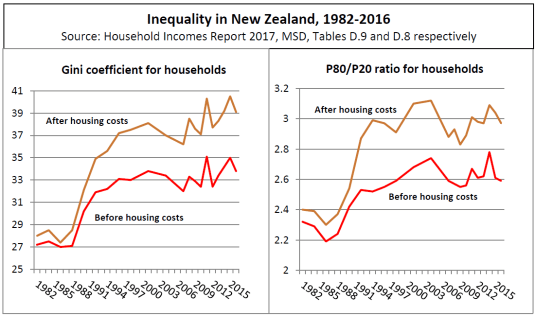
The unions do have the cheek of referring to after household housing costs inequality such as in the screen snapshot above from their submission. But as they make no suggestions on how to fix it, their concerns are of no use. After all, that would require them to advocate less regulation of land supply which is anathema to their socialist leanings. Indeed, unions want to make things worse for the low waged and beneficiaries by advocating rent controls and other regulations that make investment in rental properties less attractive.
 Utopia, you are standing in it!
Recent Comments