
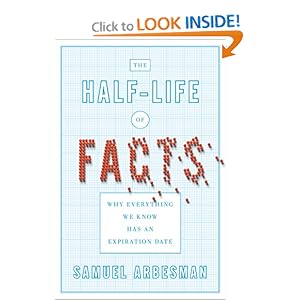
I enjoyed this book and I believe it provides an important insight. It fits well with Thinking, fast and slow (Kahneman). The author starts with a deliberately fuzzy/loose pragmatic definition of “fact” and proceeds to explore the quantitative aspects of evolution (or temporal characteristics) of knowledge and information. He uses mathematical and statistical tools to explore patterns, suggesting common or universal mechanisms. In addition, the pitfalls and biases of dissemination of knowledge, the persistence of misinformation and the inertia for “changing our minds, when the facts change” are also explored.
I learned a lot from this book. However, I found the repetition of the statement underlying regularity not an argument. I felt that the underlying potential mechanisms that lead to these regularities were tantalizingly suggested but not explored. The patterns, which I agree we do not usually consider for information/knowledge, are important but I would have liked more…
View original post 146 more words
 Utopia, you are standing in it!
Recent Comments