
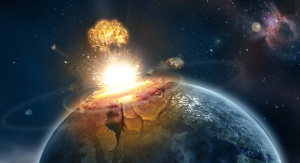
 Impact [image credit: karbalion.com]
This time, unusually, the new Younger Dryas evidence is from way below the equator, which they believe shows that ‘the Younger Dryas climatic onset was an extreme global event’.
When UC Santa Barbara geology professor emeritus James Kennett and colleagues set out years ago to examine signs of a major cosmic impact that occurred toward the end of the Pleistocene epoch, little did they know just how far-reaching the projected climatic effect would be, says Phys.org.
“It’s much more extreme than I ever thought when I started this work,” Kennett noted. “The more work that has been done, the more extreme it seems.”
He’s talking about the Younger Dryas Impact Hypothesis, which postulates that a fragmented comet slammed into the Earth close to 12,800 years ago, causing rapid climatic changes, megafaunal extinctions, sudden human population decrease and cultural shifts and widespread wildfires (biomass burning).
View original post 272 more words
 Utopia, you are standing in it!
Recent Comments