
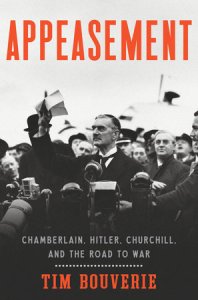
 Faith in appeasement, the central tenet of British foreign policy throughout the 1930s, remained strong among the most devout long after it had been exposed as entirely bankrupt. Even as it lay in tatters with the German military massing on the Polish frontier for the invasion of Poland in the late summer of 1939, the virtually disloyal British ambassador to Berlin Sir Nevile Henderson recommended the Polish government concede to Hitler’s demands, while in London R.A.B. Butler, member of parliament, despaired that the British Foreign Office was displaying an unwarranted “absolute inhibition” to pressure the Poles to negotiate. After the German invasion of Poland, Prime Minister Neville Chamberlain and his government prevaricated one last time before finally declaring war on Germany.
Appeasement was “the attempt by Britain and France to avoid war by making ‘reasonable’ concessions to German and Italian grievances.” The long list of “reasonable concessions” when finally catalogued included…
View original post 719 more words
 Utopia, you are standing in it!
Sep 24, 2019 @ 12:41:51
Hmm,
If appeasement went through to its logical conclusion. Germany would have gotten back its Polish corridor and then attacked the Soviet Union not France.and the rest of Europe.
The Allies could have then rearmed at its leisure and then successfully attacked which ever nation ‘won between Germany and the soviet Union.
Churchill also was so fierce in his denunciation of Nazis he conflation Germans with Nazis. This meant no German underground something that Bonhoeffer for one thought incredibly stupid.
LikeLiked by 1 person
Sep 24, 2019 @ 13:04:22
Appeasement was more about postponing war to allow for rearmament. But the polish corridor point is valid.
LikeLike
Sep 24, 2019 @ 13:07:32
Mate,
You appease Germany and they fight against the soviet Union then it is a win/win. That is where the useless Lebensraum, was.
LikeLike