Greenland Ice Melt Accelerating, Says Jonathan Amos (Conveniently Forgetting What He Wrote In 2003!)
16 Dec 2019 Leave a comment
Shadow Banking Crisis of 1763..Amazing similarities with Lehman crisis of 2008
16 Dec 2019 Leave a comment

The more you think times have changed, the more they remain the same. Amazing econ history is..
I came across this paper by Atlanta Fed econs — Stephen Quinn and William Roberds. It is just amazing to note how similar things were way back in 1763. One had pretty similar financial instruments in 1763 whose drying up led to the crisis. And yes you had pretty similar instis like Lehman Brothers which did not have access to retail deposits but relied on a form of wholesale financing.
View original post 760 more words
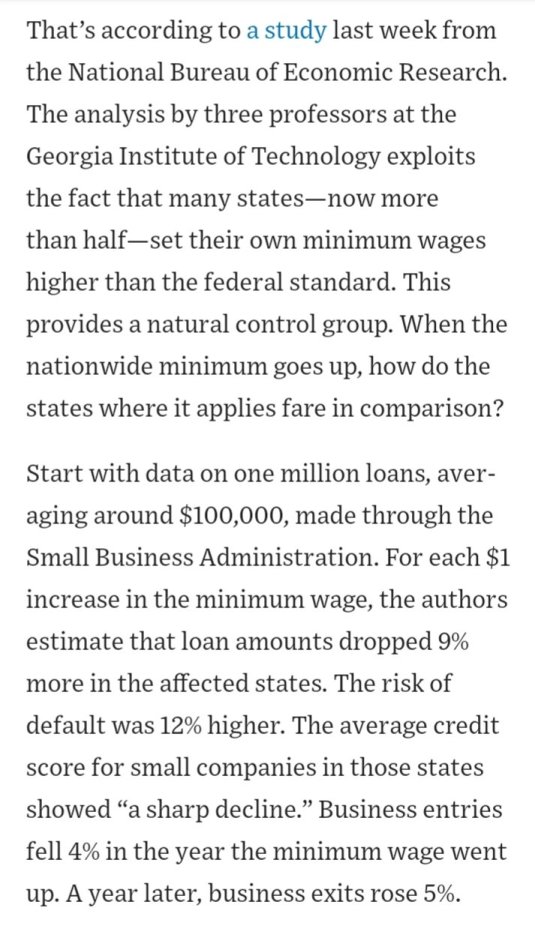
Small business and @Fightfor15: @AOC @BernieSanders @SenWarren
16 Dec 2019 Leave a comment
in applied price theory, industrial organisation, labour economics, minimum wage, politics - USA, poverty and inequality, survivor principle Tags: 2020 presidential election, offsetting behaviour, The fatal conceit, unintended consequences
“The Environmental Creed”
16 Dec 2019 Leave a comment

This is a 2007 essay economist Don Boudreaux wrote that was published during 2007 in the Pittsburgh-Tribune Review. It is now posted at Mr. Boudreaux’s website.
The Environmental Creed
Careful observers often and correctly note that, for many of its adherents, environmentalism is a religion.
Too many environmentalists disregard inconvenient truths that would undermine their faith that calamities are percolating just over the horizon. It might well be that humans’ “footprint” on the Earth is larger than ever; it might even be true that this larger footprint creates some health risks for us modern humans that our pre-industrial ancestors never encountered.
But it is undeniably true that we denizens of industrial, market economies live far better and far healthier than did any our pre-industrial ancestors.
Compared to those ancestors, our life expectancies at birth today are about three times higher. Our bodies are cleaner and more free of disease…
View original post 175 more words
Must-Watch Video From Reason TV on How Free Markets – not Obamacare – Can Solve the Healthcare Mess
16 Dec 2019 Leave a comment
in health economics, industrial organisation, Public Choice, public economics Tags: health insurance

When I travel, particularly overseas, I run into a lot of people who are totally confused about the American healthcare system.
For all intents and purposes, they think the United States relies on the free market and that government (at least in the pre-Obamacare era) was largely absent.

When explaining how government has screwed up private health insurance, I talk about third-party payer and how genuinely private insurance works for home ownership and automobiles. And I cite examples of genuine free markets for cosmetic surgery and even (regardless of your views) abortion.
But from now on, I think I will simply tell people to watch this superb video…
View original post 238 more words
Don’t Copy the United Kingdom’s Government-Run, Single-Payer Health System
16 Dec 2019 1 Comment
I’m on my way back to the United States from England. My election-week coverage (starting here and ending here) is finished, but I’m still in the mood to write about the United Kingdom.
Yesterday, I shared some “Great Moments in British Government” and today I want to look at the U.K.’s single-payer health scheme.
The National Health Service (NHS) is inexplicably popular. Boris Johnson and Jeremy Corbyn basically competed over who would dump the most money into the system.
This near-universal affection is a mystery. There’s a lot of data suggesting the system doesn’t work.
Consider these details from a column by a British doctor.
One of the most curious political phenomena of the western world is the indestructible affection in which the British hold their National Health Service. No argument, no criticism, no evidence can diminish, let alone destroy, it. …Yet again, however, the NHS is…
View original post 1,882 more words
Heather Mac Donald – The Diversity Delusion
16 Dec 2019 Leave a comment
in discrimination, economic history, economics of education, gender, human capital, labour economics, labour supply, law and economics, occupational choice, poverty and inequality Tags: affirmative action, political correctness, regressive left, sex discrimination
Can you be a prisoner of a prison that was closed and you refuse to leave
16 Dec 2019 Leave a comment

Election Aftermath!
16 Dec 2019 Leave a comment
in constitutional political economy, economics of education, economics of information, income redistribution, international economic law, international economics, International law, Public Choice Tags: Brexit, regressive left
Guardian parrots Corbyn lie that antisemitism definition stifles debate on Israel
16 Dec 2019 Leave a comment

The Labour Party’s reluctant acceptance of the IHRA Working Definition of antisemitism in 2018 didn’t occur without a fight. There was one notable dissenter to the proposal to adopt, in full, the IHRA definition: Jeremy Corbyn, who claimed that it would stifle criticism of Israel.
As we noted at the time, the Guardian shared Corbyn’s dishonest interpretation of IHRA, in the following sentences of an official editorial:
The Palestinian narrative of dispossession and expulsion could be stifled, if not outlawed, by interpretations of the IHRA. Punishing political speech would stir more discord. If Jews have a right to define what oppresses them then Palestinians should also have the same right.
They’re at it again.
The Guardian, which recently endorsed Corbyn for prime minister, published an article by US correspondent Ed Pilkington (“Trump signs antisemitism order amid concerns it targets critics of Israel”, Dec. 12) that includes a…
View original post 684 more words
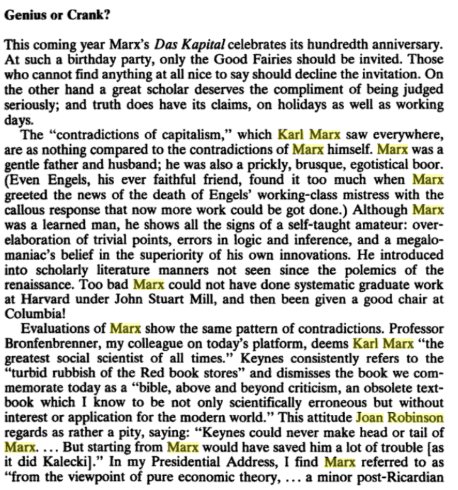
Samuelson bullying Marx again
16 Dec 2019 Leave a comment
in applied price theory, history of economic thought, Marxist economics
Doom prediction amnesia
16 Dec 2019 Leave a comment

One of the things that became abundantly clear in a previous post is how incredibly easy it is replace past failed predictions by a brand new one, even when incompatible with the failed prediction. There was the example of a Belgian activist who in 2008 claimed that we only had ten year left to avert tipping points by limiting the temperature increase to 2 C, but in 2018 -when we horribly failed to reach that target- he made a new prediction that we now had another ten years to prevent tipping points by limiting the temperature increase to … 1.5 C.
In that post, I also noticed the similarity between this prediction and the prediction by Andrew Simms and his onehundredmonths campaign. Both claimed that 2 C had to be averted otherwise we were in for tipping points, pointed to the authority of the IPCC to justify their claim…
View original post 1,050 more words
Walter E. Williams: Government, The Market, and Minorities
16 Dec 2019 Leave a comment
in applied price theory, applied welfare economics, Austrian economics, comparative institutional analysis, constitutional political economy, discrimination, economic history, economics of education, entrepreneurship, health economics, human capital, industrial organisation, labour economics, labour supply, occupational choice, poverty and inequality, privatisation, survivor principle, unemployment, welfare reform Tags: racial discrimination

 Utopia, you are standing in it!
Recent Comments