
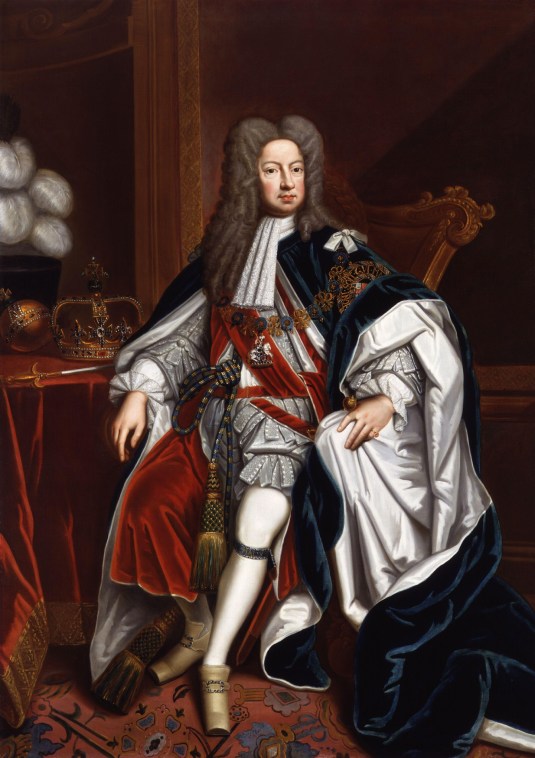
Elector Ernst-August died on January 23, 1698, leaving all of his territories to George with the exception of the Prince-Bishopric of Osnabrück, an office he had held since 1661. George thus became Duke of Brunswick-Lüneburg as well as Archbannerbearer and a Prince-Elector of Hanover within the Holy Roman Empire. His court in Hanover was graced by many cultural icons such as the mathematician and philosopher Gottfried Leibniz and the composers George Frideric Händel and Agostino Steffani.
Shortly after George’s accession to his paternal duchy, Prince William, Duke of Gloucester, son of Queen Anne, who was second-in-line to the English and Scottish thrones, died. By the terms of the English Act of Settlement 1701, George’s mother, Sophia, was designated as the heir to the English throne if the then reigning monarch, William III, and his sister-in-law, Anne, died without surviving issue.
 The succession was so designed because Sophia was the closest…
View original post 650 more words
 Utopia, you are standing in it!
Recent Comments