
Krugman vs. Krugman on Carbon Taxes – IER
14 Oct 2014 9 Comments
in climate change, economics of climate change, energy economics, environmental economics, politics - USA Tags: Paul Krugman, Quacks



Environmental and Urban Economics: Professor Stavins’ Climate Change Piece in the NY Times Today
25 Sep 2014 Leave a comment
in climate change, entrepreneurship, environmental economics, global warming Tags: climate change adaptation, global warming
He makes the following points:
- Global GHG emissions continue to rise
- The UN’s goal for sharply reducing emissions over the next few decades will be a very difficult target to reach
- It will be very costly to reach this goal
- He cites current cost estimates of what we would have to sacrifice to achieve the carbon reductions…
To my deep surprise, he never mentions climate change adaptation. That a very serious Harvard economist is not willing to even mention this topic says something on several levels.
The IPCC has only made a small investment in investigating the possibilities for adaptation to help us to minimize several of the threats we will face from climate change.
In my humble opinion, too many economists are working on the economics of climate change mitigation in part because there is so much demand by policy makers (and private consulting) for such studies. But from a research perspective, we have hit sharp diminishing returns.
In contrast, we need active researchers to more fully explore the politically incorrect topic of climate change adaptation.
via Environmental and Urban Economics: Professor Stavins’ Climate Change Piece in the NY Times Today.
Leo vs. science: vanishing evidence for climate change | New York Post
21 Sep 2014 Leave a comment
in climate change, environmental economics, global warming Tags: climate alarmism, global warming

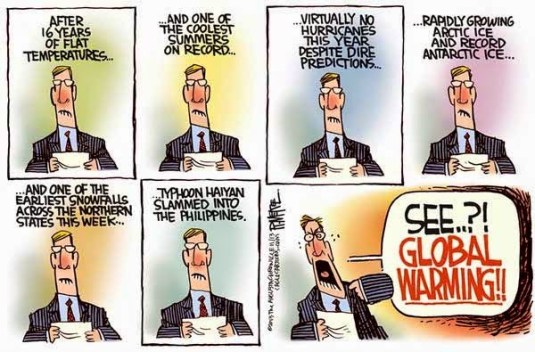
According to NASA satellites and all ground-based temperature measurements, global warming ceased in the late 1990s. This when CO2 levels have risen almost 10 percent since 1997. The post-1997 CO2 emissions represent an astonishing 30 percent of all human-related emissions since the Industrial Revolution began. That we’ve seen no warming contradicts all CO2-based climate models upon which global-warming concerns are founded.
Rates of sea-level rise remain small and are even slowing, over recent decades averaging about 1 millimeter per year as measured by tide gauges and 2 to 3 mm/year as inferred from “adjusted” satellite data. Again, this is far less than what the alarmists suggested.
Satellites also show that a greater area of Antarctic sea ice exists now than any time since space-based measurements began in 1979. In other words, the ice caps aren’t melting.
A 2012 IPCC report concluded that there has been no significant increase in either the frequency or intensity of extreme weather events in the modern era. The NIPCC 2013 report concluded the same. Yes, Hurricane Sandy was devastating — but it’s not part of any new trend.
via Leo vs. science: vanishing evidence for climate change | New York Post.



Killer green technologies alert: safety records of the nuclear and wind industries
10 Aug 2014 Leave a comment
in applied welfare economics, climate change, economics of climate change, economics of regulation, environmental economics, global warming, health economics Tags: killer green technologies; wind power
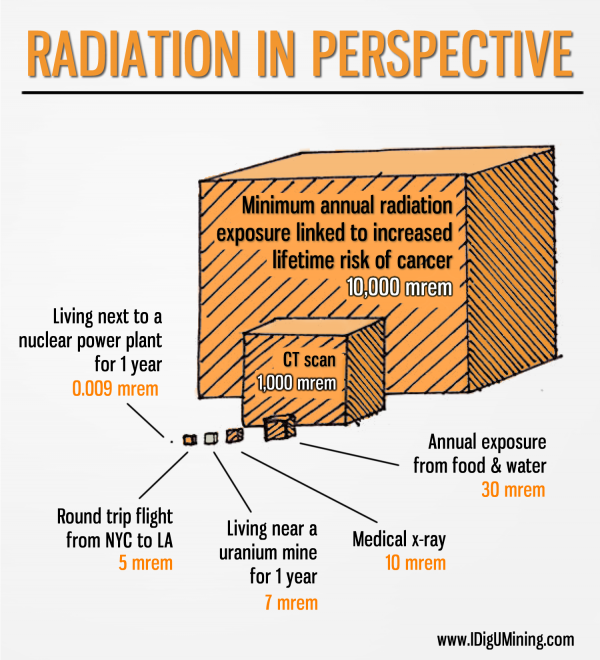
Nuclear fatalities in the last ten years: 7
Wind farm fatalities in the last ten years: 44.

No One Cares How Many Predictions Earth Day Founders Got Wrong
13 Jun 2014 Leave a comment
in climate change, development economics, environmentalism Tags: Earth Day, pessimism bias
“Air pollution… is certainly going to take hundreds of thousands of lives in the next few years alone.”
Paul Ehrlich, Stanford University biologist
“The world has been chilling sharply for about twenty years. If present trends continue, the world will be about four degrees colder for the global mean temperature in 1990, but eleven degrees colder in the year 2000. This is about twice what it would take to put us into an ice age.”
Kenneth Watt, Ecologist
“Population will inevitably and completely outstrip whatever small increases in food supplies we make. The death rate will increase until at least 100-200 million people per year will be starving to death during the next ten years.”
Paul Ehrlich
“By… [1975] some experts feel that food shortages will have escalated the present level of world hunger and starvation into famines of unbelievable proportions. Other experts, more optimistic, think the ultimate food-population collision will not occur until the decade of the 1980s.”
Paul Ehrlich
“It is already too late to avoid mass starvation.”
Denis Hayes, chief organizer for Earth Day
“Demographers agree almost unanimously on the following grim timetable: by 1975 widespread famines will begin in India; these will spread by 1990 to include all of India, Pakistan, China and the Near East, Africa.
By the year 2000, or conceivably sooner, South and Central America will exist under famine conditions…
By the year 2000, thirty years from now, the entire world, with the exception of Western Europe, North America, and Australia, will be in famine.”
Peter Gunter, professor, North Texas State University
“Scientists have solid experimental and theoretical evidence to support… the following predictions: In a decade, urban dwellers will have to wear gas masks to survive air pollution…by 1985 air pollution will have reduced the amount of sunlight reaching earth by one half.”
Life magazine, January 1970
via No One Cares How Many Predictions Earth Day Founders Got Wrong.
 Utopia, you are standing in it!
Recent Comments