For all the gravitas which Dame Marilyn’s involvement has conferred upon PSCPE, it is important not to lose sight of the fact that it represents a deliberate attempt to morally overpower what is now the law of the land. Chris Trotter writes – The People’s Select Committee on Pay Equity (PSCPE) is looking for evidence. […]
Counting the Cost
Counting the Cost
01 Jun 2025 Leave a comment
in applied price theory, discrimination, gender, human capital, income redistribution, labour economics, labour supply, occupational choice, politics - New Zealand, poverty and inequality, Public Choice, rentseeking Tags: constitutional law, gender wage gap, sex discrimination
Why the U.S. Produces More Unicorns Than China and the EU
01 Jun 2025 1 Comment
in applied price theory, comparative institutional analysis, development economics, economic history, economics of regulation, entrepreneurship, human capital, industrial organisation, labour economics, occupational choice, poverty and inequality, survivor principle Tags: creative destruction
The United States has produced about twice as many unicorns (private startups valued at $1B+) as China and more than four times as many as the European Union. These numbers reflect deep institutional and cultural advantages in the U.S. startup ecosystem. Table: Number of Unicorns Created Since ~1990 Region Cumulative Unicorns United States ~1,950 China…
Why the U.S. Produces More Unicorns Than China and the EU
Against Sociology
31 May 2025 1 Comment
in applied price theory, history of economic thought
An individualistic argument can be made that sociology is a “useless” subject, though such a claim is controversial and widely disputed. Here is how such an argument might be constructed from an individualistic or methodological individualist perspective: Individualistic Argument Against the Usefulness of Sociology Thesis:Sociology is a largely useless discipline because it focuses on abstract […]
Against Sociology
Irrationality As the Fountainhead of Market Failure
28 May 2025 Leave a comment
in applied price theory, applied welfare economics, comparative institutional analysis, economics of information, history of economic thought
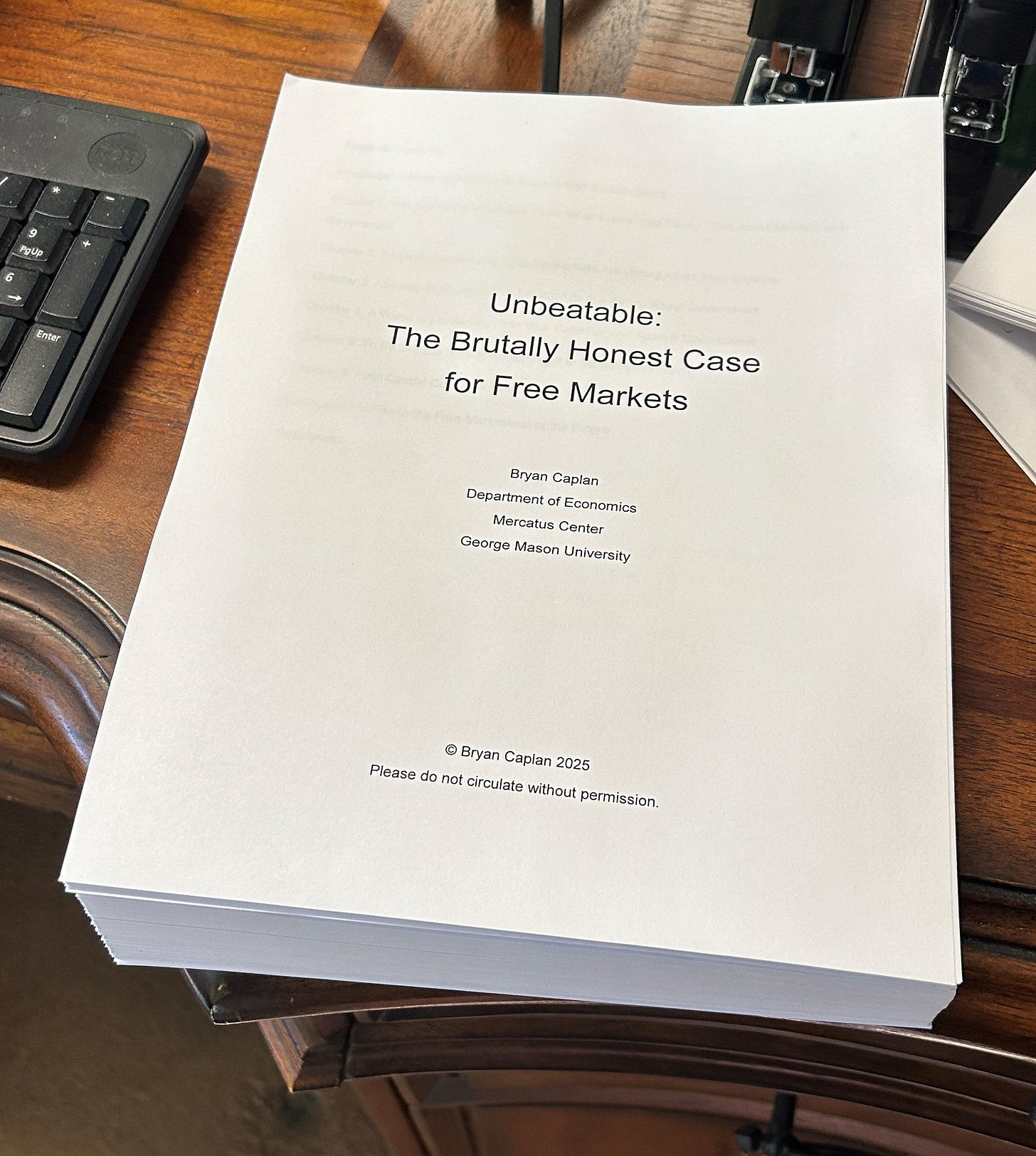
An excerpt from Chapter 4 of *Unbeatable*
Irrationality As the Fountainhead of Market Failure
New medicine approvals plan an exercise in not solving the problem
28 May 2025 Leave a comment
in applied price theory, economics of bureaucracy, economics of regulation, health economics, politics - New Zealand, Public Choice Tags: drug lags
Eric Crampton writes – New medicines are slow to be authorised for the New Zealand market. Even if a medicine has already been approved by many other trustworthy overseas regulators like those in Canada, the UK, Australia, and the EU, Medsafe can take a very long time to evaluate a medicine.
New medicine approvals plan an exercise in not solving the problem
One last post on Investment Boost
27 May 2025 Leave a comment
in applied price theory, economic growth, fiscal policy, macroeconomics, politics - New Zealand, public economics Tags: taxation and investment

After the discussion in my post yesterday on the Investment Boost subsidy scheme announced in the Budget I thought a bit more about who was likely to benefit the most from it. The general answer of course is the purchasers of the longest-lived assets. Why? Because if you have an asset which IRD estimates to […]
One last post on Investment Boost
Quotation of the Day…
25 May 2025 Leave a comment
in applied price theory, economic history, industrial organisation, labour economics, labour supply

Tweet… is from my late, great colleague Walter Williams’s January 6th, 2011, column, “Settled ‘facts’ that just ain’t so“: U.S. manufacturing is going through the same kind of labor-saving technological innovation as agriculture. In 1790, farmers were 90 percent of the U.S. labor force. By 1900, only about 41 percent of our labor force was…
Quotation of the Day…
Trade sentences to ponder
25 May 2025 1 Comment
in applied price theory, economics of regulation, industrial organisation, international economics Tags: European Union
The IMF puts the hidden cost of trading goods inside the EU at the equivalent of a 45% tariff. For services the figure climbs to 110%, higher than Trump’s “Liberation day” tariffs on Chinese imports—measures many saw as a near-embargo. These barriers are not direct taxes. Instead, a construction company might find its building materials or plans, […]
Trade sentences to ponder
Prepping for the Next Pandemic
24 May 2025 Leave a comment
in applied price theory, economics of bureaucracy, economics of natural disasters, health economics, Public Choice Tags: economics of pandemics
If you are like me, you spend a certain amount of time trying not to remember the pandemic experience. But COVID-19 pandemic did cause more than one million American deaths. In a world of sane and sensible prioritizing and policy-making, spending some time and effort focused on how to reduce the risks and costs of…
Prepping for the Next Pandemic
The (deeply underwhelming) Budget
23 May 2025 Leave a comment
in applied price theory, budget deficits, economic growth, economics of regulation, entrepreneurship, fiscal policy, macroeconomics, politics - New Zealand, Public Choice, public economics

Michael Reddell writes – There were good things in the Budget. There may be few/no votes in better macroeconomic statistics and, specifically, a monthly CPI but – years late (for which the current government can’t really be blamed) – it is finally going to happen.
The (deeply underwhelming) Budget
US State-Level Abortion Regulations: Causes and Effects
23 May 2025 Leave a comment
in applied price theory, discrimination, econometerics, economic history, gender, health economics, labour economics, politics - USA, population economics Tags: abortion law reform

Regulations about abortion are often wildly controversial. But what effects to they actually have? Caitlin Myers addresses these issues in “From Roe to Dobbs: 50 Years of Cause and Effect of US State Abortion Regulations” (Annual Review of Public Health 2025, pp. 433-446). As a starting point, consider the years before and after the 1973 US Supreme Court…
US State-Level Abortion Regulations: Causes and Effects
Excusing the Government
22 May 2025 Leave a comment
in applied price theory, applied welfare economics, comparative institutional analysis, constitutional political economy, economics of bureaucracy, economics of regulation, history of economic thought, income redistribution, international economics, labour economics, law and economics, property rights, Public Choice, public economics, rentseeking, urban economics
An excerpt from Chapter 3 of *Unbeatable*
Excusing the Government
Pro-Market & Pro-Business: Firms Strive to Satisfy the Customer
22 May 2025 Leave a comment
in applied price theory, comparative institutional analysis, economics of information, economics of regulation, entrepreneurship, history of economic thought, industrial organisation, labour economics, law and economics, property rights
Econ 101 is Underrated: Pharma Price Controls
22 May 2025 Leave a comment
in applied price theory, development economics, economics of regulation, entrepreneurship, health economics, law and economics, politics - USA, property rights Tags: 2024 presidential election, patents and copyrights, price controls, price discrimination
Econ 101 is often dismissed as too simplistic. Yet recent events suggest that Econ 101 is underrated. Take the tariff debate: understanding that a tariff is a tax, that prices represent opportunity costs, that a bilateral trade deficit is largely meaningless, that a so-called trade “deficit” is equally a goods surplus or an investment surplus—these […]
Econ 101 is Underrated: Pharma Price Controls
 Utopia, you are standing in it!
Recent Comments