Randomized Control Trials in the Field of Development: A Critical Perspective (Webinar)
05 Feb 2021 Leave a comment
in applied price theory, applied welfare economics, comparative institutional analysis, development economics, econometerics, economics of bureaucracy, economics of information, experimental economics, history of economic thought, Public Choice Tags: philosophy of science, The fatal conceit
Reforming the Reserve Bank, continued
04 Feb 2021 Leave a comment

Submissions to Parliament’s Finance and Expenditure Committee on the Reserve Bank of New Zealand bill close today. This is the next stage in the ongoing overhaul of the Reserve Bank legislation, and this particular bill focuses on a new governance structure for the Bank, largely importing for monetary policy the provisions of the amending legislation passed a couple of years ago. In the process, the substantive regulatory powers that were part of the Act are being spun out, unchanged for now, into a separate piece of legislation.
There is a fair amount of sensible stuff in the bill. The single decisionmaker model, flawed and unusual for monetary policy, deeply unsuited to the regulatory functions, will finally be no more. The MPC now makes monetary policy – well at least on paper at does, perhaps it more true that MPC is the venue at which monetary policy is made – and…
View original post 1,933 more words
A Case Study of How Venezuelan Socialism Killed the Goose with the Golden Eggs
04 Feb 2021 Leave a comment

The economic disintegration of Venezuela is a powerful example how socialism fails. Even in a nation with massive oil wealth.
This video from Reason tells the tragic story.
I think long-run data is especially valuable when assessing a nation’s economic performance.
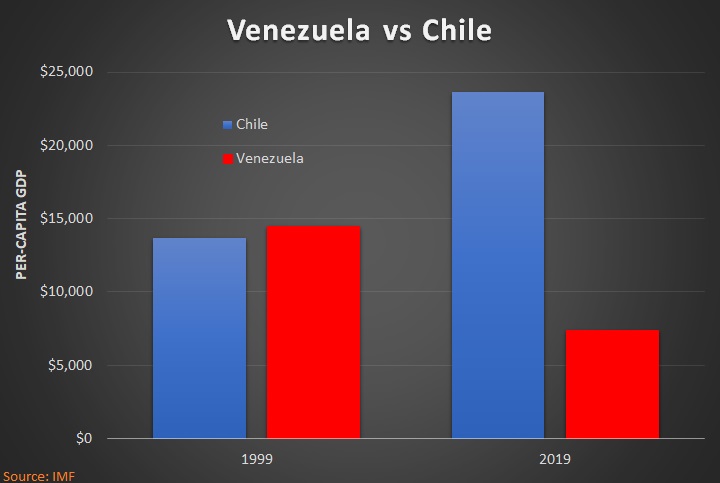 And Venezuela definitely looks terrible when looking at decades of data on per-capita economic output.
Especially when compared to a pro-market nations such as Chile.
Not that we should be surprised. This is what we find anytime capitalist-oriented counties are compared with statism-oriented countries.
And there are many other case studies.
But let’s re-focus on the problems of Venezuela. In one of her Wall Street Journal columns, Mary Anastasia O’Grady analyzes the government-caused crisis. She starts by describing what happened.
Efforts to guarantee outcomes are at odds with what it…
View original post 373 more words
France found guilty of climate inaction in ‘historic victory’
04 Feb 2021 Leave a comment


‘Hoist by their own petard’ springs to mind. French courts are now willing to hear from ‘direct victims of climate change’. How they might define climate change remains to be seen, as the insanity gets further embedded into the system.
– – –
A court in Paris has ruled that France’s government is guilty of climate inaction in a ground-breaking legal case, reports Euronews.
The decision comes after a group of NGOs, with the support of two million citizens, filed a lawsuit against the French government for failing to meet the country’s commitments to limit greenhouse gas emissions.
The legal claim was hailed as the “L’Affaire du siècle” or “the case of the century” by activists, who first started the dispute in March 2019.
View original post 160 more words
The Real-Bills Doctrine, the Lender of Last Resort, and the Scope of Banking
03 Feb 2021 Leave a comment

Here is another section from my work in progress on the Smithian and Humean traditions in monetary economics. The discussion starts with a comparison of the negative view David Hume took toward banks and the positive view taken by Adam Smith which was also discussed in the previous post on the price-specie-flow mechanism. This section discusses how Smith, despite viewing banks positively, also understood that banks can be a source of disturbances as well as of efficiencies, and how he addressed that problem and how his followers who shared a positive view toward banks addressed the problem. Comments and feedback are welcome and greatly appreciated.
Hume and Smith had very different views about fractional-reserve banking and its capacity to provide the public with the desired quantity of money (banknotes and deposits) and promote international adjustment. The cash created by banks consists of liabilities on themselves that they exchange for liabilities…
View original post 3,306 more words
Israeli Armor Pre-1973
03 Feb 2021 Leave a comment




Following World War II the opposing Arab and Israeli armies were among the primary practitioners of armored warfare, largely because the terrain and conditions were so suitable. Long before the partition of Palestine, Israeli agents began the covert purchase of heavy weapons including ten old French R39 light tanks. The newly created Arab states were arming themselves with whatever surplus weapons could be procured on the black market or were abandoned in place by the colonial powers. Egypt had a mixed bag of American M4s and M22 Locust light tanks, British Crusaders and Matildas, and even 1930s vintage British Mark VI light tanks. The Syrians had French H35 and H39 tanks. The Lebanese were stuck with venerable French FTs. Tanks played little role in the 1948–49 War of Independence.
Eager to gain a foothold in the Mediterranean, the Soviet Union cultivated relations with Egypt, and supplied about 230 T-34/85 and…
View original post 1,509 more words
Origins of the British Light Infantry
03 Feb 2021 Leave a comment

‘Light troops are, as it were, a light or beacon for the general, which should constantly inform him of the situation, the movements and nature of the enemy’s designs; it is upon the exactness and intelligence of what they report that he is enabled to regulate the time and manner of executing his own enterprises.’ (Colonel Coote Manningham)
There was nothing particularly new about light infantry at the turn of the nineteenth century. Most armies had light troops in some form, including the British who had theoretically deployed light companies of just forty-four men since the middle of the eighteenth century. Captain Cooper wrote in his 1806 compendium of works on light infantry that
In the American wars they were particularly useful; and the mode of fighting, which the American nations pursued, evidently showed the necessity of such a corps. For, until Light Infantry were established, a regular army was…
View original post 794 more words
European Emergency: Chaotic Wind & Solar Collapses Threaten Entire Europe-Wide Blackout
02 Feb 2021 Leave a comment


This winter is delivering wind and solar obsessed Europeans a banquet of consequences. Massive power price spikes in ‘wind powered’ Britain followed a period of dead calm, as the owners of Britain’s remaining dispatchable power plants cashed in: the wholesale price went from £40 to £4,000 per MWh.
Across the ditch, a complete collapse in wind and solar output on 8 January forced Europe’s grid managers to cut power to big users in France, Germany and Austria in order to avoid a complete ‘system black’. It was, like Napoleon’s Waterloo, “a close-run thing”.
The number of similar “emergency operations” has increased from a dozen or so each year to over 240, thanks to chaotically intermittent wind and solar.
None of this was on the radar when Germany was content to rely upon its ever-reliable nuclear and coal-fired power plants. As they say, you reap what you sow.
Here’s Henrik Paulitz…
View original post 917 more words
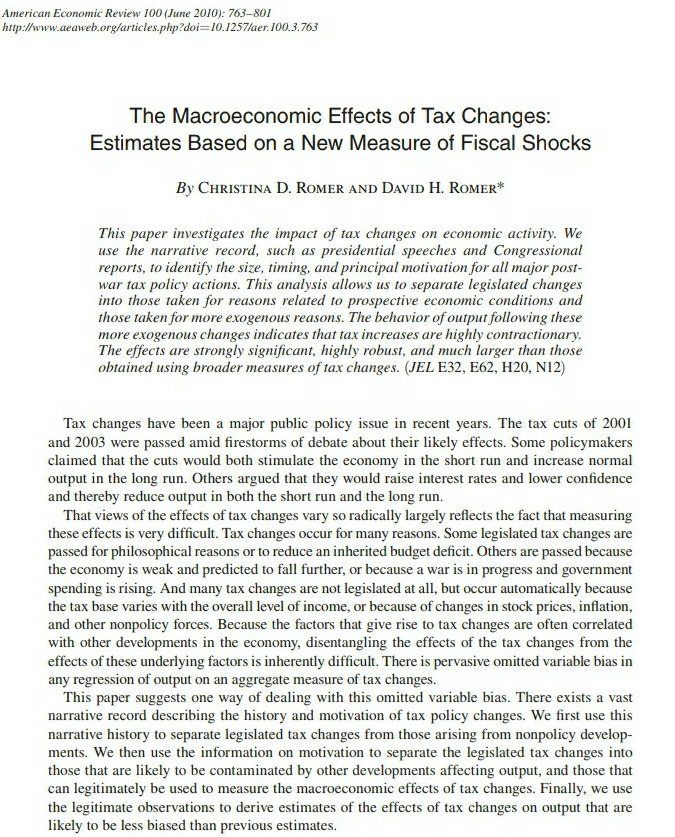
Teasing out the effect of tax policy on the business cycle
02 Feb 2021 Leave a comment
in applied price theory, business cycles, econometerics, economic growth, economic history, entrepreneurship, fiscal policy, human capital, labour economics, labour supply, macroeconomics, occupational choice Tags: real business cycles, taxation and entrepreneurship, taxation and investment, taxation and labour supply
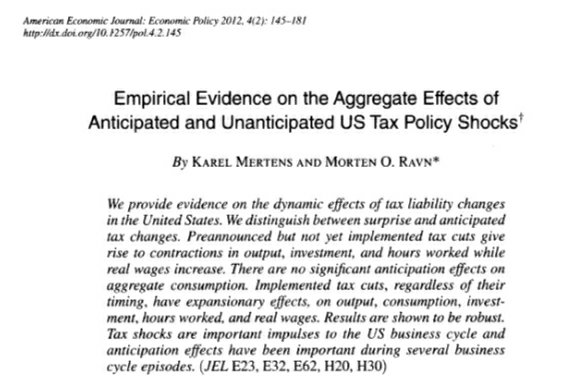
Romer on the power of tax cuts
02 Feb 2021 Leave a comment
in applied price theory, economic growth, entrepreneurship, fiscal policy, history of economic thought, human capital, industrial organisation, labour economics, labour supply, macroeconomics, poverty and inequality, public economics, survivor principle Tags: taxation and entrepreneurship, taxation and investment, taxation and labour supply, taxation and savings
What’s behind the relatively large fall in UK GDP? (reprise…)
02 Feb 2021 Leave a comment

On Sunday, Labour’s Anneliese Doddstweeted that the UK ‘had the worst recession and the worst growth of any major economy last year’, and that ‘Covid closed much of our economy, but the Conservatives crashed it’. Of course, this is just a tweet and almost all politicians try to score points in this way. Nonetheless, it was still pretty sloppy.
The Shadow Chancellor was citing the latest IMFestimates for GDP growth in the G7 economies in 2020, rather than the actual data. The official numbers have either not been published (we have to wait until 12th February for the UK), or are slightly different. But the IMF probably wasn’t far wrong (UK GDP is indeed likely to have fallen by about 10%), so I’ll let that pass.
The real issue is how the data have been spun. For a start, rather than contrast the UK with the US…
View original post 1,129 more words
The Shards of the Office of Governor General of Canada
01 Feb 2021 Leave a comment


Introduction
In January 2021, Julie Payette resigned the Office of Governor General in disgrace. Her troubled tenure has shattered the credibility of the institution and provided anti-monarchists a greater platform on which to stand than they ever dared hope. In “A Star Goes Supernova,” I reviewed three years’ worth of newspaper reports which chronicled from 2018 to 2020 her steadfast refusal to carry out her constitutional and ceremonial duties and the toxic culture of harassment and recrimination which she brewed at Rideau Hall, leading to mass resignations, insincere and mendacious non-apology apologies, and, ultimately, to a damning independent report that proved her downfall. Payette’s resignation broke new ground in Canada but has precedents elsewhere in our sister Commonwealth Realms. In this piece, I will explain what happens when the Office of Governor General becomes vacant, review similar precedents in the other Realms where other Governors have resigned their…
View original post 5,205 more words
Richard D Wolff Vs David D Friedman | Socialism Vs Capitalism Debate
01 Feb 2021 Leave a comment
in applied price theory, applied welfare economics, Austrian economics, comparative institutional analysis, constitutional political economy, David Friedman, development economics, economic history, economics of bureaucracy, growth disasters, growth miracles, industrial organisation, labour economics, labour supply, law and economics, liberalism, libertarianism, Marxist economics, occupational choice, property rights, Public Choice, survivor principle
THE MAN WHO RAN WASHINGTON: THE LIFE AND TIMES OF JAMES BAKER III by Peter Baker and Susan Glasser
01 Feb 2021 Leave a comment


Peter Baker, the chief White House correspondent for the New York Times and Susan Glasser, a staff writer for The New Yorker have written an engrossing biography of James Baker III, a man whose impact from 1976 through the election of 2000 can not be denied. The book’s range is impressive as the authors describe a childhood under the thumb of a father whose nickname was “the Warden.” As an adult we witness the death of his wife from cancer at a young age and a remarriage that merged two families resulting in eight children, a number of which experienced numerous problems including drugs and alcohol. Baker would give up the practice of law in Texas and move on to a political education in Washington, D.C. that produced lessons that stressed how to accumulate power and…
View original post 1,649 more words


Recent Comments