would see Ireland’s emissions cut by 51% by 2030
New Soviet Era: Australian Businesses Paid to Shut Down When Wind & Solar Output Drops
29 Jun 2020 Leave a comment
To call Australia’s energy debacle a ‘crisis’ is mastery in understatement: its obsession with wind and solar means its economy now operates around the vagaries of mother nature. The availability of sunshine and suitably beneficial breezes dictates when and where electricity gets delivered to power consumers.
The cause of Australia’s power pricing and supply calamity is so simple and obvious it can be laid out in a handful of pictures.
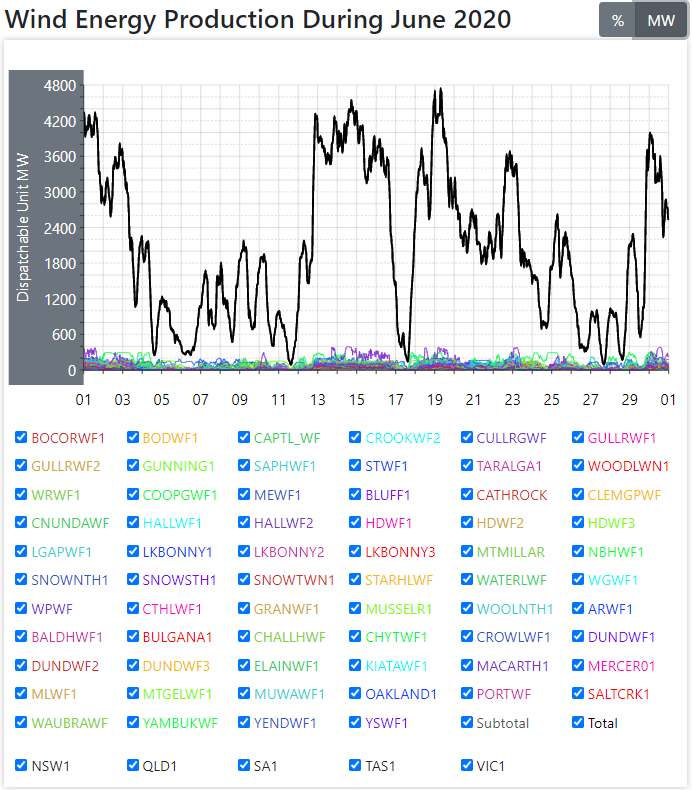
Depicted above – courtesy of Aneroid Energy – is the output delivered by Australian wind power outfits to the Eastern Grid so far this month.
Spread from Far North Queensland, across the ranges of NSW, all over Victoria, Northern Tasmania and across South Australia its entire capacity routinely delivers just a trickle of its combined notional capacity of 7,728MW.
Collapses of over 3,000 MW or more that occur over the space of a couple of hours are routine, as are…
View original post 1,171 more words
June 28, 1491: Birth of Henry VIII, King of England and Ireland.
29 Jun 2020 Leave a comment
Henry VIII (June 28, 1491 – January 28, 1547) was King of England from 1509 until his death in 1547. Henry was the third child and second son of Henry VII and Elizabeth of York, the eldest child of King Edward IV and his wife, Elizabeth Woodville.
Henry is best known for his six marriages, and, in particular, his efforts to have his first marriage (to Catherine of Aragon) annulled. His disagreement with Pope Clement VII on the question of such an annulment led Henry to initiate the English Reformation, separating the Church of England from papal authority. He appointed himself the Supreme Head of the Church of England and dissolved convents and monasteries, for which he was excommunicated. Henry is also known as “the father of the Royal Navy,” as he invested heavily in the navy, increasing its size from a few to more than 50 ships, and established…
View original post 346 more words
academic free speech: blm dissent edition
29 Jun 2020 Leave a comment
At Inside Higher Education, Jonathan Zimmerman has a great essay on why professors should support other professors who voice unpopular views. He focuses on the case of Harald Uhlig, the Chicago economics professor who, quite simply, thinks Black Lives Matter is lame. In summary, Uhlig thinks BLM has completely unrealistic goals, he implies that BLM protesters are childish, and he compared them to flat earthers. Soon thereafter, there were calls by many prominent economists to have him removed from his position as the editor of the Journal of Political Economy and some alumni accused him of racist actions in the class room.
Zimmerman thinks people should lay off:
What I cannot accept is the way they called for his head, which is different from criticizing his comments. The Federal Reserve Bank of Chicago cut ties with Uhlig, who had been a consultant in its research department. And economists…
View original post 241 more words
Why I was rejected for Labour Party membership and my response
29 Jun 2020 Leave a comment
I’m a feminist from a working-class background. I was social-class conscious before I was sex-class conscious. I’d been a member, admittedly largely inactive, of the Labour Party for most of my adult life. I’d managed to hold my nose when Tony Blair changed Clause IV in 1995, and it was removed from membership cards, symbolising to me, a move away from the party’s proud socialist history. But I resigned at some point about ten years later when his promises to reform the House of Lords failed and I was angry that a party supposedly based on equality baulked when it came to dealing with such a blatant example of inherited privilege. I can’t remember when I re-joined but I resigned for a second time in 2018 when the then General Secretary, Jennie Formby, announced that all-women-shortlists would no longer be women only. The conflict between my feminism and the party’s…
View original post 1,287 more words
Might Europe’s Covid policy be converging on – er – Sweden
27 Jun 2020 Leave a comment
Excess mortality in Europe has fallen in recent weeks, to the point where fewer deaths are occurring across the continent than you would expect at this time of the year. This doesn’t mean that Covid deaths aren’t occurring or that the problem has disappeared. It does mean it’s in a different phase.
And you could say Europe’s governments are converging on an approach which is looking more and more like that of Sweden’s – that is governments targeting a more limited range of specific public health measures, modifying policy in light of outcomes, and relying more on an informed public to make a sensible trade off between economic (and social) activity and safety-related social distancing.
View original post 604 more words
The complications of assessing racism in police departments
27 Jun 2020 Leave a comment
But this counter analysis admits that detailed statistical analysis is required to decided the bias question.
In a few previous posts (e.g., here and here), prompted by claims of African-American linguist John McWhorter, I examined the various biases and difficulties that plague attempts to see if police kill black suspects at a higher rate than whites. This new article in FiveThirtyEight, though not providing an answer to the problem, shows further complications in the attempt to get answers, so that at present we have no idea if there are racial disparities in who becomes the object of police violence.
Click on the screenshot to read:
There are three ways to compare racial disparities:
1.) Proportion of racial populations who are victims of police violence. As is well known, about 0.096% of black men and boys will be killed by the cops during their lifetime. That compares to 0.039% among whites: a 2.5-fold difference. But this doesn’t mean that blacks are more likely to…
View original post 948 more words
discussion of research on violent protest
26 Jun 2020 Leave a comment
Is the whole point of political violence to Marxists is to provoke a crackdown that causes the masses to finally lose their false consciousness?
Word on the Street, the blog of the Urban Violence Network, has a short piece by me on the research linking violence to negative outcomes. A key clip:
In the current context, these findings have sparked much online debate, including critiques of Wasow’s work and a sustained rebuttal by the author of claims that his research “allows people to blame ‘inner-city rioters’ and ignore other causes.” But the overall message of research on violence during protests is coming into focus. Violence, in the form of protests or riots, may receive attention and some policy response, but it comes at great cost. In the case of Black social movements, violent protest has been associated with more repressive administrations and sustained damage to Black communities. More generally, violence allows counter-movement actors (e.g. far right activists) to depict African American activists (e.g. of Black Lives Matter) as unreasonable and not worthy of…
View original post 82 more words
Basic Physics of the climate: A short debate with Roger Pielke Sr.
26 Jun 2020 Leave a comment
It’s always a pleasure to interact with Roger Pielke Sr. A climate scientist who is open to debate, respectful of honestly held opinion, and willing to concede ground where the facts dictate.
Roger A. Pielke Sr@RogerAPielkeSr·Nice to see sfc moist enthalpy that we proposed being added to the assessment of heat. “Outdoor Thermal Comfort and Building Energy Use Potential in Different Land-Use Areas in Tropical Cities: Case of Kuala Lumpur” https://res.mdpi.com/d_attachment/atmosphere/atmosphere-11-00652/article_deploy/atmosphere-11-00652.pdf… Our paper is https://pielkeclimatesci.files.wordpress.com/2009/10/r-290.pdf…
Rog Tallbloke @RogTallbloke·My experiment ended today Roger. It took 25ml of water at 20C at sfc pressure 12 days to evaporate compared to 2.5 hours at 20C in 266 times less pressure. What do you think really makes Earth’s surface ~90K warmer than the moon’s; GHGs or atmospheric pressure?
View original post 451 more words
June 25, 1900: Birth of Lord Louis Mountbatten, 1st Earl Mountbatten of Burma. Part II.
26 Jun 2020 Leave a comment
Personal Life
Earl Mountbatten admitted “Edwina and I spent all our married lives getting into other people’s beds.” He maintained an affair for several years with Yola Letellier, the wife of Henri Letellier, publisher of Le Journal and mayor of Deauville (1925–28). Yola Letellier’s life story was the inspiration for Colette’s novel Gigi.

Yola Letellier
After Edwina’s death in 1960, Mountbatten was involved in relationships with young women, according to his daughter Patricia, his secretary John Barratt, his valet Bill Evans and William Stadiem, an employee of Madame Claude.
Sexuality
Ron Perks, Mountbatten’s driver in Malta in 1948, alleged that he used to visit the Red House, a gay brothel in Rabat. Andrew Lownie, a Royal Historical Society fellow, wrote that the FBI maintained files regarding Mountbatten’s alleged homosexuality. He also interviewed several young men who claimed to have been in a relationship with him. Barratt has denied Mountbatten was…
View original post 694 more words
June 25, 1900: Birth of Lord Louis Mountbatten, 1st Earl Mountbatten of Burma. Part I.
26 Jun 2020 Leave a comment
Admiral of the Fleet Louis Francis Albert Victor Nicholas Mountbatten, 1st Earl Mountbatten of Burma (born Prince Louis of Battenberg; June 25, 1900 – August 27, 1979), was a British Royal Navy officer and statesman, a Maternal Uncle of Prince Philip, Duke of Edinburgh, and second cousin once removed of Queen Elizabeth II of the United Kingdom. During the Second World War, he was Supreme Allied Commander, South East Asia Command (1943–1946). He was the last Viceroy of India (1947) and the first governor-general of independent India (1947–1948).

Lord Louis Mountbatten, 1st Earl Mountbatten of Burma
Lord Mountbatten was known as His Serene Highness Prince Louis of Battenberg from the time of his birth at Frogmore House in the Home Park, Windsor, Berkshire until 1917, when he and several other relations of King George V of the United Kingdom dropped their German styles and titles.
Lord Mountbatten was the youngest child…
View original post 908 more words
Good summary
25 Jun 2020 Leave a comment
in Adam Smith, Alfred Marshall, applied price theory, applied welfare economics, Armen Alchian, Austrian economics, comparative institutional analysis, constitutional political economy, economic history, economics of crime, economics of regulation, history of economic thought, industrial organisation, James Buchanan, James Buchanan, labour economics, law and economics, Marxist economics, Milton Friedman, property rights, Public Choice, Rawls and Nozick, Robert E. Lucas, Ronald Coase, Ronald Coase, theory of the firm

Ross McKitrick: The flaw in relying on worst-case climate modelling
25 Jun 2020 Leave a comment
Credit: Wikipedia
H/T The Global Warming Policy Forum (GWPF).
Or relying on any climate modelling, some might say given its current tendency toward overheated predictive mediocrity.
– – –
The purpose of global climate policy is to get us from the dangerous upper end of the forecast range down to the safe bottom end. In fact, we are already there.
Whenever you read a media story about how we’re heading toward catastrophe if we continue operating “business as usual” — i.e., if we don’t slash carbon emissions — the reports are almost always referring to a model simulation using RCP8.5.
And you can bet that nowhere in the story will they explain that RCP8.5 is an implausible worst-case scenario that was never meant to represent a likely base case outcome, or that scientists have begun castigating its usage as a prediction of a doomed business-as-usual future.
View original post 199 more words
Electric vehicle ownership must increase by 11,000% for a net zero UK
24 Jun 2020 Leave a comment
Standing around at the EV charging station [image credit: makeitsunderland.com]
At the moment this is like trying to fill a bath from a very slowly dripping tap. A lot would need to happen to turn the tap of public enthusiasm for EVs on, starting with much lower prices. Where is all the extra electricity supply supposed to come from, and who voted for ‘net zero’ anyway?
– – –
Scottish and Southern Electricity Networks (SSEN) today publishes new research on the uptake of low carbon technologies (LCTs) required to put the UK on the road to net zero.
Examining the expected changes in SSEN’s two distribution areas in the south of England and north of Scotland, the data reveals electric vehicle ownership will increase from 44,000 to 5m in these two areas alone.
View original post 158 more words
Marriage of Charles I of England, Scotland and Ireland and Henrietta Maria de Bourbon of France.
24 Jun 2020 Leave a comment
Charles (November 19, 1600 – January 30, 1649) was King of England, King of Scotland, and King of Ireland from March 27, 1625 until his execution in 1649. Charles was born into the House of Stuart as the second son of King James VI of Scotland, but after his father inherited the English throne in 1603 (as James I), he moved to England, where he spent much of the rest of his life. He became heir apparent to the three kingdoms of England, Scotland and Ireland in 1612 on the death of his elder brother Henry-Frederick, Prince of Wales.

Charles I, King of England, Scotland and Ireland
In 1620, Charles’s brother-in-law, King Friedrich V of Bohemia was defeated at the Battle of White Mountain near Prague and his hereditary lands in the Electoral Palatinate were invaded by a Habsburg force from the Spanish Netherlands. James I-VI, however, had been seeking marriage…
View original post 809 more words


Recent Comments