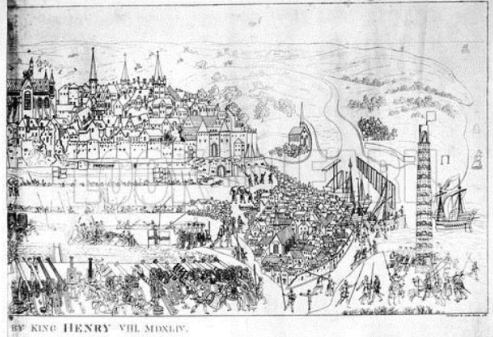
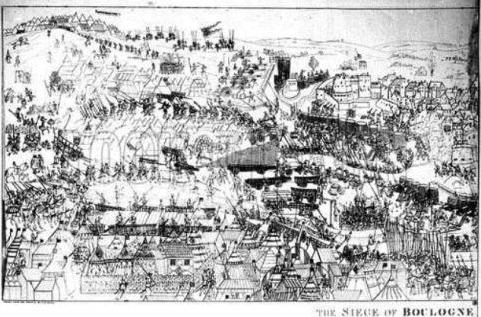
Henry VIII Invades France 1544

MSW's avatarWeapons and Warfare

The Siege of Boulogne by King Henry VIII (1491-1547) in 1544, engraved by James Basire, 1788

The Siege of Boulogne by King Henry VIII (1491-1547) in 1544, engraved by James Basire, 1788

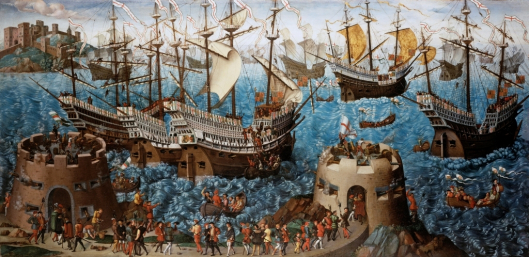
Basire_Embarkation_of_Henry_VIII

Henry VIII embarking in Dover.

Throughout this year, and the beginning of 1544, preparations were made for the great invasion of France under the combined leadership of Henry of England and Charles of Spain. The cost of the undertaking was so vast, however, that the general coinage of the realm was debased by introducing a larger amount of alloy into its gold and silver coins. By these means the king’s mint acquired large sums of money, since the face value of the currency was the same despite the smaller amount of precious metal. Prices naturally rose, at a rate of approximately 10 per cent each year, and the economy took twenty years to recover. These were the results of the king’s passion for war.

Other ways of making money were also found. It was decided to exact a ‘benevolence’ from the nation. Those who owned lands worth more than an…

View original post 1,382 more words

Covid-19 Innovation – Are We on the Right Track?

afinetheorem's avatarA Fine Theorem

I never discuss my own research on this website – it’s more fun (for me at the very least!) to dive in to the great results the rest of the economics community produces. So I hope you’ll forgive me for breaking this rule today, as I want to show a few interesting, very time-sensitive results Jorge Lemus, Guillermo Marshall and I have developed about Covid-19 innovation.

Many of us in the innovation economics world have been asked by governments how they should handle R&D right now. The basic problem is clear. There is a pandemic. Stopping this has enormous economic benefits – a vaccine that arrived tomorrow would literally be among the most economically valuable inventions ever made. Treatments which allow normal economic activity are incredibly valuable as well. As always, governments have limited knowledge about who is able to invent what. There is tremendous uncertainty about how various…

View original post 1,317 more words

UK investment trust portfolio strategies before the first world war

ehs1926's avatarThe Long Run

by Janette Rutterford and Dimitris P. Sotiropoulos (The Open University Business School)

The full article from this blog is forthcoming in the Economic History Review

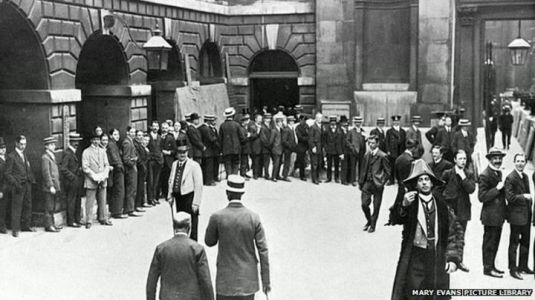
_72560439_72560401 Mary Evans Picture Library

UK investment trusts (the British name for closed-end funds) were at the forefront of financial innovation in the global era before World War I. Soon after the increase in investment choice facilitated by Companies Acts in the 1850s and 1860s – which allowed investors limited liability – investment trusts emerged to invest in a diverse range of securities across the globe, thereby offering asset management services to individual investors. They rapidly became a low-cost financial vehicle for so-called “averaging” of risk across a portfolio of marketable securities without having to sacrifice return. UK investment trusts were the first genuine historical paradigm of a sophisticated asset management industry.

Formed as trusts from the the late 1860s, by the 1880s, the vast majority…

View original post 788 more words

A wide-ranging interview with Steve Pinker on BBC Radio 4

whyevolutionistrue's avatarWhy Evolution Is True

This morning on BBC Radio 4,  Jim Al-Khalili conducted a half-hour interview with Steve Pinker in “The Life Scientific” series.  Although Steve is promoting his new book, The Better Angels of Our Nature, only about six minutes of the interview deals with it.  The rest covers a number of topics, including controversies about his first book, The Language Instinct, and about the more recent The Blank Slate.

You can hear the program archived here, and it will be rebroadcast this evening at 9:30 p.m. London time.

As always, Steve is eloquent: he appears to speak in complete and perfect paragraphs; see if you can spot anything ungrammatical. Eloquence is one thing that unites the Five Horsemen (yes, there are five): Pinker, Dawkins, Dennett, Harris, and Hitchens; and I greatly envy that talent. I consider Hitch the most eloquent, but the rest are no slouches.

Highlights:

  • How…

View original post 101 more words

Steve Pinker weighs in on the “evolutionary psychology is impossible” paper

whyevolutionistrue's avatarWhy Evolution Is True

After I wrote my critique of Subrena Smith’s anti-evolutionary-psychology paper this morning—hers titled “Is evolutionary psychology possible?”—I sent the link to Steve Pinker, who’s quarantining on Cape Cod. He wrote back with some nice words of approbation, but added a few points. I thought these points were good, relevant and, as the first two weren’t made by either me or critic Edward Hagen, I asked Steve if I could quote him. He said yes. So add these criticisms to those leveled this morning. (Steve’s words are indented.)

All your points are exactly right. The motive seems to be the slipshod politicizing I exposed 18 years ago in The Blank Slate: if we’re blank slates, there can’t be differences between races, which would make racism impossible; therefore to combat racism we must believe that humans are blank slates. It fails both in philosophical coherence (racism is not an empirical hypothesis…

View original post 664 more words

No, Observer: ‘free-market think-tanks’ haven’t changed their tune

julianhjessop's avatarPlain-speaking Economics

This Sunday the Observer ran a frontpage story headlined ‘rightwing thinktanks call time on austerity era’. I was quoted in the article, wearing my IEA hat, as were representatives of the Adam Smith Institute, Centre for Policy Studies and Policy Exchange. As it happens, I am happy with the specific comments attributed to me, which fairly reflected both my support for a temporary increase in government borrowing and my concerns about the duration of the lockdown. However, the inferences drawn, and indeed the whole narrative of the article, were badly misleading.

Let’s skip over the dubious assumption that a think-tank is ‘right-wing’ just because it favours free-market solutions to economic and social problems, or that any think-tank always speaks with a single voice. The bigger issue here is the claim that there had been a fundamental ‘shift in stance’ in favour of ‘sustained increases’ in public spending as a result…

View original post 618 more words

The Treaty, beautifully explained by a wise and honest Maori leader

John Ansell's avatar

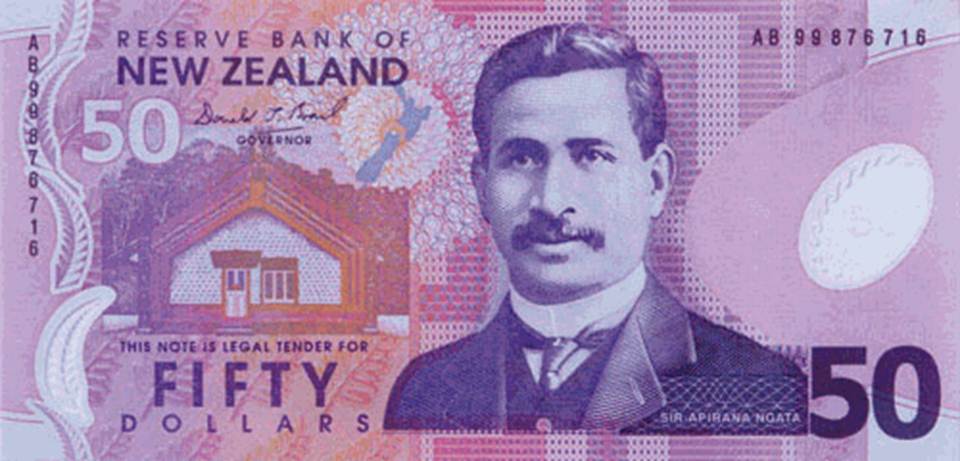
Sir Apirana Ngata, MA, LLB, D. Lit — the man on our $50 note. (Put there by Reserve Bank Governor, one Donald T. Brash.) If only today’s Maori leaders shared Ngata’s high regard for truth. 
 

THE TREATY OF WAITANGI

AN EXPLANATION

by The Hon. Sir Apirana Ngata
M.A., LL.B., Lit.D.

Published for the Maori Purposes Fund Board

 First published in 1922

Translated into English by M. R. Jones

Spaced out a bit for easy reading by J. L. Ansell

The words that follow are those of history’s greatest Maori statesman… 

View original post 9,332 more words

Image

Planet Of The Greens 

oldbrew's avatarTallbloke's Talkshop


Standard green response to criticism: ‘Shoot the messenger!’ They like to travel around the world telling people it’s a bad idea to travel around so much, due to some flaky climate theory.
– – –
Attempts by eco-activists to censor and shut down Planet of the Humans reveals the green movement’s authoritarian nature that turns most aggressively on its own apostates.

Jeff Gibbs’ and Michael Moore’s new film, Planet of the Humans has been watched more than eight million times, says The GWPF.

It has cast doubt on the green movement’s claims to be concerned with the environment and questions the motivations and integrity of its leaders and backers.

In reply, environmental activists have attacked Moore and Gibbs, and called for their film to be censored.

View original post 207 more words

Planet of the Greens

The Ownership of Swans in English History: Does the Queen Own all the Swans?

legalhistorymiscellany's avatarLegal History Miscellany

Guest post by Katy Barnett, 18 May 2020.

This blog has recently featured a fascinating post on whether it is possible to steal a peacock. In this post, I’m going to look at the laws surrounding a different kind of bird: the strange historical English laws regarding the monarch and ownership of swans. It is sometimes said that only the Queen may eat swan, and that she owns all the swans in England. This is not strictly correct. The truth, however, is far more interesting.[1]

The Case of Swans

My journey into the law of swan ownership started when I looked at a 1592 case reported by Edward Coke, The Case of Swans, in which he represented Elizabeth I. This case famously confirms the general principles regarding ownership of wild animals, and confirms the rights of the monarch with regard to unmarked swans.[2] It arose when…

View original post 3,414 more words

Profiting From Power: Subsidised Renewable Energy Nothing More Than State Sponsored Theft

stopthesethings's avatarSTOP THESE THINGS

The real delight of Michael Moore’s Planet of the Humans is watching the climate cult squirm, as those on the left sink the boots in. Of course, those who have been pointing out that heavily subsidised and hopelessly unreliable wind and solar offer no solution to our purported planetary perils are relishing the opportunity to sink the boots in, too.

As we have been reporting for a couple weeks now, Michael Moore’s withering attack on the power and money behind the renewable energy scam (see above) has incensed weather-worriers, as well as those who profit from the greatest economic and environmental fraud of all time.

The film – produced by Moore and made by Jeff Gibbs – has been uploaded to YouTube to allow all and sundry to get the message: renewable energy is the greatest economic and environmental fraud of all time. STT first covered it here: Blood &…

View original post 2,035 more words

The Medieval Siege

MSW's avatarWeapons and Warfare

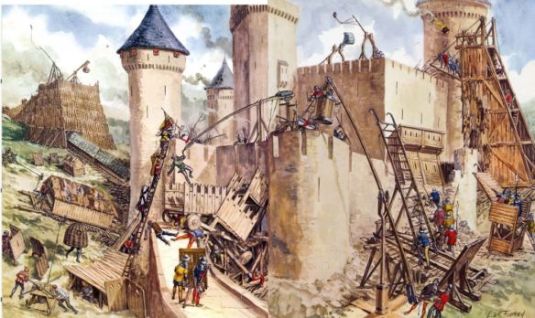
In ancient times, cities often had strong walls around them, and warfare against these cities had always involved the basic tasks of breaking the walls, going over or under the walls, or starving the defenders into surrender. In the Middle Ages, Europe’s decentralized political structure put a new twist on the siege by planting heavily fortified castles all over the landscape. Constantinople’s thick city walls were similar to the fortresses of Roman, Greek, and more ancient times. Northern Europe, on the other hand, had several hundred small fortresses that were designed to hold off disproportionately larger attackers. In order to capture a region, an invader would need to besiege more than one fortress.

After the period of the First Crusade, knights returned with much grander ideas of defensive fortification. They had seen Byzantine fortress designs and had participated in attacks on Antioch, Acre, Jerusalem, and Tyre. Crusaders had built their…

View original post 4,313 more words

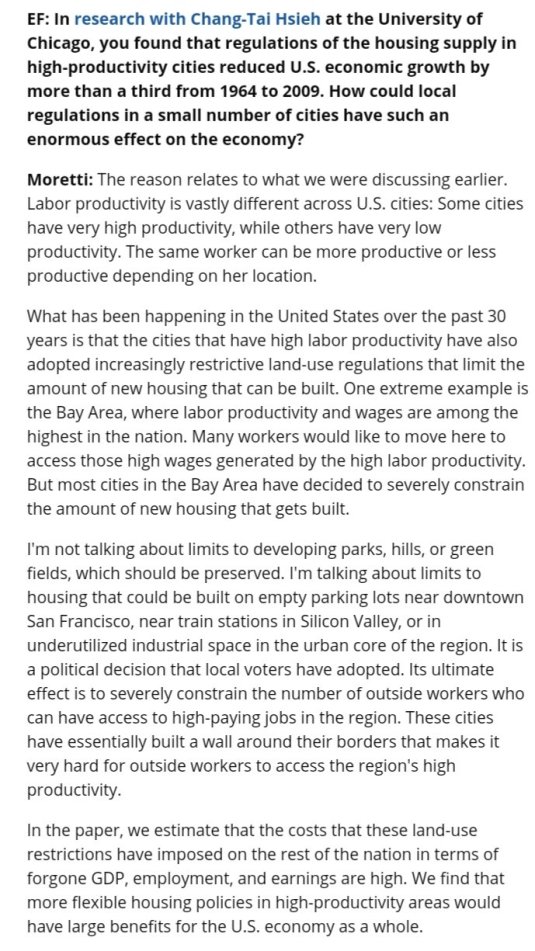
The staggering cost of NIMBYISM

Will taxes stall the #COVID19 recovery?

Doing Bad by Doing Good by Chris Coyne

Previous Older Entries Next Newer Entries

Libertarian Land

Celebrating humanity's flourishing through the spread of capitalism and the rule of law

Arin’s Substack

Celebrating humanity's flourishing through the spread of capitalism and the rule of law

David Andolfatto

Celebrating humanity's flourishing through the spread of capitalism and the rule of law

Monetary Non-Neutrality

Celebrating humanity's flourishing through the spread of capitalism and the rule of law

Reason Magazine

Celebrating humanity's flourishing through the spread of capitalism and the rule of law

Coyote Blog

Celebrating humanity's flourishing through the spread of capitalism and the rule of law

Thoughts from the North

Celebrating humanity's flourishing through the spread of capitalism and the rule of law

Fardels Bear

A History of the Alt-Right

Vincent Geloso

Econ Prof at George Mason University, Economic Historian, Québécois

Bassett, Brash & Hide

Celebrating humanity's flourishing through the spread of capitalism and the rule of law

Truth on the Market

Scholarly commentary on law, economics, and more

The Undercover Historian

Beatrice Cherrier's blog

Matua Kahurangi

Celebrating humanity's flourishing through the spread of capitalism and the rule of law

Temple of Sociology

Celebrating humanity's flourishing through the spread of capitalism and the rule of law

Velvet Glove, Iron Fist

Celebrating humanity's flourishing through the spread of capitalism and the rule of law

Why Evolution Is True

Why Evolution is True is a blog written by Jerry Coyne, centered on evolution and biology but also dealing with diverse topics like politics, culture, and cats.

NoTricksZone

Celebrating humanity's flourishing through the spread of capitalism and the rule of law

Homepaddock

A rural perspective with a blue tint by Ele Ludemann

Kiwiblog

DPF's Kiwiblog - Fomenting Happy Mischief since 2003

The Dangerous Economist

Celebrating humanity's flourishing through the spread of capitalism and the rule of law

Watts Up With That?

The world's most viewed site on global warming and climate change

The Logical Place

Tim Harding's writings on rationality, informal logic and skepticism

Doc's Books

A window into Doc Freiberger's library

The Risk-Monger

Let's examine hard decisions!

Uneasy Money

Commentary on monetary policy in the spirit of R. G. Hawtrey

Barrie Saunders

Thoughts on public policy and the media

Liberty Scott

Celebrating humanity's flourishing through the spread of capitalism and the rule of law

Point of Order

Politics and the economy

James Bowden's Blog

A blog (primarily) on Canadian and Commonwealth political history and institutions

Science Matters

Reading between the lines, and underneath the hype.

Peter Winsley

Economics, and such stuff as dreams are made on

A Venerable Puzzle

"The British constitution has always been puzzling, and always will be." --Queen Elizabeth II

The Antiplanner

Celebrating humanity's flourishing through the spread of capitalism and the rule of law

Bet On It

Celebrating humanity's flourishing through the spread of capitalism and the rule of law

History of Sorts

WORLD WAR II, MUSIC, HISTORY, HOLOCAUST

Roger Pielke Jr.

Undisciplined scholar, recovering academic

Offsetting Behaviour

Celebrating humanity's flourishing through the spread of capitalism and the rule of law

JONATHAN TURLEY

Res ipsa loquitur - The thing itself speaks

Conversable Economist

In Hume’s spirit, I will attempt to serve as an ambassador from my world of economics, and help in “finding topics of conversation fit for the entertainment of rational creatures.”

The Victorian Commons

Researching the House of Commons, 1832-1868

The History of Parliament

Articles and research from the History of Parliament Trust

Books & Boots

Reflections on books and art

Legal History Miscellany

Posts on the History of Law, Crime, and Justice

Sex, Drugs and Economics

Celebrating humanity's flourishing through the spread of capitalism and the rule of law

European Royal History

Exploring the Monarchs of Europe

Tallbloke's Talkshop

Cutting edge science you can dice with