The Sewel convention and Brexit
07 Apr 2020 Leave a comment

 In March, the Constitution Unit co-published a new report, Parliament and Brexit, in which some of the UK’s leading academics examine how parliament has managed Brexit to date, and how it might seek to handle the issue in future. Here, Nicola McEwen discusses how the Sewel convention, which regulates the relationship between the UK Parliament and its devolved counterparts, was put under strain by Brexit.
There are four legislatures in the UK, but only one of these is sovereign. The sovereignty of the Westminster parliament remains one of the most important principles of the UK constitution. Each of the devolution statutes made clear that conferral of law-making powers on the devolved institutions ‘does not affect the power of the Parliament of the United Kingdom to make laws’ for Scotland, Northern Ireland and Wales – including in areas of devolved competence. But Westminster’s parliamentary sovereignty is offset by the constitutional convention…
View original post 1,167 more words
Why bans on ‘short selling’ are a bad idea
07 Apr 2020 Leave a comment

It is understandable that people are on the lookout for villains to blame in this time of national crisis – and who better than City ‘fat cats’ who are ‘profiting from the misery of others’? Usually it only takes a moment of serious thought to realise that these attacks are ludicrous. As Tom Bailey explains here, and I discussed here, it is plain daft to criticise investment managers for taking advantage of lower prices to buy shares. But when funds are engaged in ‘short selling’ it may take a little more effort to see the bigger picture.
Short selling is essentially a bet that the price of a financial asset will fall. It traditionally involves the short seller borrowing a parcel of shares or bonds from another investor and then selling them on. The original holder will charge a fee for this, which can be substantial.
At…
View original post 653 more words
Are Anarcho-Capitalists Insane? Medieval Icelandic Living Standards in Comparative Perspective
07 Apr 2020 Leave a comment

Along with Peter Leeson, I have a new working paper. In this paper, we empirically revisit the 1979 seminal paper of David Friedman in the Journal of Legal Studies regarding the law and economics of Iceland between 900 and 1262. The case is important because Iceland constitutes the first example in the literature on the economics of anarchy of how governance is a good that can privately be produced and with competition between providers. For nearly three centuries, Iceland was without a formal state (with a monopoly on violence) even though it was home to nearly one hundred thousands individuals. However, sustained private provision does not mean that the outcomes are superior than under formal governance. We decided to see whether Icelanders enjoyed living standards above the rest of Medieval Europe. The paper is available here on my website and the abstract is below:
Medieval Iceland was governed privately. Other…
View original post 88 more words
THE CHURCHILL FACTOR: HOW ONE MAN MADE HISTORY by Boris Johnson
07 Apr 2020 Leave a comment


(English Prime Minister Winston Churchill, August 27, 1941)
If you are looking for a personal, breezy hagiography of Winston Churchill then Boris Johnson’s THE CHURCHILL FACTOR: HOW ONE MAN MADE HISTORY will be of interest. Johnson’s effort is not a traditional biography of the former occupant of 10 Downing Street, but a manifesto imploring the reader to consider the genius and greatness of Churchill. Johnson is concerned that as time has passed fewer and fewer of the non-World War II generation have forgotten or are not aware of Churchill’s accomplishments as he states at the outset “we are losing those who can remember the sound of his voice, and I worry that we are in danger….of forgetting the scale of what he did.” For the author, World War II would have been lost, if not for Churchill, and he further argues that the resident of Chartwell House and Blenheim Palace…
View original post 1,314 more words
THE SPLENDID AND THE VILE: A SAGA OF CHURCHILL, FAMILY, AND DEFIANCE DURING THE BLITZ by Erik Larson
07 Apr 2020 Leave a comment

(The bombing of London during the WWII “Blitz”)
Living at a time when leadership seems to be severely lacking with a president who enacts his personal agenda seemingly on a daily basis when people are dying is eye opening and ultimately a tragedy. In times like this it is important to examine historical leadership that is grounded in fact and strength of personality. Leadership during times of crisis is of the utmost importance be it a pandemic, wartime, economic or weather-related catastrophes. The public needs to rely on someone to step up and provide honest and factual information with direction to mitigate people’s anxiety and provide hope for the future. Examining the aerial atrocities committed by the Germans during World War II over London, Coventry and other English cities in late 1940 and early 1941 is a case in point. Winston Churchill the newly appointed Prime Minister would rise to…
View original post 1,384 more words
April 6, 1199: Death of King Richard I of England.
07 Apr 2020 Leave a comment

Richard I (September 8, 1157 – April 6, 1199) was King of England from 1189 until his death. He was the second king of the House of Plantagenet. He also ruled as Duke of Normandy, Aquitaine and Gascony, Lord of Cyprus, Count of Poitiers, Anjou, Maine, and Nantes, and was overlord of Brittany at various times during the same period. He was the third of five sons of King Henry II of England and Duchess Eleanor of Aquitaine and seemed unlikely to become king, but all of his brothers except the youngest, John, predeceased their father. Richard is known as Richard Cœur de Lion or Richard the Lionheart because of his reputation as a great military leader and warrior.
By the age of 16, Richard had taken command of his own army, putting down rebellions in Poitou against his father. Richard was a central Christian commander during the Third Crusade, leading…
View original post 673 more words
Daily Mail’s defence of an extremist: He just holds “strong views”
07 Apr 2020 Leave a comment

Here’s the headline of an article published in the Mail on Sunday (sister site of the Daily Mail) on March 29, written by their chief political correspondent Ian Gallaghar.

The Invictus Games, launched by the Duke of Sussex – himself a veteran – in 2014, allows wounded or sick military personnel and veterans to compete in sporting events. The inclusion of wounded Israeli veterans in the next biennial (in 2022), the Mail on Sunday article claims, echoing the headline, has caused a “backlash”.
However, as blogger Elder of Ziyon noted in a post that day, when you read the article, you learn that the only “backlash” Prince Harry received was by one Arab journalist with a history of supporting violence and antisemitism: Palestinian-born Abdel Bari Atwan
For instance, Atwan enthusiastically supported a brutal 2008 Palestinian terror attack which killed eight Jewish religious students in a Jerusalem Yeshiva, saying it…
View original post 370 more words
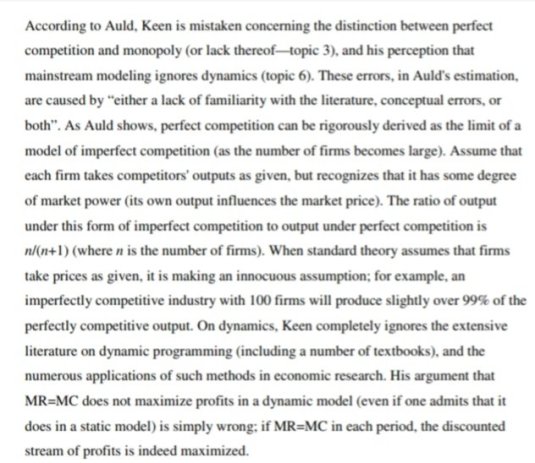
Another @ProfSteveKeen review
06 Apr 2020 Leave a comment
in applied price theory, history of economic thought Tags: cranks

Carol Harlow: Windrush: Lessons learned or perhaps not?
06 Apr 2020 Leave a comment

 What happened? When? To whom? and Why?
On 19 March, screened by the draft Corona: Defence of the Realm Bill, the long awaited Windrush: Lessons Learned Report (hereafter Lessons Learned) was published. For those who have missed out on the considerable publicity generated by the Windrush Generation scandal, a short account is in order. The Windrush Generation broadly comprises Commonwealth citizens who have indefinite leave to remain in the UK or “settled status” on the basis of having settled in the UK before 1973 when the Commonwealth Immigration Act 1971 came into force, and not since 1988 having left the UK for more than two years. Many of these elderly British citizens were unable to prove their right to live here to the satisfaction of the Home Office (perhaps because they entered the country on a parent’s passport or had lost their papers in the ensuing forty-odd years since…
View original post 2,995 more words
Virginian Vendetta: Wind & Solar Power Obsessed Government Signs Economic Suicide Pact
06 Apr 2020 Leave a comment

 No country has powered itself with sunshine and breezes. No country ever will. But that doesn’t stop virtue signalling politicians claiming that they soon will.The people of Virginia are just the latest victims of the lunacy that’s gripped much of the Western world.Virginia’s Democrats have just signed an economic suicide pact – premised on the myth that plugging windmills and solar panels into giant lithium-ion batteries will allow their State to ditch their coal-and gas-fired power plants, and become the first (and only) place in world to run on wind and solar power.In his usual capable style, Paul Driessen tips a bucket on the Democrat’s notion of an inevitable transition.
Virginia’s ‘Clean Economy Act’ will have dirty results
Watts Up With That?
Paul Driessen
4 March 2020
Largely with party-line, urban-vs-rural votes, Virginia’s legislature is poised to enact a Clean Economy Act that would eliminate coal-based electricity generation, prevent construction…
View original post 1,372 more words
Has Brexit really already cost us [insert number here]?
06 Apr 2020 Leave a comment
The first cost will be organisational capital. I read somewhere that managers are investing about two hours to per day rethinking supply chains.
The estimate of 2% is reasonable. Ed Prescott made some good arguments about trade clubs boosting growth in continental Europe. Those estimates are from a time when there is many more restrictions on trade and Brussels hadn’t got going on regulating everything in sight.
Ever since the 2016 referendum, economists have attempted to estimate what Brexit ‘has already cost’ the UK economy and households. It won’t be a surprise to see some of the most depressing numbers dusted off this week to mark the departure from the EU. But all these studies should be taken with a large pinch of salt. It would certainly be wrong to regard these numbers as gospel truth, or a reliable warning of (even) worse to come.
There are two main approaches to answering the question of what impact the referendum result has already had. One is ‘top-down’, which looks at the overall performance of the UK economy compared to its peers, usually measured by headline GDP growth. The other is ‘bottom-up’, which focuses instead on specific indicators, notably inflation and business investment, where it is relatively clear that the vote to leave has had a negative impact.
I’m…
View original post 1,400 more words
What happened to the election?
06 Apr 2020 Leave a comment
I concluded the trump won the election when all the Democratic candidates in the first debate raise their hand to support Medicare for All.
This conclusion is reinforced now the budget fiscal cupboard is bare after the bailouts present and future. There is no political constituency for college for all, Medicare for all and the green new deal. Taxes are never popular especially when tax rises have to pay for all the money borrowed

On March 17 I noted that I’d made a $100 bet with a friend that Donald Trump would lose his bid for a second term come November. My reasons were these:
Now that Trump has bungled the handling of the epidemic, makes daily statements about it so palpably stupid that even a “deplorable” can see through them, and gives himself a ten out of ten in handling the crisis, I think his chances of victory are even slimmer. And that’s on top of the economy, which is heading south so fast it will reach Antarctica before the summer.
Since then Trump has screwed up even more, repeatedly making dumb and even harmful assertions (“I might take chloroquine”), backtracking (pews filled by Easter!), praising himself, denigrating others (including governors) and generally looking like the narcissistic moron he is. It’s on view daily. And yet. . . his approval rating is as…
View original post 257 more words


Recent Comments