
Russian mates would sometimes be paid in dollars, sometimes local currency and sometimes not at all but still show up to work (as creditor in possession?)
23 Feb 2020 Leave a comment
in applied price theory, comparative institutional analysis, development economics, economic history, economics of crime, growth disasters, labour economics, labour supply, law and economics, managerial economics, Marxist economics, organisational economics, personnel economics, property rights Tags: fall of communism
Celebrating Ecuador’s Dollarization
23 Feb 2020 Leave a comment

Lawrence Reed in this piece writes on benefits of Ecuador Dollarisation:
View original post 587 more words
A fair summary by Dube; note repeated reference to modest increases. This can be offset by diluting service quality and staffing levels and hours such as in old age care studies
23 Feb 2020 Leave a comment
in applied price theory, applied welfare economics, labour economics, minimum wage Tags: offsetting behaviour, The fatal conceit, unintended consequences

Ben Vollaard on an unusually personalised habitual offender law @sst_nz @NZJusticeIdeas
23 Feb 2020 Leave a comment
in applied price theory, econometerics, economics of crime, labour economics, labour supply, law and economics, occupational choice Tags: crime and punishment, criminal deterrence, law and order

Shell’s New Battery Won’t Solve Wind Intermittency Problem
23 Feb 2020 Leave a comment
Shell’s new shiny battery will only be able to replace wind output for less than a minute, if the wind stopped blowing.
The Forstater Employment Tribunal judgment: a critical appraisal in light of Miller – by Karon Monaghan
23 Feb 2020 Leave a comment

There are several problems with the judgment in Forstater v CGD Europe and Ors (case no 2200909/2019) (“Forstater”). Some of these have been highlighted by Amir Paz-Fuch in his recent analysis on this blog, ‘Principles into Practice: Protecting Offensive Beliefs in the Workplace’. In this blog post, I look more at the specific findings of the Employment Tribunal and whether they are sustainable. I shall consider this issue in light, in particular, of the holdings of the High Court in R(Miller) v College of Policing and A’or[2020] EWHC 225 (Admin).
 Image by Mizter_X94 from Pixabay
In analysing the judgment in Forstater, it is important to identify first what the Employment Tribunal Judge was required to decide. The Claimant’s (“C”) claim had been listed to determine the answer to a single question: whether the beliefs relied upon by C (in support of…
View original post 3,131 more words
Weekend long read
23 Feb 2020 Leave a comment

1) The Times of Israel’s Raphael Ahren explains ‘Why the Palestinian case at The Hague took a big hit this past week’.
“The notion that “Palestine” is a full-fledged state that can grant jurisdiction to the International Criminal Court was dealt a serious blow over the past week, as seven countries and many scholars of international law argued that the issue was not as simple as the Palestinians and their supporters would like to make it seem.
Even some countries that have formally recognized the “State of Palestine” along the pre-1967 lines argued that Palestine cannot necessarily be considered to have validly granted the ICC jurisdiction to probe war crimes allegedly committed on its territory.
Germany, Australia, Austria, Brazil, the Czech Republic, Hungary and Uganda last week submitted written documents to The Hague, each asking to become an amicus curiae — a “friend of the court” that is…
View original post 533 more words
‘A disciplined comrade’ – Richard Burgon
22 Feb 2020 Leave a comment

forty quotes from and about
Richard Burgon
born 1980
Labour MP for Leeds East 2015–
shadow city minister 2015–16
shadow justice secretary 2016–
‘Richard Burgon broke convention by calling for the end to the Monarchy before affirming an oath of allegiance. “As someone that believes that the head of state should be elected I make this oath in order to serve my constituents,” he said.’ – Daily Mirror (2015) [i]
‘No-one was more surprised than me that my swearing in as an MP made the news last week.’ – Richard Burgon (2015) [ii]
‘New SNP MP Patricia Gibson flinched in disgust after one of her colleagues broke wind in the Commons. Shocked Patricia was caught on camera recoiling in horror when Labour rival Richard Burgon let off during a debate. She could be seen on telly covering her mouth and trying to waft away the nauseating stench as Mr Burgon ignored…
View original post 1,439 more words
Politician of the Decade (living)
22 Feb 2020 Leave a comment
In the ever-lengthening list of UKIP leaders, Baron Pearson of Rannoch was far from the worst. Nor, however, was he much good. He spent just ten months in the job, during which time he oversaw the disappointing general election result of 2010, when the average vote for a UKIP candidate fell below that for the BNP. Perhaps, though, he’d already made his contribution to the party, even before joining, by providing it with a mission statement.
He’d originally been a Conservative – he got his peerage from Margaret Thatcher – but had felt frustrated by its mealy-mouthed espousal of Euroscepticism. He was still a Tory when, during the 2004 campaign for the European Parliament elections, he called for people to vote UKIP. ‘The only party which might save our democracy, our right to govern ourselves, from the corrupt octopus in Brussels is the Conservatives,’ he said. ‘But the only people…
View original post 1,434 more words
Hearing and Speaking the Law in Medieval England
22 Feb 2020 Leave a comment

By Sara M. Butler; posted 21 February 2020.
A recent article in the Journal of Legal History by Gwen Seabourne addresses one of the more unusual requirements of medieval law. If a widower hoped to remain on the land brought into marriage by his dead wife, his claim rested on having fathered a live and legitimate child by her. Even if the child immediately died, its short life was sufficient to grant a widower an interest in his wife’s land for the remainder of his life. What is most remarkable, though, is the nature of the evidence required for proof of life: a crying test. A Year Book from the late thirteenth century spells out the condition: “[I]n order that the husband may hold the inheritance of his wife by the curtesy of England by reason of issue between them, it is necessary that the issue be heard to cry…
View original post 1,952 more words
How Radical Is Bernie Sanders?
22 Feb 2020 Leave a comment

Because of his extremist views, I often refer to Senator Sanders as “Crazy Bernie.”
You can argue I’m being unfair. After all, I pointed out during the last campaign that his voting record in the Senate was almost identical 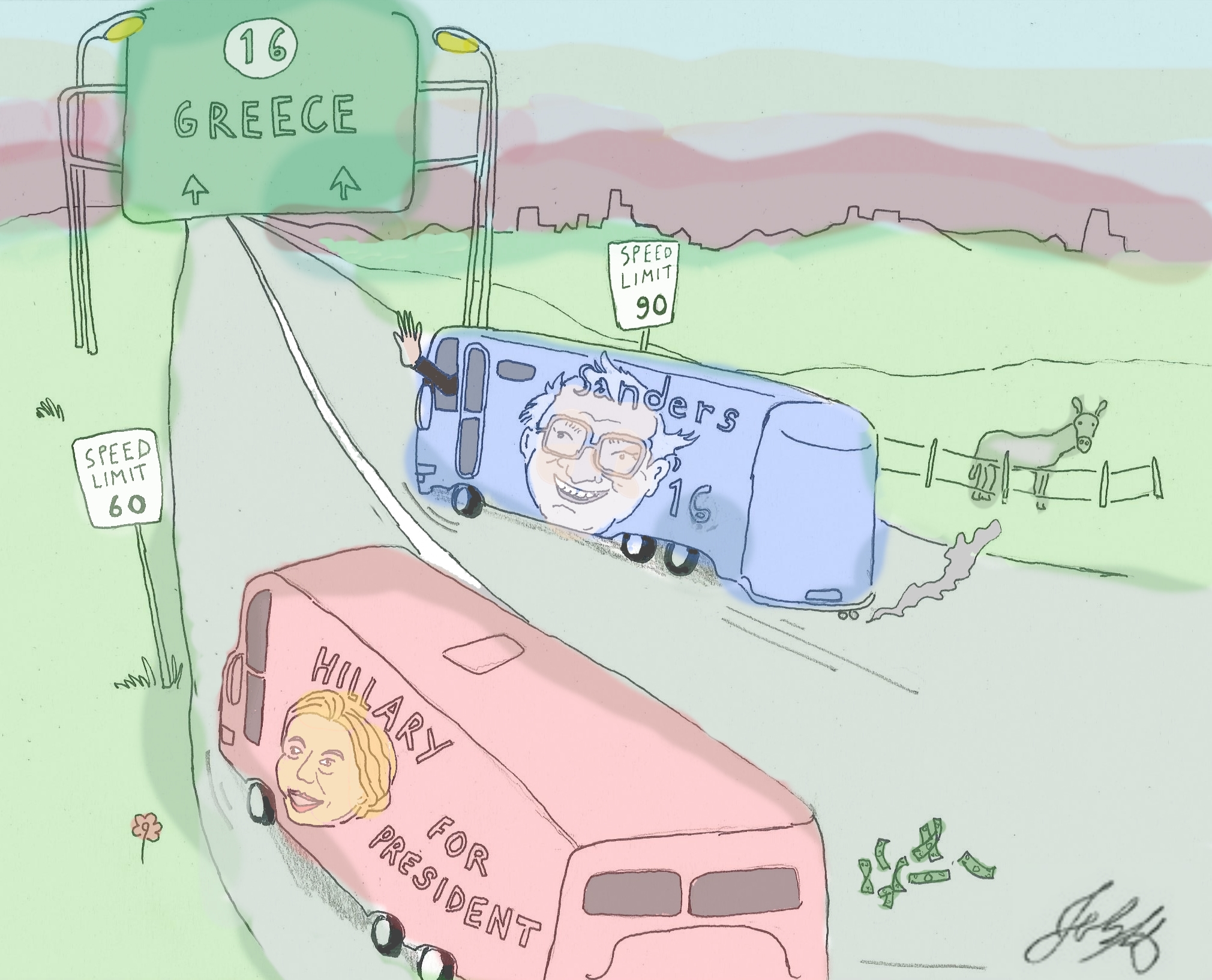 to the voting records of Hillary Clinton and Barack Obama (his vote rating also was similar to supposed moderate Joe Biden when he was a Senator).
But that doesn’t necessarily mean they think the same or have the same agenda. As the cartoon illustrates, Bernie wants to travel at a faster rate in the wrong direction.
And it’s quite likely that he wants to travel farther in the wrong direction. And he may even want to get to a very unpleasant destination.
You don’t have to believe me. You can simply listen to what Bernie Sanders has said, in this video narrated by Maxim Lott.
And if that’s…
View original post 1,466 more words
ALEXANDER HAMILTON: AMERICAN by Richard Brookhiser
22 Feb 2020 Leave a comment


Many of you are probably familiar with Ron Chernow’s biography of Alexander Hamilton which was the basis for Lin-Manuel Miranda’s musical “Hamilton.” The book is the ultimate source for the first Secretary of the Treasury, and it is a narrative that is hard to measure up to. However, there are a number of important biographies of Hamilton, one of which is Richard Brookhiser’s ALEXANDER HAMILTON: AMERICAN, a compact volume that covers all the important aspects of Hamilton’s life in a very analytical fashion that can serve as a wonderful introduction to its subject.
Brookhiser presents Hamilton as the nation’s accountant who was able to create the bureaucratic infrastructure that allowed the new republic to survive and fostered the basis of our current economy. Brookhiser identifies a number of threads that run through his narrative. First, despite his background as an immigrant throughout his life Hamilton saw himself as an…
View original post 783 more words


Recent Comments