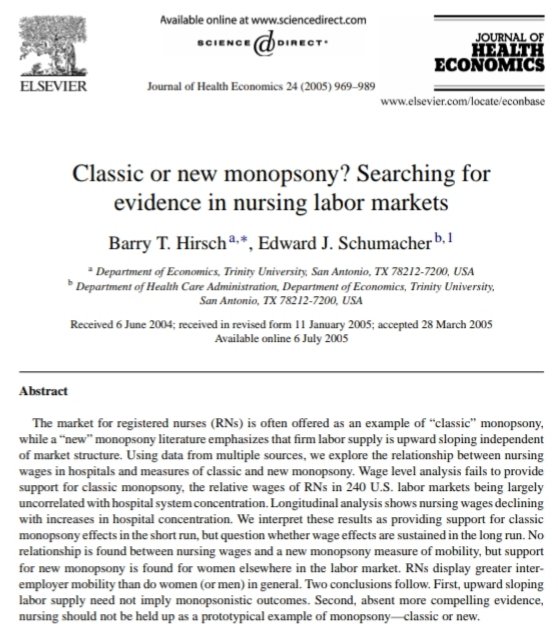
Monopsony is overblown
19 Jan 2020 Leave a comment
in applied price theory, econometerics, labour economics, labour supply Tags: inequality of bargaining power, monopsony
Young People Reject Socialism in the Classroom
19 Jan 2020 Leave a comment

Redistribution has a corrosive impact on both ends. Recipients are harmed because they get trapped in dependency, and workers are harmed because taxes discourage productive behavior.
Yet young people seem susceptible to this ideology, even when they are among the main victims.
While it might be tempting to shrug and assume they’re hopelessly clueless, this video shows young people are quite capable of grasping why redistribution is a bad idea.
I’ve previously shared a similar video, as well as a couple of written versions of this redistribution challenge.
In this case, though, we have some additional analysis.
Here are some excerpts from the accompanying article.
…for the first time ever, more young people say they’d prefer to live in a socialist country over a capitalist one. Whether it’s free healthcare, free college tuition, or universal basic income, students around America increasingly support higher…
View original post 400 more words
How Do We Rescue Young People from Socialism?
19 Jan 2020 Leave a comment
I started fretting about the socialist tendencies of young people early last decade.
And when Sanders attracted a lot of youth support in 2016, I gave the issue even more attention, and I’ve since continued to investigate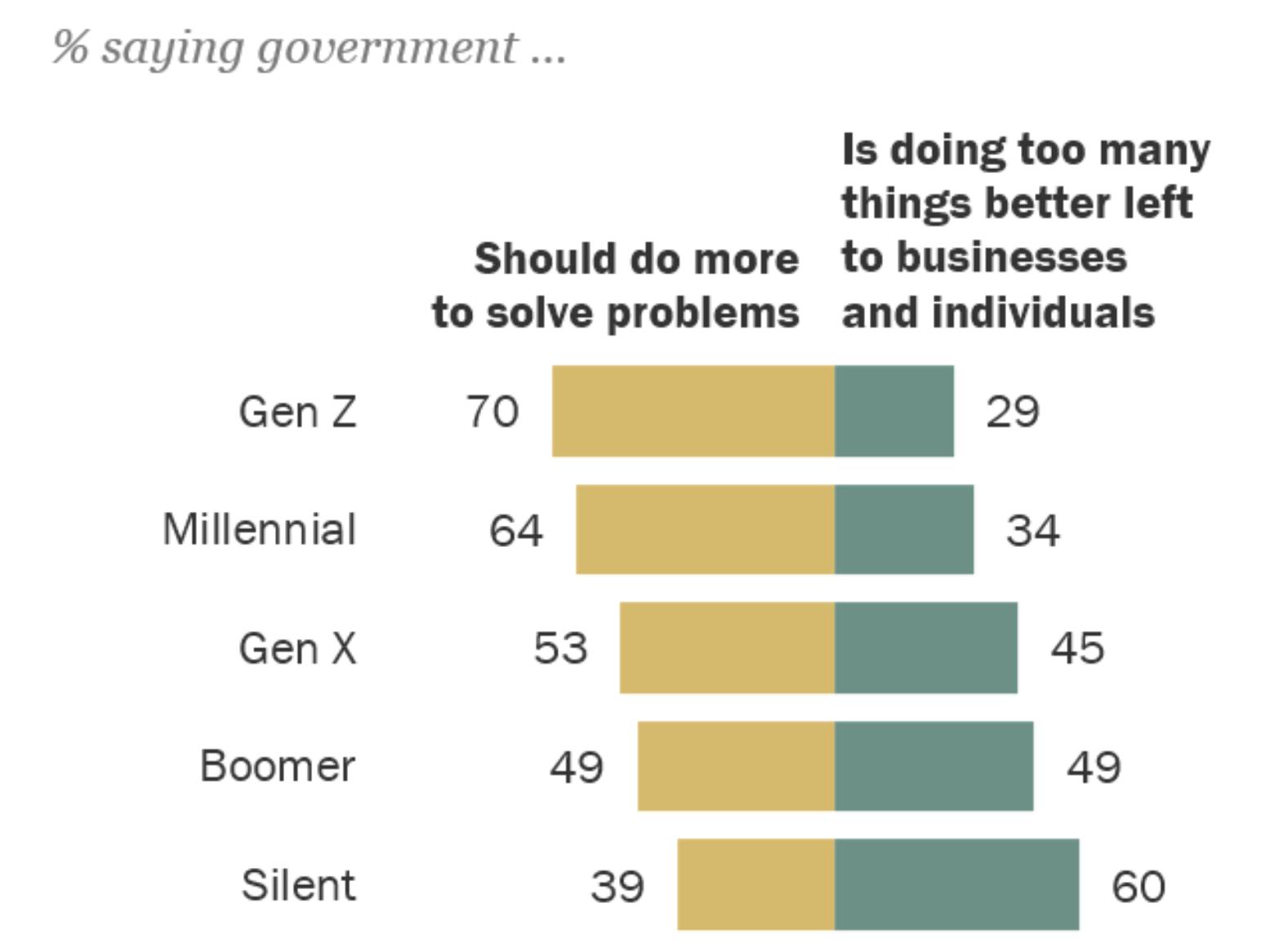 why so many young people are sympathetic to such a poisonous ideology with a lengthy track record of failure and deprivation.
Some of the recent polling data is very discouraging.
And if you want to be even more depressed, here are some tweets with the most-recent data about the the views of young people.
It’s not just that they have warm and fuzzy thoughts about so-called democratic socialism.
I’m completely horrified to learn that more than one-third of young people even have a positive perception of communism.
View original post 1,177 more words
January 18, 1871: Proclamation of the German Empire.
19 Jan 2020 Leave a comment

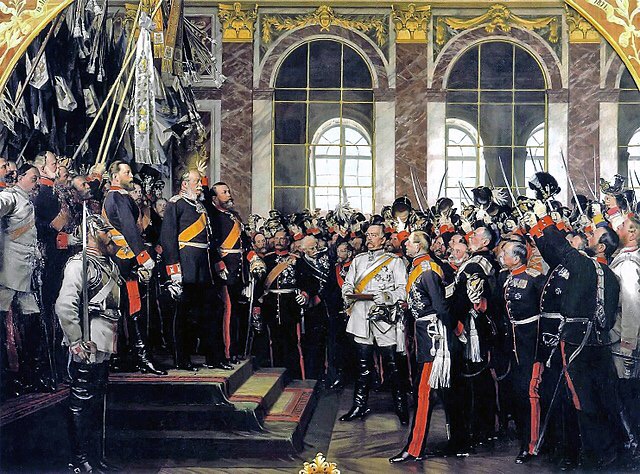
The future king and emperor was born Wilhelm Friedrich Ludwig of Prussia in the Kronprinzenpalais in Berlin on March 22, 1797. As the second son of Louise of Mecklenburg-Strelitz and King Friedrich Wilhelm III, himself son of King Friedrich Wilhelm II, Wilhelm was not expected to ascend to the throne. His grandfather died the year he was born, at age 53, in 1797, and his father Became the King of Prussia.
Ever since the Holy Roman Empire was dissolved in 1806 uniting the German lands into a modern Nation State, a new empire, was the goal of many statesman as well as the populace of the multi German states that had made up the Holy Roman Empire.
The first attempt to create the Second German Reich occurred in 1848. In the wake of the revolutions of 1848 that swept across Europe, where the people of the many autocratic monarchies demanded…
View original post 845 more words
Hoppit J. (1986) Financial crises in 18th-century England
18 Jan 2020 Leave a comment

Hoppit, Julian (1986) “Financial Crises in Eighteenth-Century England”, The Economic History Review, 39/1, 39-58.


Introduction
“Because the financial system in the 18th century was evolving and becoming more sophisticated, […] the nature of crises developed and changed”. Historians have long disagreed on the very definition of what constituted a crisis in early modern England (p.40). The author defines a crisis as a moment when expectations change leading owners of wealth to abandon a type of asset for another leading to the falls in prices of the former. The more widely available the newly-sought asset is, the lesser the crisis.
View original post 608 more words
Kid’s Climate Lawsuit Dismissed on Appeal
18 Jan 2020 Leave a comment
beyond the power of an Article III court to order, design, supervise, or implement the plaintiffs’ requested remedial plan where any effective plan would necessarily require a host of complex policy decisions entrusted to the wisdom and discretion of the executive and legislative branches.
The panel reluctantly concluded that the plaintiffs’ case must be made to the political branches or to the electorate at large.

 Juliana et al. Vs US Federal Government is Dismissed.
A federal appeals court on Friday threw out a lawsuit by children and young adults who claimed U.S. government climate policy put their future in jeopardy, a major blow to the high-profile case after a string of failed similar bids.
In a 2-1 decision, the 9th U.S. Circuit Court of Appeals said the plaintiffs, who were ages 8 to 19 when the lawsuit began, lacked legal standing to pursue their case, and that the issues they raised should be decided by other branches of the federal government.
The decision derails the potentially far-reaching case, one of more than half a dozen similar cases filed in state courts, from Washington to Alaska, by an Oregon-based youth advocacy non-profit called Our Children’s Trust.
The lawsuit had first been filed in an Oregon federal court in 2015, charging that the U.S. government’s environmental…
View original post 579 more words
The Media (and Presidential Candidates) Remain In Error On The Distinction Between Global Warming And Climate Change
18 Jan 2020 Leave a comment


There continues to be a lack of clarity as to the distinction between changes in the heat content of the climate system (global warming and cooling), and climate change, in the media and by the presidential candidates. There are erroneous views on the climate issue being presented.
As an example see the Washington Post article on August 19 2011 by Joel Achenbach and Juliet Eilperin titled
Climate-change science makes for hot politics
The article includes the text [highlight added]
“Four years ago in New Hampshire, campaigning for the Republican presidential nomination, John McCain said to voters, “I do agree with the majority of scientific opinion, that climate change is taking place and it’s a result of human activity, which generates greenhouse gases.” He made global warming a key element of every New Hampshire stump speech.
This week in New Hampshire, the governor of Texas and newest presidential contender, Rick Perry
View original post 1,139 more words
The Need For Precise Definitions In Climate Science – The Misuse Of The Terminology “Climate Change”
18 Jan 2020 Leave a comment
UPDATE JUNE 17 2012
My son had an insightful discussion on this subject in his post
The Narrow Defintion of Climate Change
where he refers to two of his papers
Pielke, Jr., R.A., 2005. Misdefining ‘‘climate change’’: consequences for science and action, Environmental Science & Policy, Vol. 8, pp. 548-561.
Pielke, Jr., R. A., 2004. What is Climate Change?, Issues in Science and Technology, Summer, 1-4.
*********ORIGINAL POST*************
The terminology in the field of climate and environmental science is filled with jargon words and the misuse of definitions. I have posted on this issue before with respect to the terms “global warming” and “climate change” in my posts
and
Recommended Definitions of “Global Warming” And “Climate Change”
To properly define these two terms…
View original post 937 more words
Second draft of Religious Discrimination Package released
18 Jan 2020 Leave a comment

The Commonwealth Government has released a second version of its draft legislation dealing with religious discrimination issues, for further comment before it is formally introduced into the Federal Parliament in the New Year. There are a number of important changes from the previous drafts which in my view make it a much better package of amendments. But there are areas for improvement.
View original post 4,421 more words
The Sixth Extinction: An Unnatural History by Elizabeth Kolbert (2014)
18 Jan 2020 Leave a comment

Back in the late 1980s and 1990s there was a fashion for popular science books, and I read as many as I could, becoming better informed about the three major subjects which dominated the lists – cosmology, paleontology with an emphasis on human origins, and environmental biology.
Among them were a number of books by E.O. Wilson, particularly the brilliant Diversity of Life (1992), which gives an unparalleled sense of the wonder and diversity of the natural world, and Richard Leakey’s book, The Sixth Extinction (1995). This latter is an often quite technical account of discoveries and debates in paleontology and environmental biology which, taken together, suggest that the rate at which humanity is killing off species of animals, plants, fish and other fauna amounts to a holocaust, a global extermination, which ranks with the other Big Five mass extinction events that have punctuated the 500-million year story of life…
View original post 3,650 more words
January 16, 1547 – Grand Duke Ivan IV of Muscovy becomes the first Czar of Russia.
17 Jan 2020 Leave a comment
January 16, 1547 – Grand Duke Ivan IV of Muscovy becomes the first Czar of Russia, replacing the 264-year-old Grand Duchy of Moscow with the Czardom of Russia.
Ivan IV Vasilyevich (August 25, 1530 – March 28, 1584), commonly known as Ivan the Terrible, or more accurately, “Ivan the Formidable” or “Ivan the Fearsome”, was the Grand Prince of Moscow from 1533 to 1547 and the first Czar of Russia from 1547 to 1584.
Ivan IV was the son of Vasili III Ivanovich Grand Prince of Moscow (1479 – 1533) and and his second wife, Elena Glinskaya, daughter of Prince Vasili Lvovich Glinsky from Grand Duchy of Lithuania and Serb Princess Ana Jakšić, member of the Jakšić family.

Ivan IV, Czar of all the Russia’s.
When Ivan was three years old, his father died from an abscess and inflammation on his leg that developed into blood poisoning. Ivan was proclaimed the Grand…
View original post 1,088 more words
Ross McKitrick 2014 on the hiatus and the Nordhaus damage estimates
16 Jan 2020 Leave a comment
in applied price theory, applied welfare economics, econometerics, energy economics, environmental economics, global warming, politics - Australia, politics - New Zealand, politics - USA, public economics Tags: carbon tax, climate alarmists


Recent Comments