
"Museums are nice, but not with people trapped inside them." Interview on Mexico and the Cultural Critique of Capitalism https://t.co/2jrEc23t11
— DeirdreMcCloskey.org (@PrudentiaMag) April 10, 2018
Celebrating humanity's flourishing through the spread of capitalism and the rule of law
04 Sep 2018 Leave a comment
in applied price theory, development economics, economic history, growth disasters, growth miracles Tags: Deirdre McCloskey, The Great Enrichment
04 Sep 2018 Leave a comment
It looks like a zero carbon economy is very much like the case for a universal basic income. The best way to talk yourself out of it is to simply read the material put out by its advocates.
In the case of universal basic income, a huge tax rise is required without making any one for whom the modern welfare state was designed to protect better off.
In the case of a zero carbon economy, the costs are enormous relative to any reasonable estimate of the costs of runaway climate change to New Zealand. Indeed the unreasonable and wild estimates are still less than the cost of a zero carbon economy.
Among those holding the reins of power – and their supporters – there appears to be an almost passionate commitment to a goal of eliminating (net) all greenhouse gas emissions by 2050. So passionate as, it seems, to care very little about the consequences for New Zealanders. And since some of the easiest and least costly (probably actually net beneficial) ways to make big inroads on New Zealand greenhouse gas emissions run head-on into other passionately-held ideological commitments, those options simply get ignored as well. None of this seems based on any robust analysis, either of the specific issues facing New Zealand, nor of the way in which the substantial costs of adjustment would be likely to fall most heavily on the poorest in our society. Some, who should know better, seem to want to pretend that a major coerced reorientation of our economy would actually be net beneficial (in…
View original post 2,547 more words
04 Sep 2018 Leave a comment
Again and again I hear people criticise women generally, and feminists in particular, for not accepting transwomen as “real” women and for “excluding” them. Trans people are oppressed, they say, and these so-called exclusionary behaviours and attitudes create the dogma behind this oppression just as racism is the dogma behind the oppression of Black people. It is misguided, they say, and dangerous and is called transphobia, which makes you, me, anyone who doesn’t agree with them, a bigot who deserves to go to hell with all fascists and racists.
But when feminists try to explain that of course they oppose all discrimination and violence against trans people, but there are issues that are complicated that we need to look at, discuss, understand, it seems that our accusers won’t listen. (Not that this is a surprise – not listening to women is, after all, a major characteristic of male…
View original post 9,419 more words
03 Sep 2018 Leave a comment
in applied price theory, Austrian economics, comparative institutional analysis, development economics, economic history, economics of bureaucracy, growth disasters, growth miracles, history of economic thought, industrial organisation, law and economics, Marxist economics, property rights, Public Choice, survivor principle Tags: fall of communism, kibbutzim
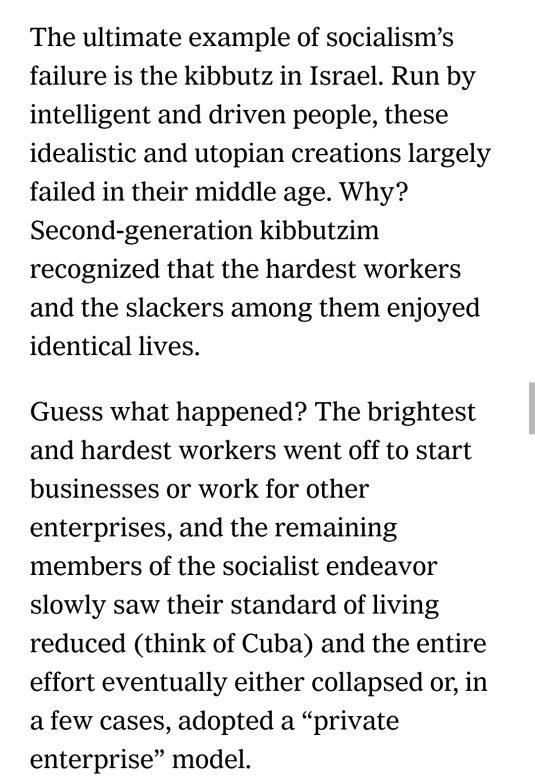
Would Socialism Better Our Lives? https://nyti.ms/2MFC2v8
03 Sep 2018 Leave a comment
On September 1st the BBC News website replaced its original report on the topic of the US administration’s decision to cut funding to UNRWA (discussed here) with an article titled “Palestinians brand US aid cut to UN group ‘a flagrant assault’“.
As may be expected given that choice of headline, 16.3% of the report’s word count was given over to criticism of the US decision from various Palestinian factions, including the PLO (together with a link) and the Hamas terror group. An additional 48 words were used to describe Palestinian denunciation of previous unrelated US Administration decisions. A further 13.7% of the report’s word count was devoted to amplification of statements from UNRWA’s spokesman Chris Gunness, meaning that in all, 30% of the article was devoted to informing BBC audiences of condemnations of the US move.
Readers were told that:
“The US has been the…
View original post 748 more words
03 Sep 2018 Leave a comment
A week or so ago, advertisements appeared in the major newspapers inviting applications from people wishing to be considered for appointment as external (non-executive) members of the Monetary Policy Committee. Should you wish to apply, the advert is here, with applications closing on Friday.
All of which is quite remarkable. The Monetary Policy Committee is to be created by legislation currently before Parliament, and not expected to be passed until the end of the year (the select committee isn’t due to report back until early December). The appointments are not expected to take effect until April next year. In fact, submissions on the Reserve Bank of New Zealand (Monetary Policy) Amendment Bill themselves also close on Friday. The select committee process is supposed to involve members looking carefully at the details of the legislation, considering public submissions, and recommending any refinements or amendments the committee considers appropriate. …
View original post 1,703 more words
03 Sep 2018 Leave a comment
British historian Andrew Roberts explains what the Cold War was all about. Oddly enough, even those who lived through it are apt to forget. The left really thought that communism might be a better system.
You still hear the echoes in Nancy Pelosi’s comments that tax cuts have nothing to do with growing an economy, but are simply gifts for the very wealthy who clearly don’t deserve it. (That’s what the Left wants the poor to believe) Since she is very wealthy, who knows what she really believes. Democrats want people to pay more taxes so they will have more money to give to the poor to buy their votes.
The idea that free people, able to keep more of their own money, can create, invent, expand their businesses, or act on their own ambitions, somehow is not as important as control by their betters.
It’s followed by a fireside…
View original post 4 more words
02 Sep 2018 Leave a comment
Earlier this month, a physician and molecular biologist named Henry Miller had an op-ed published in The Wall Street Journalpointing out the dubious claims and questionable science behind organic foods. Shortly after Dr. Miller’s commentary appeared, FDA Commissioner Scott Gottlieb expressed concern about information on organic food labels and the need to have more information put on them.
Consumers need to have full and factual information about products and services they shop for, including the food they consume. Overall, the idea behind organic foods sounds noble, but are they good for people and good for the natural environment overall? Bjorn Lomborg looks into this in the below video.
The dirty little secret about their substitute menu items is that they can be worse, and not better, for your health. It’s all about killing people off as fast as possible for the environmentalists, including lying about foods to include in…
View original post 2 more words
02 Sep 2018 Leave a comment
‘We are now launching into a wide and boundless field, puzzled with mazes and o’erspread with difficulties.’
George Washington, autumn 1779
At 680 larger-than-usual pages, this is a very long, very thorough and very heavy book.
I bought it under the misapprehension that it would explain the economic and political background to the American War of Independence, which was a mistake. Almost a Miracle is a highly detailed account of the arguments about military strategy conducted by both sides in the war, and of the actual battles fought during the war.
In this respect its focus on the nitty-gritty of military engagements large and small follows straight on from the couple of books I recently read about its immediate predecessor, the Seven Years War:
View original post 5,132 more words
02 Sep 2018 Leave a comment
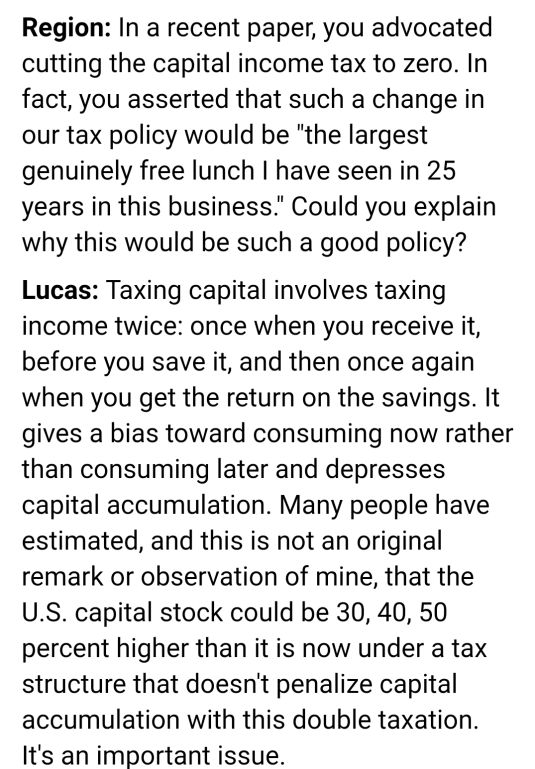
in applied price theory, economic growth, macroeconomics, public economics, Robert E. Lucas Tags: capital gains tax, taxation and investment
02 Sep 2018 Leave a comment
In New Zealand, Official Information Act requests have revealed that there are currently approximately thirty-three trans-identified males in New Zealand prisons in total. Eighteen are in for violent crimes, including sexual assault. Seven are in women’s prisons already. According to Corrections New Zealand, in 2017 alone, four assaults were reported against women by trans-identified persons in women’s prisons.
This is a collection of facts and statistics relating to gender identity, catered to a New Zealand audience.
View original post 1,662 more words
02 Sep 2018 Leave a comment
The old Turkey hands, of course, were aghast. But it is a good working rule, wherever you are, to ignore the old hands; their mentalities grow inwards like toenails. (p.191)
Strong sense of déjà vu about the story of Kim Philby, the greatest betrayer in British espionage history, because I’ve heard of the Cambridge spies all my life – attended the Alan Bennett play about Blunt, saw the TV play starring Alan Bates, read the sections of Graham Greene’s biography which describe GG working for him during the war – they’re as much a part of English 20th century folk lore as England winning the World Cup in 1966 or the Great Train Robbery.
And then, just in this volume, the outline of his story is told in the blurb on the back of the book, in a thorough summary on the inside page, then again in the introduction by…
View original post 2,779 more words
01 Sep 2018 Leave a comment
In America, we usually don’t talk much about the Middle Class — we just assume that most everyone is in it. Except for a surprising number of billionaires, there isn’t much difference between being middle class or being wealthy, and most people simply described themselves as being middle class without giving it much thought. Historically, 85 to 90 percent of Americans have self-identified as middle class. Sixty percent is more usual today.
Gallup surveys show that only about 2 percent of Americans self-identify as “Upper” class. And we have lots of articles about the “shrinking U.S. middle class”, from the media or politicians. They usually forget to mention that the middle class in America is shrinking because more people are getting wealthier. (Economics is not a strong point for the Left)
But reaching the middle class is not just a class designation. Nor is it a matter of money. A…
View original post 543 more words
31 Aug 2018 Leave a comment
Reader Jon sent a one-minute video of Serena Williams as a little girl (already great at tennis) and at the U.S. Open. John said “this is good for a commercial”, but it’s made by Nike and looks just like a commercial. Regardless, it’s really good. Jon’s take:
Caution: might make you tear up. This is good for a commercial. Nike used home movies of a 9-year-old Serena Williams with her father, Richard Williams, encouraging her and telling her to imagine she is at the US Open, with jump cuts of modern footage of the US Open. Toward the end she celebrates on court when she spots her father cheering in the stands. Her father was such a gentle, caring coach. To date, I think she’s won the US Open six times.
31 Aug 2018 Leave a comment
Losalini Rainima has just completed a nine-month stint in a NSW prison for driving without a valid licence. This surprising punishment is the result of her of her refusal to accept conditional bail or, following her lengthy remand in custody, a good behaviour bond, or, following her sentence, the conditions of parole. Her refusal in each case was, I assume, for the same reason as her refusal to accept NSW’s driving licence regime. As she told her magistrate:
God has given me a right that is given to me, it’s within me. … I have a right of passage. I have a right of movement. All living things are given graces; the birds fly, the fish swim, the kangaroo hops, and I’ve been given the graces to drive.
She speaks, of course, of a right that Victorians have under the Charter, albeit given to them not by God but by…
View original post 1,050 more words
Celebrating humanity's flourishing through the spread of capitalism and the rule of law
Celebrating humanity's flourishing through the spread of capitalism and the rule of law
Celebrating humanity's flourishing through the spread of capitalism and the rule of law
Celebrating humanity's flourishing through the spread of capitalism and the rule of law
Celebrating humanity's flourishing through the spread of capitalism and the rule of law
Celebrating humanity's flourishing through the spread of capitalism and the rule of law
Celebrating humanity's flourishing through the spread of capitalism and the rule of law
Celebrating humanity's flourishing through the spread of capitalism and the rule of law
A History of the Alt-Right
Econ Prof at George Mason University, Economic Historian, Québécois
Celebrating humanity's flourishing through the spread of capitalism and the rule of law
Scholarly commentary on law, economics, and more
Beatrice Cherrier's blog
Celebrating humanity's flourishing through the spread of capitalism and the rule of law
Celebrating humanity's flourishing through the spread of capitalism and the rule of law
Celebrating humanity's flourishing through the spread of capitalism and the rule of law
Why Evolution is True is a blog written by Jerry Coyne, centered on evolution and biology but also dealing with diverse topics like politics, culture, and cats.
Celebrating humanity's flourishing through the spread of capitalism and the rule of law
A rural perspective with a blue tint by Ele Ludemann
DPF's Kiwiblog - Fomenting Happy Mischief since 2003
Celebrating humanity's flourishing through the spread of capitalism and the rule of law
The world's most viewed site on global warming and climate change
Tim Harding's writings on rationality, informal logic and skepticism
A window into Doc Freiberger's library
Let's examine hard decisions!
Commentary on monetary policy in the spirit of R. G. Hawtrey
Thoughts on public policy and the media
Celebrating humanity's flourishing through the spread of capitalism and the rule of law
Politics and the economy
A blog (primarily) on Canadian and Commonwealth political history and institutions
Reading between the lines, and underneath the hype.
Economics, and such stuff as dreams are made on
"The British constitution has always been puzzling, and always will be." --Queen Elizabeth II
Celebrating humanity's flourishing through the spread of capitalism and the rule of law
Celebrating humanity's flourishing through the spread of capitalism and the rule of law
WORLD WAR II, MUSIC, HISTORY, HOLOCAUST
Undisciplined scholar, recovering academic
Celebrating humanity's flourishing through the spread of capitalism and the rule of law
Res ipsa loquitur - The thing itself speaks
In Hume’s spirit, I will attempt to serve as an ambassador from my world of economics, and help in “finding topics of conversation fit for the entertainment of rational creatures.”
Researching the House of Commons, 1832-1868
Articles and research from the History of Parliament Trust
Reflections on books and art
Posts on the History of Law, Crime, and Justice
Celebrating humanity's flourishing through the spread of capitalism and the rule of law
Exploring the Monarchs of Europe


Recent Comments