
David Friedman – Hidden Order (Booknotes on C-SPAN)
22 Jun 2018 Leave a comment
in applied price theory, David Friedman, law and economics
The “New” Monopsony Argument and the Suppression of Wages
21 Jun 2018 Leave a comment

A recent issue of The Economisthad an article on monopsony and the “non-compete“ agreements that some lower-paid fast-food chain workers have had to sign as a condition of employment. On the whole, The Economist doesn’t like this because it supposedly holds down wages. The Economist is not alone in thinking this. Even noted economists Jason Furman and Alan Krueger have said in The Wall Street Journal: “There is no reason why employers would require fast-food workers and retail salespeople to sign a noncompete clause—other than to restrict competition and weaken worker bargaining power.” What Furman and Krueger are thinking is that these employees have no “trade secrets” to reveal to other firms.
Does this make sense?
The fast-food low wage case has little to do with trade secrets. In this situation the usual argument in favor of such agreements turns on the provision of general human capital. When…
View original post 502 more words
Why the Greenies may be browned off with their party of principle
21 Jun 2018 Leave a comment

When Labour went into coalition with NZ First, it seemed astute on the part of the Greens to back it on confidence and supply in exchange for ministerial positions. The Greens believed they would be able to achieve several of their major policy goals, without suffering the fate of other small parties suffocated in the embrace of a major party in the process of governing the country.
So how is it looking less than nine months into the term? The assessment is far from favourable: the Greens have scored enough own-goals to dismay even onetime champions like Sue Bradford.
Any government starts losing votes from the day it takes office. For the Greens, as polls show, leakage of support has been on a scale which could threaten the party’s survival at the next election.
View original post 481 more words
How did BBC News report the latest Gaza missile attacks?
21 Jun 2018 1 Comment

Visitors to the BBC News website’s main homepage, its ‘World’ page or its ‘Middle East’ page on the morning of June 20th were all informed that the people who had fired forty-five military grade projectiles at Israeli civilian communities in the space of some five hours during the previous night are ‘militants’ rather than terrorists.
 In typical ‘last-first’ style, the headline to the BBC News website’s report on that story read “Israeli jets strike Gaza after rocket and mortar fire” and the euphemism ‘militants’ was seen again.
“Israeli jets have hit militant positions in Gaza after Palestinians fired rockets and mortars into Israeli territory, the Israeli military said.
The military said 25 targets linked to the militant Hamas movement were hit, in response to a barrage of about 45 rockets and mortar shells.”
Quoting “Gaza’s health ministry” without informing readers that it is run by the same…
View original post 562 more words
Putting a price on the hair shirt
21 Jun 2018 Leave a comment
“the 10 per cent sacrifice (a deliberately chosen act) of annual GDP estimated by NZIER seems to be very much at the low end of the plausible range”

A couple of weeks ago I wrote about the government’s consultative document on its proposal to target net-zero emissions by 2050, and particularly the commissioned modelling NZIER had undertaken on the likely consequences of each of several options for future real GDP. As the consultative document itself put it
The analysis by NZIER suggests that GDP will continue to grow but will be in the range of 10 per cent to 22 per cent less in 2050, compared with taking no further action on climate change.
Those are breathtakingly large numbers (future GDP gains) for a government to simply propose walking away from. As one comparison, high end estimates of the GDP gains from preferential trade agreements (such as CPTPP or the proposed new one with the EU) tend to be about 1 per cent each.
A couple of days ago NZIER’s final report itself was released, making it…
View original post 2,859 more words
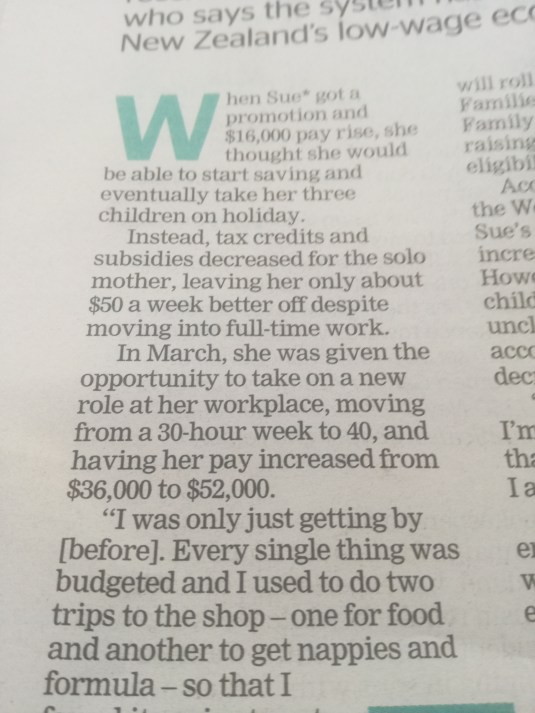
Poverty traps explained
21 Jun 2018 Leave a comment
in applied price theory, labour economics, labour supply, politics - New Zealand, public economics, welfare reform Tags: family poverty, poverty traps
History: Churchill’s Darkest Decision
20 Jun 2018 Leave a comment

Documentary on Churchill’s decision to shell the French Fleet in Oran
Impact of global warming now: a slight net benefit; by 2100, likely 2-3% GDP cost (3-3.7°C)
20 Jun 2018 Leave a comment
in applied price theory, applied welfare economics, energy economics, environmental economics, global warming Tags: climate alarmism
Arkansas Man Arrested After Giving Waitress Her Own Stolen Credit Card To Pay For Meal
20 Jun 2018 Leave a comment

 Shamon West, 21, may want to look a bit more closely at the stolen ids of his victims. West stole the purse of Flora Lunsford from her car while she was getting gas. Two days later, he gave the card back to Lunsford after claiming to be her to pay for his meal. She called the police instead.
View original post 60 more words
A ‘BBC Minute’ backgrounder misleads on Palestinian refugees
20 Jun 2018 Leave a comment
Yesterday we saw how a backgrounder on Jerusalem produced by the BBC World Service’s ‘BBC Minute’ misled its target audience of “young people” with regard to the 1949 armistice lines.
Last month BBC Minute produced two more of the items that it portrays as “making sense of the news” – this time relating to the Gaza Strip. In those two items – still available online – once again a BBC Arabic journalist misled audiences with inaccurate information and presented context-free portrayals.
The first item is titled “BBC Minute: On Gaza clashes” and was published on May 16th.
“Gaza witnessed what’s described as the deadliest day of violence since 2014. Some 58 Palestinians were killed and Palestinian officials say around 2,700 were wounded during clashes with Israeli troops. It comes amid weeks of rising tension. We hear from the BBC’s Nida Ibrahim, who is in Gaza.”
BBC…
View original post 802 more words
Before foreigners pass the buck, new investment law will require a quality check
19 Jun 2018 Leave a comment
The bill stopping foreigners from buying houses in NZ has emerged from select committee study with significant amendments. Associate Finance Minister David Parker says the new law will ensure the market for homes is a “NZ market not an international one”. He contends Kiwis should not be outbid by “wealthier foreign buyers”.
But the same bill now includes a move to encourage “foreign direct investment” in forestry. Forestry Minister Shane Jones says the legislation – by bringing forestry rights into the overseas investment regime – will help promote high-quality foreign investment which puts more emphasis on genuine benefits for New Zealanders.
So – foreign money for NZ homes is dirty but foreign money for NZ trees is clean?
View original post 532 more words
War over country names: Like Greece and Macedonia now, India and Pakistan had a (brief) naming dispute in 1947..
19 Jun 2018 Leave a comment

No Way Back From RE Disaster: Energy Minister Abandons Australia’s Power Consumers
19 Jun 2018 Leave a comment


What passes for political leadership in this country is engaged in a wind and solar-fuelled economic suicide mission. Subsidies to grid wrecking wind and solar (when soft loans, green schemes and taxpayer handouts are added) are pushing $5 billion a year, punishing households and businesses alike.
As wind and solar power capacity increases, power prices are rocketing out of control and major energy users are being chopped from the grid whenever the sun sets – killing solar – and sudden bursts of calm weather cause precipitous wind power output collapses.
And yet, Australia’s Energy Minister, Josh Frydenberg continues to act as if nothing’s wrong. Gormless doesn’t cover it.
Exasperation and desperation are giving way to anger and fury. As Alan Moran details below.
Energy policy, price escalation and the destruction of industry competitiveness
Catallaxy Files
Alan Moran
8 June 2018
For some in Australia, the renewable rich UK electricity market…
View original post 734 more words


Recent Comments