Capitalism in Utopia Jason Brennan
08 Jun 2018 Leave a comment
in applied price theory, applied welfare economics, comparative institutional analysis, constitutional political economy Tags: capitalism and freedom, moral psychology
Justice as Fairness by John Rawls — A Summary
07 Jun 2018 Leave a comment

Rawls, John. 1958. “Justice as Fairness.” The Philosophical Review 67 (2). [Duke University Press, Philosophical Review]: 164–94.
http://www.jstor.org/stable/2182612.
Section I claims that the fundamental idea for the concept of justice is fairness.
Section II introduces the two principles of this conception.
Section III explains how these two principles are arrived at.
Section IV pre-empts possible criticisms against justice as fairness as developed in Sections II and III.
Section V sketches why fairness should be central to any concept of justice.
Section VI characterises the utilitarian conception of justice as one concerned with efficacy.
Section VII discusses why such utilitarianism fails as a conception of justice.
I
The fundamental idea in the concept of justice is fairness. The paper will try to justify this claim. It is this aspect of justice (as fairness) that classical utilitarianism fails to account for.
Three things should be kept in mind. First, justice is…
View original post 2,659 more words
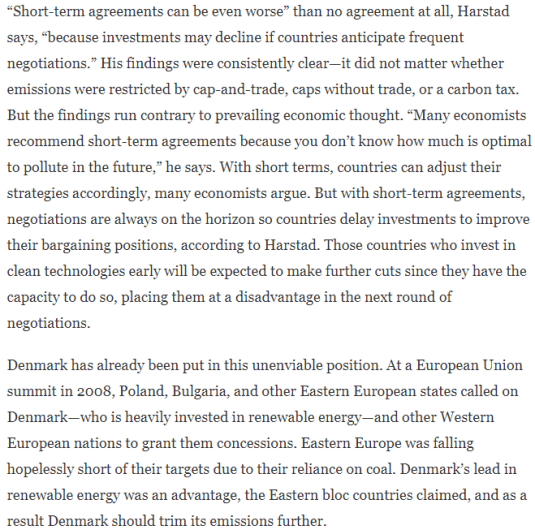
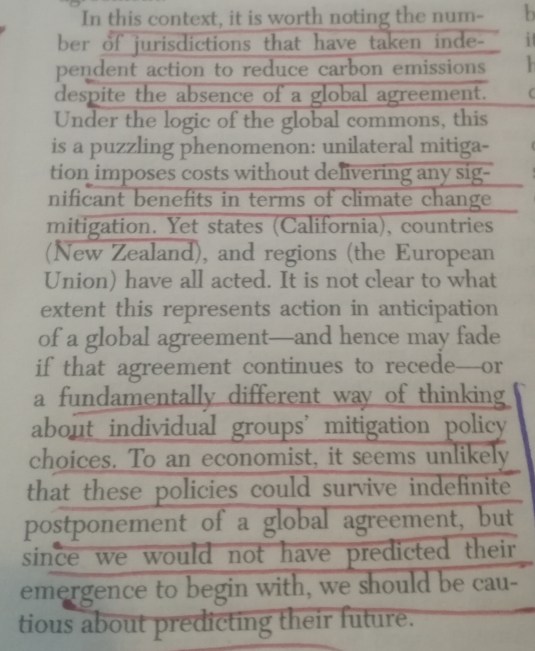
#ZeroCarbonBill sets us up to be screwed at future multilateral climate talks #ourclimateyoursay
07 Jun 2018 Leave a comment
in applied price theory, environmental economics, global warming, politics - New Zealand, Public Choice
Trump Can Indeed Pardon Himself . . . And We Should Now Never Speak Of This Again
07 Jun 2018 Leave a comment

 Below is my column in USA Today on the assertion of President Donald Trump that he can pardon himself. Since such an act would be the most profoundly disgraceful moment in the history of the American presidency, it is chilling to have a president to even engage in such a public debate. However, I believe that such a power does exist in the Constitution. It is a long and unresolved debate that turns on how you interpret silence. Since the Constitution is silent on any bar against a president benefitting from this power, I believe that a self-pardon is indeed constitutional, even if distasteful.
View original post 990 more words
Why did @jamespeshaw put Suzi Kerr on his climate committee after letting this cat out of the bag in her JEL 2015 survey?
07 Jun 2018 Leave a comment
in applied price theory, applied welfare economics, economics of regulation, energy economics, environmental economics, global warming, law and economics, politics - New Zealand, Public Choice Tags: carbon tax, expressive politics, game theory, international public goods
Trade wars, explained
07 Jun 2018 Leave a comment
in applied price theory, applied welfare economics, industrial organisation, international economic law, labour economics, politics - USA, Public Choice, rentseeking, unemployment Tags: protectionism, strategic trade theory
Funemployment
06 Jun 2018 Leave a comment

When a great thinker like Scott Alexander designates the strongest argument for a policy you oppose, you should certainly pay attention:
This strikes me as the strongest argument for the minimum wage and other job-killing labor regulations: that they are turning otherwise-miserably-employed people into unemployed welfare recipients.
It’s rare, and refreshing, to read arguments for the minimum wage that acknowledge even the potential for disemployment effects, let alone acknowledge them as a feature rather than a bug. The problem with Alexander’s analysis is that, ceterus parabus, we would expect the minimum wage to disemploy workers in less miserable jobs.
Imagine an economy with two jobs for low skilled workers: elevator attendant and fry cook. Let’s assume for simplicity that demand for fry cooks and elevator attendants is roughly equal. However, since fry cooks have to slave over a hot grill rather than in an air-conditioned elevator, the supply of fry…
View original post 202 more words

A Conversation with Gary Becker: The Future of US Economic Policy
06 Jun 2018 Leave a comment
in applied price theory, applied welfare economics, comparative institutional analysis, development economics, economic history, economics of regulation, environmental economics, Gary Becker, industrial organisation, labour economics, law and economics, politics - USA
Graziella Romeo: It Was a Dark and Stormy Night: The Italian Institutional Crisis and Europe
06 Jun 2018 Leave a comment

 There is no shortage of stories on Italian institutional crises originated in the context of a parliamentary system with multi-party inclinations and a misfit electoral law. And Italy is not even an isolated case of hard processes of formation of government after troubled elections: the cases of the Netherlands and Belgium may be easily recalled. But this crisis was a particularly dark and stormy night. The role played by President Sergio Mattarella in vetoing the appointment of an Eurosceptic finance minister has left many commentators bewildered, including both those more inclined to recognise the presidential power to influence political decisions and those less willing to support a government of parties with a clear populist rhetoric.
The bewilderment is justified by the absence of precedents, but the President’s conduct corresponds to his constitutional powers. In terms of political convenience and in light of recent developments, Mr. Mattarella’s choice was wise, even…
View original post 1,396 more words
History: BBC – The Great War – E07/26 – We Await The Heavenly Manna
06 Jun 2018 Leave a comment
The Great War is a 26-episode documentary series from 1964 on the First World War. The documentary was a co-production of the Imperial War Museum, the British Broadcasting Corporation, the Canadian Broadcasting Corporation and the Australian Broadcasting Commission. The narrator was Michael Redgrave, with readings by Marius Goring, Ralph Richardson, Cyril Luckham, Sebastian Shaw and Emlyn Williams. Each episode is c.40 minutes long.
In August 1963, at the suggestion of Alasdair Milne, producer of the BBC’s current affairs programme Tonight, the BBC resolved to mark the fiftieth anniversary of the outbreak of the First World War with a big television project. The series was the first to feature veterans, many of them still relatively fit men in their late sixties or early seventies, speaking of their experiences after a public appeal for veterans was published in…
View original post 492 more words
Thomas Schelling and Dr. Strangelove
05 Jun 2018 Leave a comment

An interview with Thomas Schelling and his role in the creation of one of my favorite movies, “Dr. Strangelove”. HKS reports,
Kubrick travelled to Cambridge to meet with Schelling and George. The three spent an afternoon wrestling with a considerable plot hole: when “Red Alert” was written in 1958, inter-continental ballistic missiles were not much of a consideration in a potential U.S.-Soviet showdown. But by 1962, ICBMs had made much of the book’s plot points impossible. The speed at which a missile strike could occur would offer no time for the plot to unfold. “We had a hard time getting a war started,” said Schelling.
Hence, the B52s?


Recent Comments