The 2023 Version of America’s Dismal Fiscal Future

Dan Mitchell's avatarInternational Liberty

The Congressional Budget Office has released its new Long-Term Budget Outlook and I will continue a now-annual tradition (see 2018, 2019, 2020, 2021, 2022) of sharing some very bad news about America’s fiscal future.

Here’s the most important chart. It shows two unfortunate developments. First, we see that the tax burden is gradually increasing as a share of economic output. Second, we see that the burden of federal spending is increasing even faster.
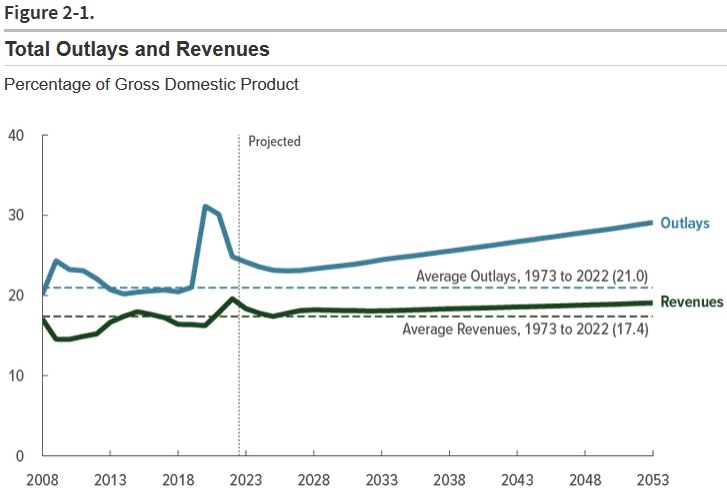
What happens when spending grows even faster than revenue?

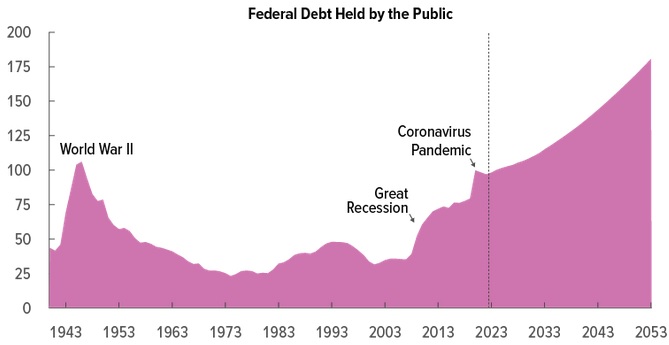
We get more government debt. Or, to be more precise, this next chart shows that we get a lot more debt.

Indeed, the debt is going to reach unprecedented levels over the next 30 years.
I normally don’t fret that much about red ink. After all, deficits and debt are largely symptoms of a much bigger problem, which is excessive government spending.

That…

View original post 471 more words

Image

June 28, 1914: Assassination of Archduke Franz Ferdinand of Austria-Este. Part I

liamfoley63's avatarEuropean Royal History

From the Emperor’s Desk: I was going to post this yesterday but I needed a day off. Today, tomorrow and Saturday I will post on the life of Archduke Franz Ferdinand of Austria-Este and the outbreak of World War I.

Archduke Franz Ferdinand of Austria-Este (December 18, 1863 – June 28, 1914) was the heir presumptive to the throne of Austria-Hungary.

Early life

Archduke Franz Ferdinand of Austria-Este was born in Graz, Austria, the eldest son of Archduke Charles Ludwig of Austria (the younger brother of Emperor Franz Joseph of Austria-Hungary and Emperor Maximilian of Mexico) and of his second wife, Princess Maria Annunciata of Bourbon-Two Sicilies, a daughter of King Ferdinand II of the Two Sicilies and his wife, Archduchess Maria Theresa of Austria, eldest daughter of Archduke Charles of Austria-Hungary, Duke of Teschen (the third son of Holy Roman Emperor Leopold II) and Princess Henrietta of Nassau-Weilburg.

View original post 449 more words

The First Accession Council

Ben Coates's avatarThe History of Parliament

In modern Britain, the death of a monarch has little political impact; the work of government continues uninterrupted, apart from a period of official mourning. But four centuries ago, when the king or queen actually ran the government, the situation was more complicated, as Dr Ben Coates of our Lords 1558-1603 section explains…

When the succession of Charles III to the throne was formally proclaimed on 10 September 2022, it marked the first appearance on television of an accession council. This body dates back to 24 March 1603, when a meeting of the lord mayor of London, assorted English peers and bishops, and those commoners who had served as privy councillors to the recently deceased monarch, Elizabeth I, proclaimed the accession of James VI of Scotland as James I of England. Forty-four years earlier Elizabeth had issued the proclamation of her accession in her own name, but a new procedure…

View original post 1,051 more words

Death by Regulation

Dan Mitchell's avatarInternational Liberty

As Frederic Bastiat sagely observed nearly 200 years ago, a good economist considers the indirect or secondary effects of any action.

For instance, a politician might claim we can double tax revenue by doubling tax rates, but a sensible economist will warn that higher tax rates will discourage work, saving, investment, and entrepreneurship.

And those changes in behavior (along with increases in evasion and avoidance) will result in less economic activity, which means lower taxable income. So tax revenues will not double. In some cases, they might even fall.

This analysis also applies to regulatory policy.

In an article for the Competitive Enterprise Institute, James Broughel explains how red tape actually causes needless death because of less economic growth.

Regulations can contribute to an increased death toll by imposing costs that eat into disposable income. As spending power dwindles, so too does the potential for spending on risk management…

View original post 266 more words

The $10bn amendment

Michael Reddell's avatarcroaking cassandra

Late yesterday afternoon the Minister of Finance issued a new Remit to the Reserve Bank Monetary Policy Committee (his statement is here, the new Remit itself is here). The Minister’s statement tends to minimise the entire thing (and nothing really about the inflation target changes), but – no doubt consciously and deliberately – gives not a mention to the most material addition to the Remit.

The lead-in to the more-specific targets section of the Remit is now as follows:

This was the backdrop to the additional words I’ve highlighted

$10 billion of so of losses of taxpayers’ money as a result of Reserve Bank MPC choices around the LSAP programme, choices that had the imprimatur of the Minister of Finance (and apparently no objection from the Treasury). As the bonds are being sold back to The Treasury, the realised component of the losses is mounting significantly each month…

View original post 467 more words

June 26, 1483: Richard III becomes King of England and Lord of Ireland

liamfoley63's avatarEuropean Royal History

Richard III (October 2, 1452 – August 22, 1485) was King of England and Lord of Ireland from June 26, 1483 until his death in 1485. He was the last king of the Plantagenet dynasty and its cadet branch the House of York. His defeat and death at the Battle of Bosworth Field, the last decisive battle of the Wars of the Roses, marked the end of the Middle Ages in England.

Early life

Richard was born on October 2, 1452, at Fotheringhay Castle in Northamptonshire, the eleventh of the twelve children of Richard, 3rd Duke of York, and Cecily Neville, and the youngest to survive infancy. His childhood coincided with the beginning of what has traditionally been labelled the ‘Wars of the Roses’, a period of political instability and periodic open civil war in England during the second half of the fifteenth century, between the Yorkists, who supported Richard’s…

View original post 469 more words

Image

June 26, 1830: Death of King George IV of the United Kingdom of Great Britain and Ireland, King of Hanover

liamfoley63's avatarEuropean Royal History

George IV (August 12, 1762 – June 26, 1830) was King of the United Kingdom of Great Britain and Ireland and King of Hanover from January 29, 1820 until his death in 1830. At the time of his accession to the throne, he was acting as prince regent for his father, George III, having done so since February 5, 1811 during his father’s final mental illness.

George was born at St James’s Palace, London, on August 12, 1762, the first child of King George III and Charlotte of Mecklenburg-Strelitz, the youngest daughter of Duke Charles Ludwig Friedrich of Mecklenburg, Prince of Mirow (1708–1752), and his wife Princess Elisabeth Albertine of Saxe-Hildburghausen (1713–1761). Mecklenburg-Strelitz was a small north-German duchy in the Holy Roman Empire.

As the eldest son of a British sovereign, he automatically became Duke of Cornwall and Duke of Rothesay at birth; he was created Prince of Wales and…

View original post 1,337 more words

Image

Record Renewables Growth Fails To Cut Global Fossil Fuel Share of 82%

oldbrew's avatarTallbloke's Talkshop


Fossil fuels are consistent at 82% of the global energy cake, so to speak, but the cake is getting bigger. Someone wails that ‘overall global energy-related greenhouse gas emissions increased again’ as the so-called Paris climate agreement fades further into irrelevance. Time to stop clinging to pipedreams and admit realities.
– – –
Record increases in solar and wind installations in 2022 failed to cut into the massive 82% share of fossil fuels in global energy consumption, says OilPrice.com, amid turbulent energy markets and energy security concerns, the annual Statistical Review of World Energy showed on Monday.

Moreover, despite the record growth of global solar and wind capacity additions last year, emissions rose again, to a new record high, and further put the world off track to the Paris Agreement targets, said the report, published by the Energy Institute (EI) and partners KPMG and Kearney, which earlier this year…

View original post 59 more words

The Papacy: The Renaissance (1447-1492)

Great Books Guy's avatarGreat Books Guy

Tradition holds that Martin V was the first Renaissance pope, but it was his successor, Eugenius IV (or “Eugene”), who actually brought the flower of the Renaissance to Rome. After spending nine months with the Medici in Florence, he returned to Rome and began serious efforts to bring the city back from its medieval decay. He sought to emulate the magnificence of northern cities like Milan, Genoa, and Venice.

John Julius Norwich offers the following reflections on this exciting epoch, the dawn of the Renaissance:  

“Artistically and culturally, however, Rome was still something of a backwater when Cardinal Tommaso Parentucelli, the son of a modest physician in Liguria, was elected pontiff in March 1447, taking the name of Nicholas V. Of the previous 140 years the popes had been absent for well over half, and thanks to the consequent chaos the flowering of classical and humanistic learning that had…

View original post 2,907 more words

MEAT NEEDS TO BE KILLED.

Gravedodger's avatarNo Minister

It was so when humans lived in caves and remains true today.

It must be killed to eat it, It needs to be killed before it kills the hunter, it sometimes needs to be killed as a humane act, some killing can be a defensive act, most rural children learn lessons at a young age, although there will be protein on sale sometime that was never a living animal it remains a fact every bit of flesh on sale to eat was very likely once a living thing, ironically that is a fact of life.

A south sufffolk female sheep was reared by the Dodger Children in the seventies as a lamb, she failed to conceive as a hogget, again as a 2 tooth, and finally as a 4tooth at three years of age it could be accepted infertile was highly probable, A family group conference was initiated and quickly…

View original post 1,023 more words

While people focus on the election radical change is happening without voter awareness

Peter Winsley's avatarPeter Winsley

It is election year. Political parties are building candidate visibility – they are testing each other in the House before they clash on the hustings – they are refining existing policy and announcing new manifesto commitments.

Democracy requires free, fair and regular elections based on one person, one vote, and all votes are of equal value. It requires freedom of speech, open Government, a critical media, and the rule of law. It assumes human universality and therefore equal citizenship rights. It requires a secular Parliament and other Government institutions.

That is the way democracy is supposed to work in New Zealand. However, the reality is that radical change is now occurring with little scrutiny, and much electioneering is just a side show.

One change driver is the belief that centralization and Government control will give better outcomes than market workings, subsidiarity, individual initiative and local democracy. However, the major driver…

View original post 1,247 more words

June 24, 1540 King Henry VIII of England commands, Anne of Cleves, to leave the court.

liamfoley63's avatarEuropean Royal History

Having considered the matter of finding a new wife for King Henry VIII, his chief minister, Thomas Cromwell suggested Anne of Cleves.

Anne was born in 1515, on either September 22, or more probably June 28. She was born in Düsseldorf, the second daughter of Johann III of the House of La Marck, Duke of Jülich jure uxoris, Cleves, Berg jure uxoris, Count of Mark, also known as de la Marck and Ravensberg jure uxoris (often referred to as Duke of Cleves) who died in 1538, and his wife Maria, Duchess of Jülich-Berg (1491–1543). Anne grew up in Schloss Burg on the edge of Solingen.

In 1527, at the age of 11, Anne was betrothed to François, the 9-year-old son and heir of Antoine, Duke of Lorraine. But because François was under the age of consent (10 years old) at the time of the arrangement, the betrothal was…

View original post 1,001 more words

A Comprehensive Critique Of Net Zero Fantasies

Coal-Fired Power Saves Day: Wind & Solar Output Collapses During Hot, Calm Weather

stopthesethings's avatarSTOP THESE THINGS

Goldilocks-thinking is the basis for the wind and solar transition, which relies on power sources that can only operate when conditions are “just right”.

When the weather turns nasty, giant industrial wind turbines simply turn off. When there’s no wind, they produce nothing; when winds hit gale force, they produce nothing.

Solar panels aren’t any more resilient.

A few fluffy clouds give them grief.

Hailstones make short work of them; a blanket of snow and ice cuts their production to nothing, even when the sun is shining.

A hurricane or tornado soon tears them to worthless shreds.

As the wind and sun cult would have it, however, the answer is always more wind and solar capacity, not less.

Their central and founding myth is that solar panels and wind turbines are gradually, inevitably replacing conventional generators, especially coal-fired power plants.

Meanwhile, back on Earth, the weather is…

View original post 580 more words

June 24, 1509: Coronation of King Henry VIII of England, Lord of Ireland and Infanta Catherine of Aragon.

liamfoley63's avatarEuropean Royal History

King Henry VII of England, Lord of Ireland died on April 21, 1509, and the 17-year-old Henry succeeded him as King Henry VIII of England, Lord of Ireland. Soon after his father’s burial on May 10, Henry suddenly declared that he would indeed marry Catherine of Aragon. Technically at this time she was the Dowager Princess of Wales as the widow of Henry’s brother, Prince Arthur, Prince of Wales.

Catherine of Aragon daughter of Queen Isabella I of Castile and King Fernando II of Aragon, Catherine was three years old when she was betrothed to Prince Arthur, heir apparent to the English throne. They married in 1501, but Arthur died five months later. Catherine spent years in limbo, and during this time, she held the position of ambassador of the Aragonese crown to England in 1507, the first known female ambassador in European history.

Henry’s desire to marry Catherine which…

View original post 284 more words

Previous Older Entries Next Newer Entries

Bassett, Brash & Hide

Celebrating humanity's flourishing through the spread of capitalism and the rule of law

Truth on the Market

Scholarly commentary on law, economics, and more

The Undercover Historian

Beatrice Cherrier's blog

Matua Kahurangi

Celebrating humanity's flourishing through the spread of capitalism and the rule of law

Temple of Sociology

Celebrating humanity's flourishing through the spread of capitalism and the rule of law

Velvet Glove, Iron Fist

Celebrating humanity's flourishing through the spread of capitalism and the rule of law

Why Evolution Is True

Why Evolution is True is a blog written by Jerry Coyne, centered on evolution and biology but also dealing with diverse topics like politics, culture, and cats.

Down to Earth Kiwi

Celebrating humanity's flourishing through the spread of capitalism and the rule of law

NoTricksZone

Celebrating humanity's flourishing through the spread of capitalism and the rule of law

Homepaddock

A rural perspective with a blue tint by Ele Ludemann

Kiwiblog

DPF's Kiwiblog - Fomenting Happy Mischief since 2003

The Dangerous Economist

Celebrating humanity's flourishing through the spread of capitalism and the rule of law

Watts Up With That?

The world's most viewed site on global warming and climate change

The Logical Place

Tim Harding's writings on rationality, informal logic and skepticism

Doc's Books

A window into Doc Freiberger's library

The Risk-Monger

Let's examine hard decisions!

Uneasy Money

Commentary on monetary policy in the spirit of R. G. Hawtrey

Barrie Saunders

Thoughts on public policy and the media

Liberty Scott

Celebrating humanity's flourishing through the spread of capitalism and the rule of law

Point of Order

Politics and the economy

James Bowden's Blog

A blog (primarily) on Canadian and Commonwealth political history and institutions

Science Matters

Reading between the lines, and underneath the hype.

Peter Winsley

Economics, and such stuff as dreams are made on

A Venerable Puzzle

"The British constitution has always been puzzling, and always will be." --Queen Elizabeth II

The Antiplanner

Celebrating humanity's flourishing through the spread of capitalism and the rule of law

Bet On It

Celebrating humanity's flourishing through the spread of capitalism and the rule of law

History of Sorts

WORLD WAR II, MUSIC, HISTORY, HOLOCAUST

Roger Pielke Jr.

Undisciplined scholar, recovering academic

Offsetting Behaviour

Celebrating humanity's flourishing through the spread of capitalism and the rule of law

JONATHAN TURLEY

Res ipsa loquitur - The thing itself speaks

Conversable Economist

In Hume’s spirit, I will attempt to serve as an ambassador from my world of economics, and help in “finding topics of conversation fit for the entertainment of rational creatures.”

The Victorian Commons

Researching the House of Commons, 1832-1868

The History of Parliament

Articles and research from the History of Parliament Trust

Books & Boots

Reflections on books and art

Legal History Miscellany

Posts on the History of Law, Crime, and Justice

Sex, Drugs and Economics

Celebrating humanity's flourishing through the spread of capitalism and the rule of law

European Royal History

Exploring the Monarchs of Europe

Tallbloke's Talkshop

Cutting edge science you can dice with

Marginal REVOLUTION

Small Steps Toward A Much Better World

NOT A LOT OF PEOPLE KNOW THAT

“We do not believe any group of men adequate enough or wise enough to operate without scrutiny or without criticism. We know that the only way to avoid error is to detect it, that the only way to detect it is to be free to inquire. We know that in secrecy error undetected will flourish and subvert”. - J Robert Oppenheimer.

STOP THESE THINGS

The truth about the great wind power fraud - we're not here to debate the wind industry, we're here to destroy it.

Lindsay Mitchell

Celebrating humanity's flourishing through the spread of capitalism and the rule of law

Alt-M

Celebrating humanity's flourishing through the spread of capitalism and the rule of law

croaking cassandra

Economics, public policy, monetary policy, financial regulation, with a New Zealand perspective

The Grumpy Economist

Celebrating humanity's flourishing through the spread of capitalism and the rule of law

International Liberty

Restraining Government in America and Around the World