Democracy and Political Ignorance: Why Smaller Government Is Smarter
11 Jun 2016 Leave a comment
in applied price theory, applied welfare economics, comparative institutional analysis, constitutional political economy, economics, economics of information, income redistribution, Public Choice, public economics, rentseeking Tags: rational ignorance, rational irrationality, voter demographics
Desperately seeking to agree with @JulieAnneGenter on transport investment quality
11 Jun 2016 Leave a comment
in applied price theory, applied welfare economics, economics of bureaucracy, environmental economics, politics - New Zealand, Public Choice, transport economics, urban economics Tags: cost benefit analysis, KiwiRail, New Zealand Green Party, road pricing
I just wrote an op-ed for National Business Review online (pay-walled) agreeing with an op-ed last week by Green MP Julie Anne Genter on transport investment. My op-ed started
The Taxpayers’ Union welcomes the commitment of the Green Party yesterday to evaluating transport investments without any bias or favouritism to one transport mode over another.
The Taxpayers’ Union could not agree more with Julie Anne Genter when she said that the question ministers should always ask is “what is the best investment we can make?”
This op-ed was my rejoinder to her reply to my op-ed criticising a recent Green Party on national freight policy. That policy called for 25% of all freight by kilometres travelled to each go by rail and road. That would near double their freight market share from 30% currently to 50% when measured by kilometre.
For my troubles I got nothing but criticism and accusations in the comments section in National Business Review Online. A tweet by Genter was far more gracious.
There was no praise in the comment section at the National Business Review online for agreeing with the Green policy. In the first comment I was told I did not understand economics and that
When the policy default is “cut taxes and spending and let me selfishly keep my money” they miss out on the much larger benefit to everyone, including themselves, by nudging or economy to spend more on intrinsically more efficient transport – like rail – and less on alternatives.
No thanks at all for agreeing that transport investments should be the best we can make. After saying that in their recent freight policy, the Greens set targets were specific transport technologies they favour, which are rail and sea freight.

You cannot argue that transport investments should be the best we can make then declare a preference for a particular technology or mode of transport. But let us not quibble over that glaring contradiction.

The broader principle was agreed which is transport investments should be driven by cost benefit analysis and value for money. It should be technology neutral and transport mode neutral. That, of course, means the Greens cannot declare targets for the market shares of particular modes of freight shipment if they want to follow their own policy about value for money.
Most things are getting cheaper
11 Jun 2016 Leave a comment
in applied welfare economics, economic history Tags: living standards, pessimism bias
Why Capitalism is Better than Socialism
09 Jun 2016 Leave a comment
in applied price theory, applied welfare economics, comparative institutional analysis, constitutional political economy, development economics, economic history, history of economic thought, Marxist economics Tags: capitalism and freedom
@eigoodwin forgot @cjsbishop’s private members’ bill on organ donation
09 Jun 2016 Leave a comment
in applied price theory, applied welfare economics, health economics, politics - New Zealand
The Otago Daily Times health reporter wrote today that
…individualist new-right” attitude that holds sway in New Zealand is holding back organ donation rates, a University of Otago biomedical ethics authority says
Eileen Goodwin contacted Eric Crampton at the New Zealand Initiative for comment. She did not mention, much less contact a National Party backbencher who has a private members’ bill before the house to promote organ donation.
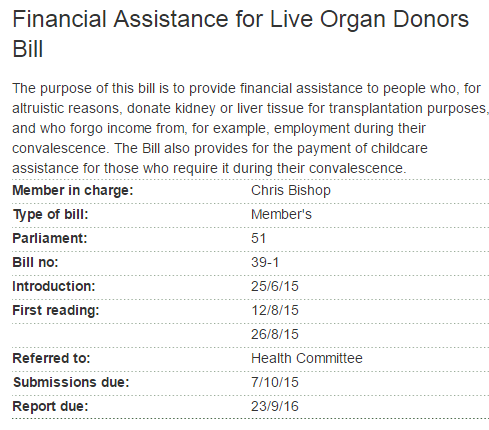
Source: New Zealand Parliament – Financial Assistance for Live Organ Donors Bill.
Chris Bishop’s bill passed its first reading and is now before a select committee for public hearings. Michael Woodhouse, MP first put the bill in the ballot.
This private members bill ensures that live organ donors are not out of pocket. The financial cost of time out the workforce to recover from a live organ donation is sufficient to prevent some from doing so. As Chris Bishop said in his first reading speech
I think it is wrong that at the moment live organ donors are essentially penalised for their altruism, facing a large loss of income even though their actions save lives and contribute to a healthier New Zealand.
Moreover, the current system in many ways actually favours the wealthy. If you have a relative who can afford to take time off work and make the financial sacrifice is entailed in donating an organ to you, and they are a match, then you have a good shot of getting that organ.
But if you have someone who is a match but cannot afford to take time off work to donate an organ to you, then you are obviously in a less advantageous position.
It is bizarre that people cannot donate organs because they cannot afford the time off work to recover and still pay the mortgage or rent. They currently receive a sickness benefit of $206 per week. The private members bill will ensure they receive 80% of their previous income for 12 weeks.
Organ donation is a repugnant market. Live organ markets are illegal because most people are just repelled by the very idea of such trading as The Economist explains
In most countries it is illegal to buy or sell a kidney. If you need a transplant you join a waiting list until a matching organ becomes available.
This drives economists nuts. Why not allow willing donors to sell spare kidneys and let patients (or the government, acting on their behalf) bid for them? The waiting list would disappear overnight.
The reason is that most societies find the concept of mixing kidneys and cash repugnant. People often exclude financial considerations from their most important decisions, from the person they marry to the foster child they adopt.
Al Roth has written an excellent survey article on repugnant markets in the Journal of Economic Perspectives where he said.
Because healthy people have two kidneys and can remain healthy with only one, kidneys from living donors are now widely used for kidney transplantation, the preferred treatment for end-stage renal disease.
The laws against buying or selling kidneys reflect a reasonably widespread repugnance, and this repugnance may make it difficult for arguments that focus only on the gains from trade to make headway in changing these laws.
Requiring people to opt-out rather than opt-in, as suggested by the medical ethics professor that the Otago Daily Times interviewed, is an antagonistic move that many will oppose.
Prof Gillett supports a shift to an opt-off organ donation system that would involve families in the decision-making process.
He said the political ideology of the Ministry of Health and the Government hindered efforts to foster a different view of organ donation.
“The ministry’s got quite an individualist new-right sort of agenda.
“I think it’s shared by the Government at large; I think that’s the reason why we are encouraged to tolerate the inequalities [in society].”
“It’s fundamental to neoliberalism that every individual should be able to be accountable for their own stuff, wrapped up in their own life, and not have dues to others.”
Organ donation should be seen as a normal way to contribute to society, Prof Gillett believed.
“An opt-off system is consistent with the solidarity view of human beings.”
Requiring people to opt out rather than opt in wastes political energy on a losing proposal when far simpler reforms are yet to be done. Piecemeal social reform in the tradition of Karl Popper is better. We should first do simpler things like making sure that people do not donate organs to a relative because they cannot afford to do so.
When I heard of Chris Bishop’s private members bill, it is one of those social reforms you wonder why it was not done years ago. The notion of someone not been able to donate an organ to a relative to save their life because of financial constraints is far more repugnant than an organ market. Their financial constraint is the need to pay the rent and buy the groceries while off work recovering from the live organ donation. As Roth says
One often-noted regularity is that some transactions that are not repugnant as gifts and in-kind exchanges become repugnant when money is added…
Many people clearly regard monetary compensation for organ donation as something that transforms a good deed into a bad one.
While a repugnance against an organ market is a common preference, I cannot see anyone opposing making sure that live organ donors are not out of pocket because of their tremendous generosity. There is no slippery slope you despite some people’s concerns as Roth explains
Concern that monetizing some transactions might lead to other changes seems to lurk beneath the more explicit concerns. Some critics fear a commercial dystopia in which kidney sales would enter into contracts: for example, as collateral, or as payment for other medical services, or to repay debts, or as means tests for eligibility for social services and financial aid. Such scenarios have found their way into fiction and movies
Repugnance is a real constraint on the emergence of markets. The issue of making sure the people are not out of pocket for live organ donations is separate from the repugnance against commercial transactions over human organs.
I have made a complaint to the editor of the Otago Daily Times about sloppy journalism and sloppy editing. If I am not satisfied with their response, I will take the matter to the Press Council. Yes, I have a bee in my bonnet.
Fossil fuels and The Great Escape
09 Jun 2016 Leave a comment
in applied welfare economics, development economics, economic history, energy economics, environmental economics, global warming, growth miracles, Public Choice, rentseeking Tags: China, energy poverty, extreme poverty, India, The Great Enrichment, The Great Escape
#feelthebern will raise your taxes
09 Jun 2016 Leave a comment
in applied price theory, applied welfare economics, economics, entrepreneurship, health economics, labour economics, minimum wage, politics - USA, public economics Tags: 2016 presidential election, antimarket bias, expressive voting, living wage, Old Left, pessimism bias, rational irrationality
#FeeltheBern? There’s a Cure.
09 Jun 2016 Leave a comment
in applied price theory, applied welfare economics, comparative institutional analysis, economic history, economics of education, economics of regulation, health economics, income redistribution, industrial organisation, international economics, politics - USA, Public Choice, public economics, rentseeking Tags: 2016 presidential election, antimarket bias, crony capitalism, living wage, pessimism bias, top 1%
Thomas Sowell talk in Jacksonville, FL (1993)
06 Jun 2016 Leave a comment
in applied price theory, applied welfare economics, comparative institutional analysis, constitutional political economy, economic history, economics of media and culture, economics of regulation Tags: Thomas Sowell
#MiltonFriedman v. @berniesanders
05 Jun 2016 Leave a comment
in applied price theory, applied welfare economics, comparative institutional analysis, constitutional political economy, development economics, economic history, economics, economics of regulation, entrepreneurship, growth disasters, growth miracles, income redistribution, industrial organisation, labour economics, macroeconomics, Milton Friedman, minimum wage, occupational choice, politics - USA, Public Choice, public economics Tags: 2016 presidential election, Leftover Left
Deirdre McCloskey on the importance of paying attention to what happened under the jackboot of neoliberalism
05 Jun 2016 Leave a comment
in applied price theory, applied welfare economics, development economics, economic history, economics of regulation, income redistribution, liberalism, Marxist economics
Yes, the World is Getting Better. Here’s Why.
05 Jun 2016 Leave a comment
in applied welfare economics, development economics, economic growth, economic history Tags: pessimism bias, The Great Enrichment
3 common myths about capitalism
05 Jun 2016 Leave a comment
in applied price theory, applied welfare economics, development economics, economic history, growth disasters, growth miracles, industrial organisation Tags: capitalism and freedom, The Great Fact

 Utopia, you are standing in it!
Recent Comments