Entrepreneurship and the Market Process with Israel Kirzner
18 Apr 2014 Leave a comment
in applied welfare economics, Austrian economics, entrepreneurship, industrial organisation, market efficiency
The Austrian Approach to Competition Israel M. Kirzner
14 Apr 2014 Leave a comment
in Austrian economics, industrial organisation, regulation
What Have We Learned from the Collapse of Communism? by Peter Boettke
13 Apr 2014 Leave a comment
in Austrian economics, constitutional political economy, development economics, entrepreneurship, law and economics, liberalism, Public Choice Tags: collapse of communism
the collapse of Communism has taught political economists several things:
first, that economic policy is always nested within a set of institutions—that there are economic/financial, political/legal, and social/cultural issues, which all must be taken into account;
second, that leadership matters throughout the transition process;
and third, that historical contingency can either work in your favour or cut against the successful transition.
And I would add a fourth one: that political power corrupts even the most informed and idealistic of individuals, such that you cannot count on ideological alignment to win the day. You have instead a small window of opportunity in which ideological alignment can be utilized to establish institutions that make it difficult for even bad men to do much harm.
In other words, the goal of our political/legal institutions should not be to ensure that the best and the brightest can govern, but instead that if the worst get in power, they can do little damage. This is the idea of a “robust political economy”.
Hayek’s spotty record as a prophet in The Road to Serfdom – Part 1
10 Apr 2014 Leave a comment
in Austrian economics, constitutional political economy, F.A. Hayek, liberalism, politics Tags: Hayek, Road to Serfdom, Tullock
Gordon Tullock used Sweden to support his argument that the basic problem with The Road to Serfdom was:
“that it offered predictions which turned out to be false. The steady advance of government in places such as Sweden did not lead to any loss of non-economic freedoms.”
Hayek discusses the Road to Serfdom
When looking back longingly at the mixed economies of 1950s and 1960s, people often forget who won elections much of the time back then.
The period that managed to combine a large degree of state ownership and control of the UK economy with a free and diverse media and political pluralism was often under Tory rule (1951 to 1964) with the Labor governments (1964-1970) often with a margin of a few seats.
Then there was the Menzies era in Australia with Liberal party rule from 1949 to 1972; and then 1975 to 1983. Much the same in New Zealand. The Left rarely held power in the mid-20th century.
The Christian democrats usually ran both Italy and Germany in coalitions, as I recall, up until the late 1960 or the early 1970s. Gaullist France? The LDP in Japan?
That is where Hayek got it wrong. The left-wing parties were not the face of the future.
Power rotated in Schumpeterian sense. Governments were voted out when they disappointed voters with the replacement not necessarily having very different policies.
The right-wing parties won many western European elections by that well-proven old trick of being slightly to the right of the left-wing parties. Hayek failed to predict this.
Hayek was himself a major critic of detailed predictions:
“We can build up beautiful theories which would explain everything, if we could fit into the blanks of the formulae the specific information; but we never have all the specific information.
Therefore, all we can explain is what I like to call “pattern prediction.”
You can predict what sort of pattern will form itself, but the specific manifestation of it depends on the number of specific data, which you can never completely ascertain. Therefore, in that intermediate field — intermediate between the fields where you can ascertain all the data and the fields where you can substitute probabilities for the data–you are very limited in your predictive capacities.”
“Our capacity of prediction in a scientific sense is very seriously limited. We must put up with this.
We can only understand the principle on which things operate, but these explanations of the principle, as I sometimes call them, do not enable us to make specific predictions on what will happen tomorrow.”
Hayek’s warnings in The Road to Serfdom was against a background where democracy was still young and insecure in Europe and peacetime democratic governments were, up until then, not much bigger than a post office and a military. The big governments of his day were not democratic.
As Popper and Kuhn understood it, bold, risky hypotheses are at the heart of great advances in the sciences and scholarship generally.
Why are there so few workers’ co-ops?
19 Mar 2014 6 Comments
in Austrian economics, industrial organisation, labour economics, managerial economics, organisational economics, theory of the firm Tags: adverse selection, cooperative ownership, Jon Elster, kibbutzim, moral hazard, Ran Abramitzky, Robert Nozick, worker ownership
If workers’ cooperatives are so efficient, why are there so few cooperatives? Workers’ cooperatives should be able to slowly undercut other firms on price because they do not have to pay a profit to the capitalists.
Building societies, credit unions and some life insurance companies were mutually owned by their customers for a long time, but recently fell out of favour because of a growing lack of competitiveness and under-capitalisation.
Cooperatives are not economically viable because of intrinsic difficulties of entrepreneurship and management. And most workers prefer to work in firms for a wage rather than wait for the co-op to start up and hopefully break even before they get their first pay cheque. That could be a slow train coming.
The kibbutzim are Israeli agricultural communities initially organized on socialist lines, mostly between the 1910s and 1950s. The kibbutz is an example of voluntary socialism. The founders of kibbutzim were socialist idealists wanting to create a new human being.
Robert Nozick pointed out that few people actually join a kibbutz. Six per cent is the maximum proportion of any population who would voluntarily choose to live in these socialist communities. More recently, 2.6% of the Israeli population live on a kibbutz.
Originally, most kibbutzim followed strict socialist policies forbidding private property; they also required near-total equality of income regardless of differences in productivity, and in some cases, even abandoned the specialisation of labour. Kibbutzim are communities whose aim is equal sharing.
Kibbutzim were expected to fail because of moral hazard and adverse selection. Other organisations subject to adverse selection and moral hazard are professional partnerships, co-operatives, and labour-managed firms because they are all based on revenue sharing.
Kibbutzim have persisted for most of the twentieth century and are one of the largest communal movements in history. About 40% are still run on communist principles. Why is this so?
The kibbutz movement was founded by individuals who can be regarded as ex-ante homogeneous in their ability and potential income, and who came to a new land full of uncertainties. They were young unattached individuals who share a comparatively long period of social, ideological, and vocational training.
An even more durable example of voluntary collectivist living is Catholic monasteries and convents, but notice that these too were founded on a realization that close family ties are inimical to communal order.
Kibbutz founders wanted insurance, but their founders realised that members who would turn out to have high abilities might leave the Kibbutz.
- The founders of the kibbutzim decided to abolish all private property and to own all wealth commonly, which served as a lock-in device.
- Like monasteries and convents, kibbutzim deter members from fleeing through this communal ownership of property. You leave with the shirt on your back!
Kibbutzim also put prospective members through lengthy trial periods to make sure they are made of the right stuff. Those raised on a kibbutz tend to have learned kibbutz-specific skills, such as agronomy, which also makes exit to the outside world even more difficult.
Kibbutzim are similar to law firms, medical and business partnerships that pool income for risk sharing purposes.
Mutual monitoring and peer pressure replace direct monetary incentives in mitigating moral hazard in a kibbutz (and in monasteries and convents) in the same way as in professional partnerships, cooperatives, and labour-managed firms with pooled assets and the option of exit.
The trade-off between insurance and adverse selection determines the level of equality within a kibbutz and its size, as with any other professional partnership:
- Kibbutz vary in size from less than a hundred to over a thousand, but most have between 400 and 600 members, with an average of 441 members.
- Kibbutz size is limited by the savings on income insurance no longer offsetting the costs of moral hazard and other transaction costs as the Coasian firm grows in size.
Ran Abramitzky writes with great insight on the economics of the kibbutzim. He is writing a book The Mystery of the Kibbutz: How Socialism Succeeded. He found that high-ability individuals are more likely to leave a kibbutz. The brain drain would be worse if kibbutzim didn’t make it so costly to exit. Is this a familiar theme of socialism?
Many hybrid organisations exist in the market, ranging from joint ventures and agricultural seller and supermarket buyer co-ops to labour-owned firms such as in most of the professions.
But rarely do we find real life existing cooperatives with all workers and only workers having equal ownership rights. As Jon Elster noted, there are often non-working owners, non-owning workers and unequal distribution of shares in real life workers’ co-ops. All other types of co-ops and professional partnership share this feature.
An Austrian school economist visits Tacloban
12 Mar 2014 Leave a comment
in Austrian economics, development economics, economics of natural disasters, liberalism Tags: capitalism, development economics, economics of natural disasters, Liberalism, Philippines, Tacloban
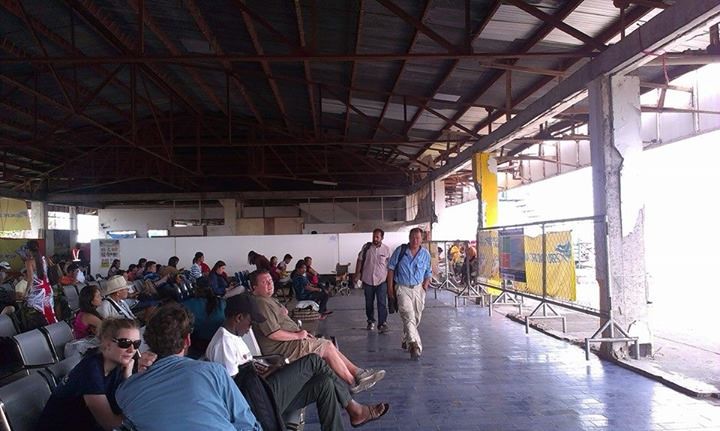
When we landed at Tacloban airport just before New Year’s Day, the devastation from Typhoon Haiyan (Yolanda to the locals) was everywhere. Most of the walls of the airport were missing but the supporting beams survived and there was a make-shift roof. We drove for an hour before the damage was no more than lost roofs.
At the airport, there were no barriers between the departure area and the tarmac.
A little known use of those lost walls was stopping the jet engines blasting into the waiting lounge. No photo because I was too busy running.
The Tacloban airport is named after an uncle of Imelda Marcos. The city mayor is her nephew; you may have seen him on CNN. Other relatives of Imelda on the island of Leyte have been congressmen, provincial governors or town mayors in a dynasty that rotates between offices because of term limits.
The café next to the airport where I had breakfast when I was last in Tacloban in January 2012 was washed away, sadly along with its owner.
I remember reading the local newspapers in that café in January 2012. A feature story was about the private armies employed by local politicians. These private armies could be 40 strong. Cronyism and a lack of a rule of law could explain why Leyte is among the poorest islands in the Philippines.
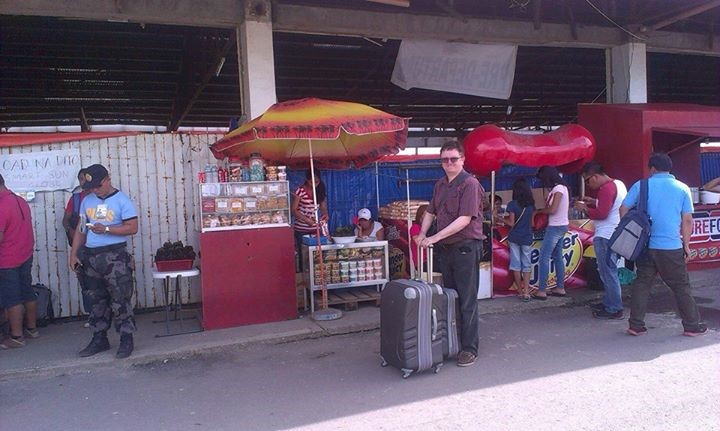
All the surrounding restaurants were wiped out. But the food vendors are back at the airport – the entrepreneurial spirit is very resilient! Tacloban airport was one of the few places where I could get diet coke in all of Leyte.
The only upside of the typhoon was Imelda’s large sea-side walled compound was washed away. There is a god: a vengeful god!?
We dropped in on a friend on the way to my parents-in-law. He had lost power. He said that straight after the typhoon, entrepreneurs were going door to door selling bottled water.
By the time we had arrived, everyone on the island of Leyte had received five-weekly rations of five kilos of rice and other essentials from the town hall. My mother-in-law had no need for this ration so she gave it to less well-off neighbours. Her town was not damaged much at all by the typhoon. They are on the other side of the mountain from Tacloban.
My in-laws living on an island further north of Leyte lost their roof and a wall. Terrifying.
Local merchants must find it hard to rebuild their businesses when everyone is getting food for free from the town hall many weeks after the disaster. This includes areas that suffered little damage.
The consular travel warning for all of Leyte was very ‘high risk’ – one below ‘avoid all travel’. Advised to be self-sufficient and be on guard for bandits, etc.
The owners of a very nice 5-room chalet at the other end of Leyte where my sister-in-law and her family stayed were most unimpressed by the over-inclusive consular travel warnings.There were many cancellations so their business was just ticking over rather than in a profit. Little wonder that the girl behind the makeshift car rental desk in the arrivals lounge at Tacloban airport did not seem to get much business when we arrived.
 Utopia, you are standing in it!
Recent Comments