
via 10 facts about technology use in the emerging world | Pew Research Center.
Celebrating humanity's flourishing through the spread of capitalism and the rule of law
18 May 2015 Leave a comment
in development economics, economics of media and culture, growth disasters, growth miracles Tags: cellphones, creative destruction, technology diffusion
18 May 2015 Leave a comment
in development economics, growth disasters, growth miracles Tags: Africa, Google
Google Autocomplete results by African country when you type in “Why is [name of country] so…?” http://t.co/MwCZLJEa8M—
Dr.iDaywa (@iDaywa) February 06, 2014
17 May 2015 Leave a comment
in development economics, economic growth, economic history, growth disasters, growth miracles, macroeconomics Tags: Australia, British economy, convergence, lost decades, Maddison database, New Zealand
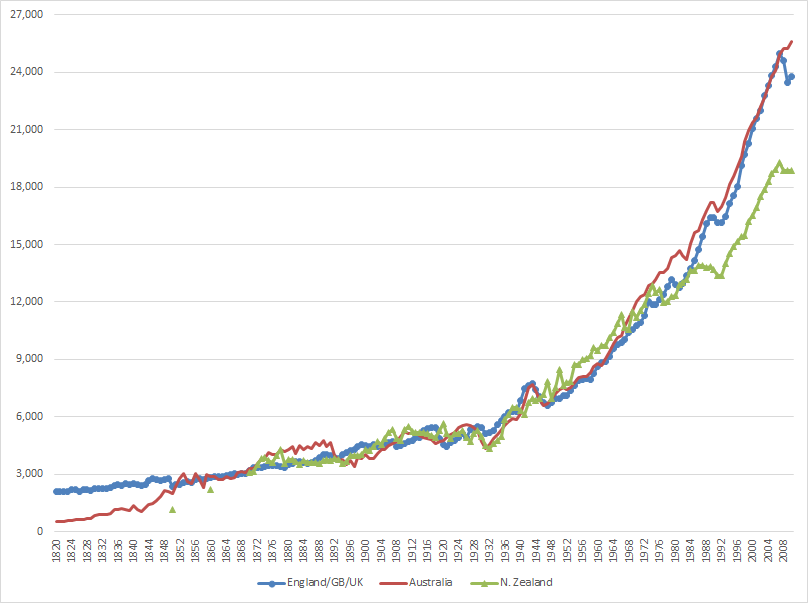
Pretty quickly according to figure 1. Britain, Australia and New Zealand quickly had similar standards of living in the middle of the 19th century until about 1880. Australia was richer for about 20 years until the great Federation drought took the wind out of its sails.
Figure 1: British, Australian and New Zealand GDP per capita (1990 Int. GK$PPP), 1820 – 2010
Source: The Maddison-Project, http://www.ggdc.net/maddison/maddison-project/home.htm 2013 version.
New Zealand then broke away at the end of the Second World War from both Australia and UK. In the mid-1960s circumstances changed with Australia drifting ahead of the UK and New Zealand drifting away to a lower standard of living.
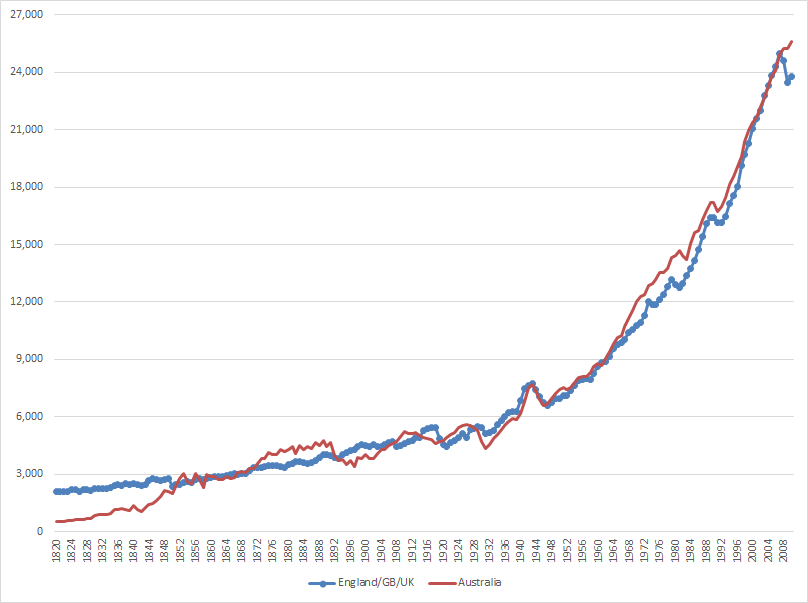
Figure 2: British and Australian GDP per capita (1990 Int. GK$PPP), 1820 – 2010
Source: The Maddison-Project, http://www.ggdc.net/maddison/maddison-project/home.htm 2013 version.
Figure 2 shows that from about 1960 until 1990 Australia was richer than the UK. After that, the growth dividend of Thatchernomics allowed the British to catch up again to the Australians.
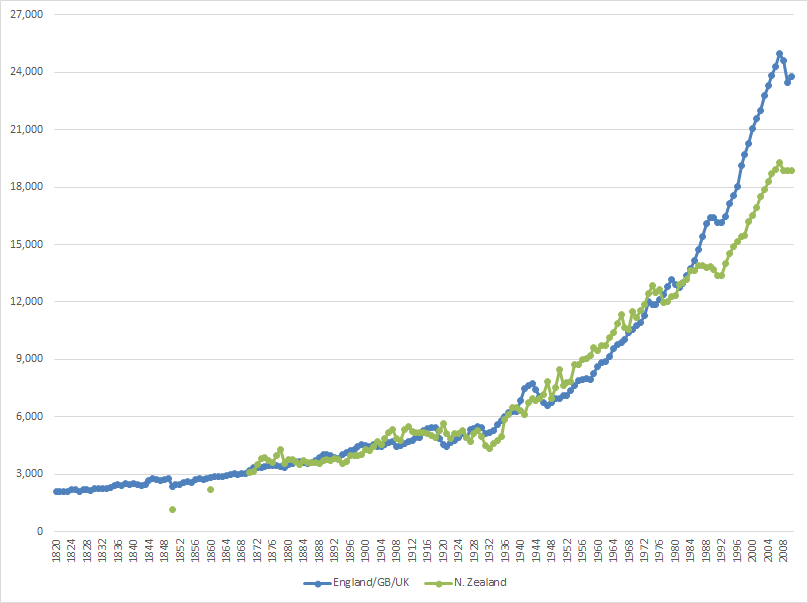
Figure 3: British and New Zealand GDP per capita (1990 Int. GK$PPP), 1820 – 2010
Source: The Maddison-Project, http://www.ggdc.net/maddison/maddison-project/home.htm 2013 version.
Figure 3 shows that New Zealand was richer than the UK in the mid-20th century. The lost decades in New Zealand from 1974 to 1992 let the sick man of Europe overtake New Zealand before Thatchernomics caused a growth spurt in the UK to take the British well ahead.
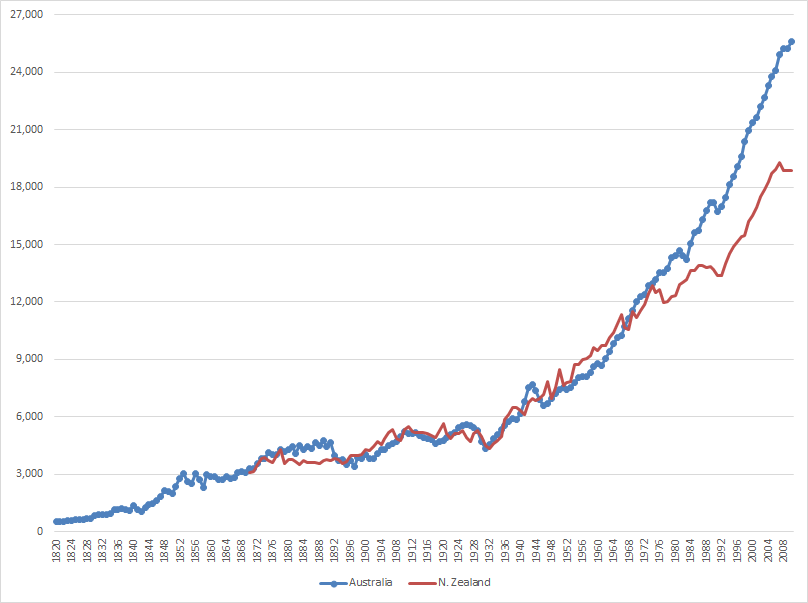
Figure 4: Australian and New Zealand GDP per capita (1990 Int. GK$PPP), 1820 – 2010
Source: The Maddison-Project, http://www.ggdc.net/maddison/maddison-project/home.htm 2013 version.
Figure 4 shows that New Zealand was richer than Australian in the first part of the post-war period. The divergence started with the onset of the lost decades in New Zealand in the early 1970s.
17 May 2015 Leave a comment
in development economics, economic history, entrepreneurship, growth disasters, growth miracles, industrial organisation, survivor principle Tags: China, creative destruction, international technology diffusion, technology diffusion
17 May 2015 Leave a comment
in development economics, growth disasters, growth miracles, health economics Tags: The Great Escape
14 May 2015 Leave a comment
in development economics, growth disasters, growth miracles, health economics Tags: child mortality, infant mortality, The Great Escape
Child mortality rate down across the globe via @UNICEF
statista.com/chart/3410/glo… http://t.co/SAYPhFMIC0—
Statista (@StatistaCharts) April 17, 2015
12 May 2015 Leave a comment
in development economics, energy economics, growth disasters, growth miracles Tags: Oil prices
#Dailychart: Oil at $50 econ.st/14nUWvA http://t.co/eg1PpoipWZ—
The Economist (@ECONdailycharts) January 07, 2015
12 May 2015 Leave a comment
in development economics, environmental economics, environmentalism, global warming, growth disasters, growth miracles, health economics Tags: climate alarmism, doomsday prophets, The Great Enrichment, The Great Escape, The Great Fact, Twitter left
Leaving the Left Exposed. James Hansen: dld.bz/dBnyq http://t.co/ZQsKSJxlr1—
The Left, Exposed (@leftexposed) April 23, 2015



12 May 2015 Leave a comment
4.3 million die every year. Indoor air pollution is the least reported problem of the world. bit.ly/1BfMiZg http://t.co/CDhafWSbj8—
Max Roser (@MaxCRoser) May 07, 2015
11 May 2015 Leave a comment
in development economics, growth disasters, health economics Tags: Africa, AIDS
At the epidemic's peak, AIDS affected half of people aged 15-49 in Middle Africa. Today? <20%. buff.ly/1EVz4Wo http://t.co/koHasDe2EX—
HumanProgress.org (@humanprogress) May 10, 2015
06 May 2015 Leave a comment
in development economics, economic history, growth disasters, growth miracles Tags: capitalism and freedom, The Great Escape, The Great Fact
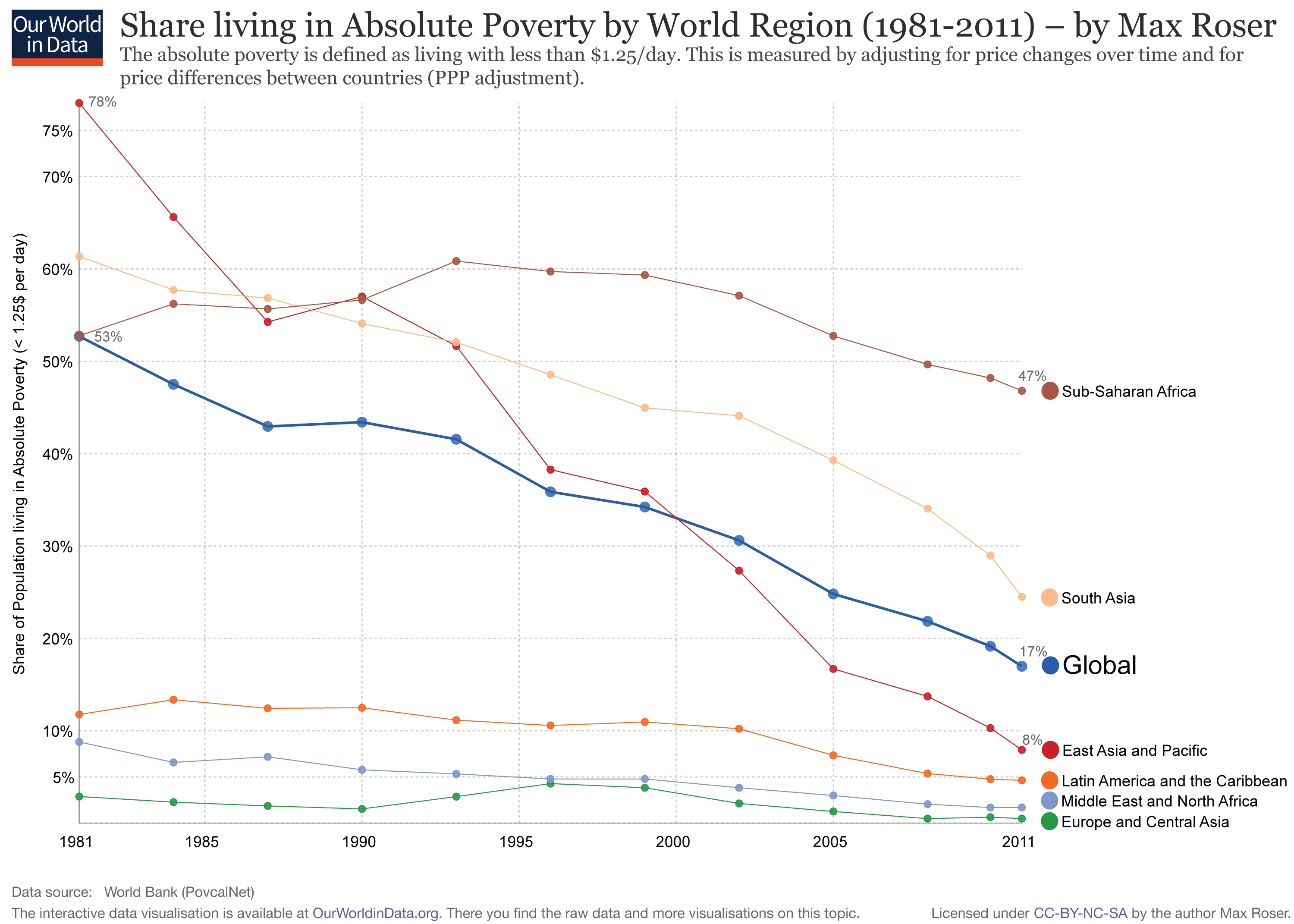
Global poverty is rapidly falling, says @BrookingsInst: buff.ly/1PM4Mdr #progress http://t.co/nGzbnxSHnp—
HumanProgress.org (@humanprogress) April 29, 2015
05 May 2015 Leave a comment
in development economics, energy economics, environmental economics, growth disasters, growth miracles, population economics, resource economics Tags: agricultural economics, doomsday prophets, ecological economics, Paul Ehrlich, population bomb, The Great Escape, The Great Fact
"Although the size and wealth of the human population has shot up…"—Jesse H. Ausubel. buff.ly/1Gz5vb8 http://t.co/ZvnnhV9aXH—
HumanProgress.org (@humanprogress) April 30, 2015
Despite a recent uptick, food prices have been declining for over a century, says @chellivia: j.mp/1Evos3r http://t.co/perdLhFods—
Cato Institute (@CatoInstitute) April 24, 2015
Even taking population growth into account, food production per person is actually increasing: j.mp/1Qo0fPt http://t.co/VH0NieLMOX—
Cato Institute (@CatoInstitute) April 23, 2015
Climate experts @PaulREhrlich says we all died during the 1980s http://t.co/C7k1Qc4B4O—
Steve Goddard (@SteveSGoddard) May 14, 2015
05 May 2015 Leave a comment
in development economics, economic history, growth disasters, growth miracles Tags: The Great Escape, The Great Fact
https://twitter.com/humanprogress/status/594875847552675841/photo/1
As China grew freer economically, its poverty rate fell. buff.ly/1DiVIow http://t.co/8upmR6NUvV—
HumanProgress.org (@humanprogress) April 26, 2015
04 May 2015 Leave a comment
in development economics, economics of natural disasters, growth disasters, growth miracles Tags: capitalism and freedom, earthquakes, Nepal, richer is safer, The Great Escape, The Great Fact, wealthier is healthier
Prosperity strengthens resilience against disasters. buff.ly/1JORl8y #Nepal #EarthQuakeResponse http://t.co/yx4E98QJn6—
HumanProgress.org (@humanprogress) April 28, 2015
04 May 2015 Leave a comment
in development economics, growth disasters, growth miracles, Music Tags: Bono, ODA, overseas aid, U2
Celebrating humanity's flourishing through the spread of capitalism and the rule of law
Scholarly commentary on law, economics, and more
Beatrice Cherrier's blog
Celebrating humanity's flourishing through the spread of capitalism and the rule of law
Celebrating humanity's flourishing through the spread of capitalism and the rule of law
Celebrating humanity's flourishing through the spread of capitalism and the rule of law
Why Evolution is True is a blog written by Jerry Coyne, centered on evolution and biology but also dealing with diverse topics like politics, culture, and cats.
Celebrating humanity's flourishing through the spread of capitalism and the rule of law
Celebrating humanity's flourishing through the spread of capitalism and the rule of law
A rural perspective with a blue tint by Ele Ludemann
DPF's Kiwiblog - Fomenting Happy Mischief since 2003
Celebrating humanity's flourishing through the spread of capitalism and the rule of law
The world's most viewed site on global warming and climate change
Tim Harding's writings on rationality, informal logic and skepticism
A window into Doc Freiberger's library
Let's examine hard decisions!
Commentary on monetary policy in the spirit of R. G. Hawtrey
Thoughts on public policy and the media
Celebrating humanity's flourishing through the spread of capitalism and the rule of law
Politics and the economy
A blog (primarily) on Canadian and Commonwealth political history and institutions
Reading between the lines, and underneath the hype.
Economics, and such stuff as dreams are made on
"The British constitution has always been puzzling, and always will be." --Queen Elizabeth II
Celebrating humanity's flourishing through the spread of capitalism and the rule of law
Celebrating humanity's flourishing through the spread of capitalism and the rule of law
WORLD WAR II, MUSIC, HISTORY, HOLOCAUST
Undisciplined scholar, recovering academic
Celebrating humanity's flourishing through the spread of capitalism and the rule of law
Res ipsa loquitur - The thing itself speaks
In Hume’s spirit, I will attempt to serve as an ambassador from my world of economics, and help in “finding topics of conversation fit for the entertainment of rational creatures.”
Researching the House of Commons, 1832-1868
Articles and research from the History of Parliament Trust
Reflections on books and art
Posts on the History of Law, Crime, and Justice
Celebrating humanity's flourishing through the spread of capitalism and the rule of law
Exploring the Monarchs of Europe
Cutting edge science you can dice with
Small Steps Toward A Much Better World
“We do not believe any group of men adequate enough or wise enough to operate without scrutiny or without criticism. We know that the only way to avoid error is to detect it, that the only way to detect it is to be free to inquire. We know that in secrecy error undetected will flourish and subvert”. - J Robert Oppenheimer.
The truth about the great wind power fraud - we're not here to debate the wind industry, we're here to destroy it.
Celebrating humanity's flourishing through the spread of capitalism and the rule of law
Celebrating humanity's flourishing through the spread of capitalism and the rule of law
Economics, public policy, monetary policy, financial regulation, with a New Zealand perspective
Celebrating humanity's flourishing through the spread of capitalism and the rule of law
Restraining Government in America and Around the World
 Utopia, you are standing in it!
Recent Comments