Child mortality declined in all world regions.
Here is by how much: http://t.co/06lS3ZELKr—
Max Roser (@MaxCRoser) June 26, 2015
The Great Escape: infant mortality since 1990
10 Jul 2015 Leave a comment
in development economics, growth disasters, growth miracles, health economics Tags: child poverty, extreme poverty, global poverty, infant mortality, life expectancies, The Great Enrichment, The Great Escape, The Great Fact
The reduction of Polio in Africa
10 Jul 2015 Leave a comment
in development economics, growth disasters, growth miracles, health economics Tags: Africa, anti-vaccination movement, polio, quackery, vaccinations, vaccines
The reduction of Polio in Africa. http://t.co/JKL1Kfx2qr—
Max Roser (@MaxCRoser) June 29, 2015
The Great Fact: the rise of the middle class in developing countries
09 Jul 2015 Leave a comment
China pulled 203m into the middle class from 2001-11; more than half the global gain of 385m pewrsr.ch/1LSs6Wz http://t.co/DiskvneykJ—
Rakesh Kochhar (@RakeshKochhar) July 08, 2015
Richer is greener: environmentalists are Environmental Kuznets Curve deniers
07 Jul 2015 Leave a comment
in applied price theory, applied welfare economics, development economics, economic growth, economic history, energy economics, environmental economics, growth disasters, growth miracles, health and safety, industrial organisation, international economics, labour economics, law and economics, liberalism, property rights, public economics Tags: healthier is wealthier, Japan, Kuznets environmental curve, richer is greener, richer is safer
The Kuznets environmental curve describes an empirical regularity between environmental quality and economic growth. Outdoor water, air and other pollution first worse and then improves as a country first experiences economic growth and development.

While many pollutants exhibit this pattern in the Kuznets environmental curve, peak pollution levels occur at different income levels for different pollutants, countries and time periods. John Tierney explains:
In dozens of studies, researchers identified Kuznets curves for a variety of environmental problems.
There are exceptions to the trend, especially in countries with inept governments and poor systems of property rights, but in general, richer is eventually greener.
As incomes go up, people often focus first on cleaning up their drinking water, and then later on air pollutants like sulphur dioxide.
As their wealth grows, people consume more energy, but they move to more efficient and cleaner sources — from wood to coal and oil, and then to natural gas and nuclear power, progressively emitting less carbon per unit of energy.
When I was living in Japan in the mid 1990s, they just completed a period of rapid operation of the Kuznets environmental curve. I was told by my professors at Graduate School that in the 1960s, cities and prefectures welcomed polluting industries because of the better paid jobs they offered. At that time, shipping companies used like to go to Tokyo because the pollution in Tokyo Bay was so bad that it would clean all the barnacles off their ships. That made them sail faster.

Japanese incomes and wages doubled over the course of the 1960s. The Japanese voter was now prepared to support stricter pollution standards and environmental controls.
Life expectancy is at an all time high: buff.ly/1ICraAi http://t.co/jgRqKy8LfQ—
HumanProgress.org (@humanprogress) June 28, 2015
In the early 1970s, the ruling LDP stole the long-standing environmental policies of their opponents in a big crack down on pollution because the country could now afforded them.
Poverty has plummeted in East Asia and the world. buff.ly/1NtIDyY http://t.co/SsY3sf3kyH—
HumanProgress.org (@humanprogress) July 01, 2015
Plenty of developing countries are democracies now. Their people could demand through the ballot box higher environmental standards and clean tap water but they don’t because of its cost to economic development.
These 4 nations are 50% of mankind. That's 3.5 billion people who are living longer. buff.ly/1Kle6mU #health http://t.co/949oqisMsL—
HumanProgress.org (@humanprogress) June 30, 2015
The environmental movement lives in a state of denial regarding the relationship between economic growth and environmental quality.
OECD Better Life Index correlates with GDP
But US lower than poorer countries
& NZL higher than richer countries http://t.co/yrTCnO1B0l—
Max Roser (@MaxCRoser) June 26, 2015
Fertility is down everywhere
07 Jul 2015 Leave a comment
in development economics, population economics Tags: demographic transition, economics of fertility
The world is making less people en.wikipedia.org/wiki/Total_fer… | http://t.co/FlgwlrkUJO—
Charts and Maps (@ChartsAndMaps) April 04, 2015
Matt Ridley on the Pope and The Great Fact
06 Jul 2015 Leave a comment
in applied price theory, applied welfare economics, development economics, economic history, economics of regulation, energy economics, entrepreneurship, environmental economics, financial economics, growth disasters, growth miracles, health economics, history of economic thought, human capital, industrial organisation, labour economics, liberalism, survivor principle Tags: doomsday prophecies, Matt Ridley doomsday prophets, Papal economics, The Great Enrichment, The Great Escape, The Great Fact
See which way the data points for yourself, like @mattwridley. buff.ly/1HsZxgx #health #progress http://t.co/B3KbUJOn05—
HumanProgress.org (@humanprogress) June 30, 2015
The Great Fact in Sudan
06 Jul 2015 Leave a comment
in development economics, growth disasters, growth miracles Tags: Sudan, The Great Escape, The Great Fact
Access to education and to the Internet are expanding and helping to improve lives: buff.ly/1NzHbKP #progress http://t.co/45AISWVKHQ—
HumanProgress.org (@humanprogress) July 02, 2015
Legal systems and property rights in Greece and Russia – Index of Economic Freedom rankings compared
05 Jul 2015 Leave a comment
in applied price theory, applied welfare economics, comparative institutional analysis, constitutional political economy, development economics, economics of crime, economics of regulation, growth disasters, industrial organisation, law and economics, property rights Tags: capitalism and freedom, Greece, rule of law, Russia
Figure 1: Index of Economic Freedom rankings for legal systems and property rights, Greece, Russia and USA, 2012
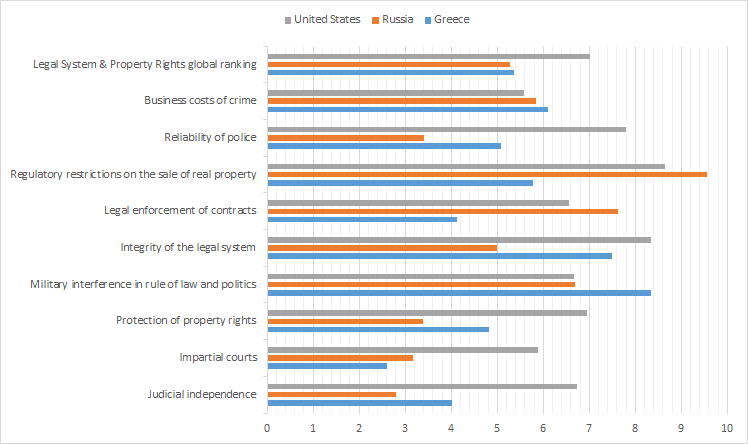
Source: Economic Freedom of the World – Annual Report 2014 | www.freetheworld.com.
Overall, there are not that many differences between Greece and Russia in the quality of their legal systems and property rights. Don’t go to the police in Russia and good luck trying to enforce contracts in Greece.
@MaxCRoser only one line in this chart about India matters
05 Jul 2015 Leave a comment
in comparative institutional analysis, constitutional political economy, development economics, economic history, growth disasters, growth miracles, poverty and inequality, Public Choice Tags: capitalism and freedom, extreme poverty, global poverty, India, Leftover Left, The Great Escape, The Great Fact, top 1%
In #India poverty is falling very, very rapidly – while inequality is rising.
More at: bit.ly/1KLT8Lh http://t.co/xTxlW1i06o—
Max Roser (@MaxCRoser) June 29, 2015
Corruption index for south-east Asia
04 Jul 2015 Leave a comment
in development economics, growth disasters, growth miracles, rentseeking Tags: bribery and corruption, China, Indonesia, Philippines
Corruption in Indonesia: Jokowi’s arduous task in cleaning up the government econ.st/1FJ3sS0 http://t.co/1myuRbwoXK—
The Economist (@EconBizFin) June 11, 2015
Only one line in this chart matters
04 Jul 2015 Leave a comment
in applied welfare economics, development economics, economic history, growth disasters, growth miracles Tags: capitalism and freedom, child poverty, extreme poverty, global poverty, Malaysia, The Great Escape, The Great Fact
In #Malaysia inequality and poverty are falling.
More at: bit.ly/1KLUA02 http://t.co/aXEmuA0bnb—
Max Roser (@MaxCRoser) July 02, 2015

The rise of the South
03 Jul 2015 Leave a comment
in development economics, growth disasters, growth miracles Tags: China, India, The Great Fact, undeveloped countries
The GDP of the South doubled to 40% by 2012, w/ China —12% of global GDP: wrld.bg/N9CYe #RisingoftheSouth http://t.co/Yt2LiF9srr—
World Bank Pubs (@WBPubs) May 20, 2015
Extreme poverty is not the same thing as digital poverty
01 Jul 2015 Leave a comment
Percentage of people around the world who own smartphones, via @conradhackett. Note #China. http://t.co/wAOmIklVbW—
Legatum Institute (@LegatumInst) May 30, 2015
Countries where you become a citizen just by being born there
01 Jul 2015 Leave a comment
in constitutional political economy, development economics, economics of media and culture, law and economics, politics Tags: citizenship
Countries where you become a citizen just by being born there.
Interesting difference between old and new world! http://t.co/DzsH64SAqa—
Max Roser (@MaxCRoser) May 31, 2015


Recent Comments