13 Dec 2014
by Jim Rose
in climate change, development economics, environmental economics, global warming, growth disasters, growth miracles, history of economic thought, liberalism, population economics, technological progress
Tags: capitalism and freedom, The Great Enrichment, The Great Escape, The Great Fact
Now, my conception (read: European) of progress and a better standard of living would place many advances above composting, organic farming, or even urban chicken coops.
- Higher incomes that allow people to make livings that afford them more than merely survival or avoiding starvation.
- A low poverty rate.
- High quality and diversity of employment opportunities. Rather than the choice of being a farmer or being a blacksmith, the average citizen should have an array of careers to choose from, and the ability to be industrious and take risks for profit.
- The availability of housing. On an average night in the United States, a country with a population of somewhere around 350 million, fewer than one million people are homeless.
- Consistent GDP growth.
- Access to quality health care.
- The availability of quality education. (I suppose we could quibble over the word “quality,” but certainly there is widespread free education availability.)
- High life expectancy. Worldwide life expectancy has more than doubled from 1750 to 2007.
- Low frequency of deadly disease.
- Affordable goods and services.
- Infrastructure that bolsters economic growth.
- Political stability.
- Air conditioning.
- Freedom from slavery, torture and discrimination.
- Freedom of movement, religion and thought.
- The presumption of innocence under the law.
- Equality under the law regardless of gender or race.
- The right to have a family – as large as one can support. Maybe even larger.
- The right to enjoy the fruits of labor without government – or anyone else – stealing it.
There’s much more, of course. If the “sustainability movement” had its way, many of these advances would be degraded.
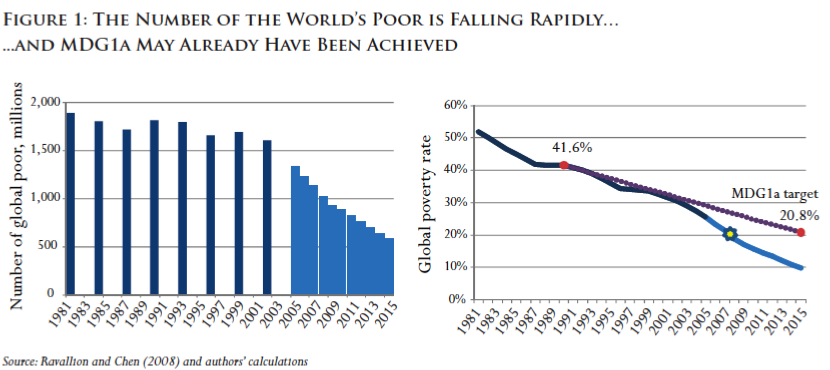
And since Caradonna offered a few charts highlighting climate change and population growth (a bad thing), I too was assembling a number of graphs that could offer visual examples of the rise of positive developments since the Industrial Revolution. I also soon noticed that all of them looked virtually identical.
So below is what a graph encompassing nearly every one of my bullet points looks like:

via Global Warming Was Worth It.
11 Dec 2014
by Jim Rose
in applied welfare economics, development economics, economics of natural disasters, growth disasters, growth miracles
Tags: corruption, natural disaster relief, Philippines, rent seeking, Tacloban

The good news is that we find that fund allocations do indeed respond to the location and intensity of typhoons and tropical storms.
However, political ties between members of Congress and local mayors, specifically party and clan ties, are also associated with greater funding for a given municipality.
One of the most devastated cities in the aftermath of Typhoon Haiyan is Tacloban City, with a population of 221,174 people.
Our research suggests that for a municipality of this size, a match in party affiliation between the member of Congress and the mayor increases the distribution of funds by PHP 1.74 million ($40,000), while a match in clan affiliation increases this distribution by PHP 6.23 million ($142,000).
The result that clan ties have a much larger effect than party ties on the distribution of per capita reconstruction funds underscores the relative importance of clan loyalty in decision-making by Philippine congressional representatives.
via Politics and disaster aid in the Philippines – The Washington Post.
11 Dec 2014
by Jim Rose
in applied welfare economics, development economics, economics of natural disasters, growth disasters, growth miracles
Tags: corruption, disaster relief, Philippines, rent seeking

Regrettably, we find no evidence that poverty, vulnerability to disasters, or other objective measures of infrastructure needs are determinants of road construction and repair expenditures at the local level.
Instead, our evidence highlights the importance of political connections and electoral strategies.
Consistent with the story in many other countries in the developing world, we find that mayors divert construction funding to electorally contested areas where they need to win more votes, while congressmen use their discretionary funding to shore up political connections by allocating funding to localities where the mayor is an ally.
via The politics of the Philippines’ vulnerability to natural disasters – The Washington Post.
06 Dec 2014
by Jim Rose
in applied welfare economics, development economics, economics of media and culture, growth disasters, growth miracles, population economics, technological progress
Tags: food snobs, growth disasters, growth miracles, The Great Escape, The Great Fact
Previous Older Entries Next Newer Entries
Recent Comments