The Economics of Foreign & Military Intervention with Chris Coyne
04 Apr 2014 Leave a comment
in applied welfare economics, constitutional political economy, development economics, law and economics, liberalism, Public Choice
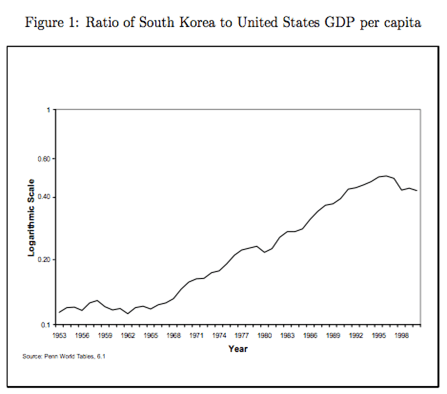
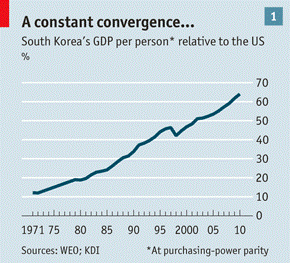
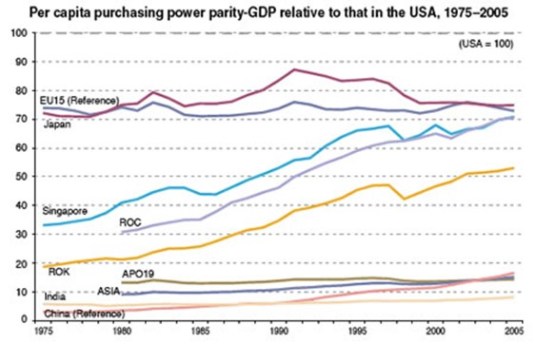
Natural experiments and how South Korea became rich – updated again
04 Apr 2014 Leave a comment
in development economics, Gordon Tullock, Public Choice Tags: industry policy, state-led development
In the early 1960s, Joan Robinson argued with a colleague about the great economic success of Korea. It was a confusing debate until a listener realised Robinson was talking about North Korea and the other about the South. Soon after this discussion, there was a military coup in South Korea.
Gordon Tullock is an interesting writer on South Korea and the consequence of this military coup saying that:
- Syngman Rhee was a socialist who knew nothing of capitalism when he took over after the Second World War.
- To make his country look capitalist to the Americans, Rhee gave many previously Japanese owned industries to his friends as monopolies.
When General Park overthrew Syngman Rhee in 1961, he knew no economics, but Park knew the bureaucracy was filled with Rhee’s cronies, so he fired them all. Before a new lot of cronies got properly in place, the economy boomed.
Tullock considered that South Korea became a prosperous, open economy as a by-product of this political purge. At the time of the 1961 coup, Tullock specialised in China and Korea. He was formerly a diplomat to both countries in the late 1940s and early 1950s. Tullock published in top economic journals on China and Korea in the 1950s despite having completed only one course in economics. Tullock is one of the last great polymaths.

Mancur Olson argued that the accumulation of interest groups in even a previously prosperous society may lead to its economic stagnation because of this institutional sclerosis. These special interests build their power over time and start to slow down a society’s capacity to adopt new technologies and to reallocate resources in response to changing conditions, and thereby reduce the rate of economic growth.
President Park swept away these interest groups after he came to power in Korea. The rest is history. When the old political networks are disrupted, the lack of political connections forces the remain entrepreneurs to focus on productive market activities. The defeat of Germany and Japan in the war also led to the overthrow of special-interest groups that impeded growth.
A realignment of patronage is common after leadership successions in autocratic societies. These routine reallocations of patronage – Perestroika is an example – can get out of hand and destabilise the entire pre-existing rent-seeking society. This happened to the old order when President Park cleaned house in South Korea.
For a discussion of Korean industry policy, see this paper by an old class mate of mine, Heather Smith. A more general survey of the myths of state-led development in East Asia was written by Ben Powell:
Although some state industrial planning did exist in East Asian countries, when these countries were growing, they were some of the most free market in the world.
Hong Kong and Singapore are consistently ranked the top two freest countries in the world, and in 1970, when Japan and Taiwan were growing quickly, they were ranked seventh and sixteenth. Even Korea ranked in the top 20 per cent.
Although state development planning did exist in these countries, overall broader measures of the market’s relative sphere of influence in these countries show that they were far more market oriented than slower growing areas of the world.
Latin America is a good example of stagnation after an extended period of prosperity because of the accumulation of special interests and barriers to efficient production. Latin America has many more barriers to competition than the successful East Asian countries. Why are there no Latin Tigers apart from Chile?
External threats, the dynamics of internal politics, including dramatic break-ups of established interest groups, low taxes and competition in export markets were the enablers of market-led rapid development in Japan, Singapore, South Korea, Hong Kong and Taiwan. Many other under-developed nations did not grow because institutional sclerosis locked them into yesterday’s technologies and industries.
The usual suspects for natural experiments are countries with the same cultures, peoples and similar resources that are suddenly partitioned for arbitrary reasons.
These would be East and West Germany, North and South Korea and Taiwan and China. In each case, the socialist solution was left for dead by capitalism.
Taiwan and Cuba were threatened with invasion and trade sanctions by large bellicose superpower neighbours. Cuba is a dump. Taiwan changed from a rural backwater to a rich country.
I am not too sure how Mises and other Austrian economists would view the use of these natural experiments. The view of Mises on theory and history is that the correctness of a theory can be ascertained without the aid of experience. Natural experiments make no sense without a correct theory to tell us what and how to measure and what to make of our discoveries. Without a theory, we neither know where to look nor what to look for.
p.s. there was some excitement over at Reddit about the role of Chaebol. These are Korean conglomerates. The term was first used in 1984, long after the 1961 coup and after President Park was assassinated in 1979.
The Chaebol invested heavily in export-oriented manufacturing. As such, they would have zero market power and would have been subject to strong global market disciplines on both their costs and any lack of innovation. Their relative domestic size does not matter much if their markets are global.
Post-war trade liberalisation and tariff cuts gave Korean and the other East Asian Tigers much greater access to major export markets. This allowed export production to expand without limit.
Institutional reforms and imported new technologies increased employment and incomes through this explosion in exporting. This allowed the losers from the economic changes to be compensated directly or with new opportunities in the export sectors (Parente and Prescott 1999, 2005; Olson 1982, 1984; Acemoglu and Robinson 2005).
Let the climate science be settled! Only the economics matter
03 Apr 2014 2 Comments
in applied welfare economics, development economics, environmental economics, politics, Public Choice Tags: global warming
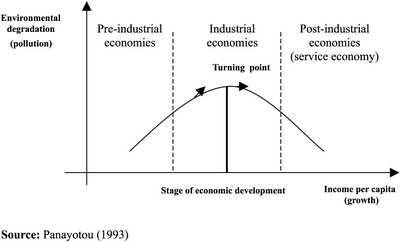
The great tactical victory of environmentalists is keeping the debate on the science going because even if the science is right, the economic costs are small.
Richard Tol on the scientific consensus about human-caused global warming skepticalscience.com/graphics.php?g… http://t.co/OpdRtsY1tx—
John Cook (@skepticscience) March 24, 2015
Let the climate science be settled. How much will global warming cost is the correct question for policy debate.

Global warming, although real, is not apt to be severe. It will lower the level of GDP by maybe 2%. The loss of one year’s income growth! Courtesy of David Friedman’s reading of the report, this is what the IPCC said this week:
With these recognized limitations, the incomplete estimates of global annual economic losses for additional temperature increases of ~2°C are between 0.2 and 2.0% of income (±1 standard deviation around the mean)
Many of the consequences of global warming will be beneficial – warmer in some places, colder in others; wetter in some places and drier in others. The sea level rises will mean local problems, not a planetary crisis.
New Zealand will have a more reliable power supply because of increased winter rainfall as well as warmer winters. Most of New Zealand’s power supply is from lakes that rely on the Spring melting of the winter snow rather than winter rainfall.
The chances of India, China and the rest of the Third World agreeing to forego or even slow their economic development to fight global warming is zero even before you consider the international collective action, verification and free rider problems.
Climate changes have a greater impact in the most under-developed countries that are yet to embrace capitalism. Agriculture provides the livelihoods of 30 per cent or more of their populations, many of whom still practice subsistence agriculture.
Yet the trend in developing countries is to be much less dependent on agriculture as a source of employment and family incomes. If per capita income in the poor countries grows in the next forty years as rapidly as it has in the forty years just past, their vulnerability to climate change should diminish.
Adaptation and richer is safer are the only games in town for both the developed and the developing worlds.
The only case for even a token carbon tax is to avoid green tariffs in the EU and USA on exports. We may as well collect the revenue for ourselves rather than let the EU and USA pocket it.
p.s The report of the IPCC yesterday was a one-day media wonder in the country where I live. I could not find a single story today in the Dominion Post, which is the paper for the political capital for New Zealand.
When two refugees from the Khmer Rouge found paradise on Earth
01 Apr 2014 Leave a comment
in development economics, politics
When a Cambodian man and his pregnant wife, having fled the Khmer Rouge, were on the bus from Sydney Airport, they quickly concluded that they were in paradise. They slept on top of the blankets of the neatly made bed at the migrant hostel in 1978 because they did not want to get into any trouble for messing up the bed and be sent back to hell. Such was their ingrained fear of arbitrary power and victimisation.
After a few weeks, they stopped stealing the sauces and other condiments from the dining hall at the hostel because they realised that the food would keep coming and there was no need to hoard. They then started to act as mentors to incoming refugees assuring them that they could sleep under the blankets, and the food would arrive three times a day, every day.
When the Salvation Army helped them and their new baby into a house in suburban Sydney, the Salvos were very embarrassed about the furniture they managed to find for them.
The Cambodian couple thought they were in paradise again. The house and furniture were better than anything they had seen in a middle-class home in their own country.
After a few years of hard work, the father saved enough to open an electrical retailing franchise store in the suburbs.
The mother went to the store one afternoon to fill in for an absent worker.
She did not come back for 7-years.
She was great at bargaining with fellow refugees. She knew that her fellow refugees only had a certain amount of money, and she bargained to find out what that was. She wrapped the goods up tightly because she knew that they took public transport home.
The word spread that her store was a good place for a bargain, and the store prospered.
Their daughter grew up to be a lawyer and wrote one of the best autobiographies I have read.
I had some Cambodian friends at graduate school in Japan in 1995 to 1997. Friendly, kind people despite growing up in hell.
They also gave me great insight into the blinding power of nationalism.
Two Cambodian friends, educated urbane people, referred to the time after the Vietnamese invasion of Cambodia as when they were a Vietnamese colony.
Another Cambodian, who no one liked, when he annoyed his Vietnamese class mates too much, they would say, “Remember 1979.”

This taunt would throw this Cambodian into a fit of nationalist pique. He raged against the invasion.
If any country would have benefited from an invasion from hell, it would have been Cambodia under Pol Pot and the Khmer Rouge by 1979. At least, the Devil waits for you to die before he torments you.
Monty Python – What have the Romans ever done for us?
30 Mar 2014 Leave a comment
in development economics, P.T. Bauer Tags: political satire
The best of all their clips. P.T.Bauer would have been proud. The British did similar improvements in their colonies.
Wild Swans and Star Trek
29 Mar 2014 1 Comment
in applied price theory, development economics, economics of bureaucracy, Marxist economics, Public Choice, technological progress, television Tags: economics of planning, star trek
About the only book I almost read in one sitting was Wild Swans. I stopped reading at 2 in the morning. This autobiography is 676 pages long. Wild Swans is the story of three generations of women and their families in 20th century China. It is the biggest grossing non-fiction paperback in publishing history.

Wild Swans starts with Jung Chang’s grandmother whose feet were bound at the age of two in 1909. She was later to be a concubine to the local warlord. Her mother was a communist revolutionary in the 1940s onwards and her own story as among other things a teenage Red Guard in the Cultural Revolution. The Guardian described Wild Swan as “For many in the west, Wild Swans was their first real insight into life under the Chinese Communist party.”
I will only mention the part of it that reminded me of Steven Cheung’s analysis of how class ridden communist societies were.
A party membership card puts you above others. That card described in enormous detail what privileges you received depending on your rank in the party.
This is exactly what happened in wild swans. Jung Chang’s father was of the 14th rank while her mother was of the 17th rank. This rank decided what food you got, your accommodation, whether your parents could live with you and even the type of seat you got on the railways.
Star Trek was supposed to be a society that had abolished money and as a post-scarcity economy because everything was available through a replicator. The type of economics it is based on is cooperative economics. To quote Captain Picard:
A lot has changed in three hundred years. People are no longer obsessed with the accumulation of ‘things’. We have eliminated hunger, want, the need for possessions.
The economics of the future is somewhat different. You see, money doesn’t exist in the 24th century… The acquisition of wealth is no longer the driving force in our lives. We work to better ourselves and the rest of Humanity.
The Ferengi and their 285 rules of acquisition were a satire on capitalism. The Ferengi was originally meant to replace the Klingons as the Federation’s arch-rival but they were far too comical.
Gene Roddenberry’s love story with socialism is the most class-ridden society I have ever seen. In Star Trek, higher ranked officers had larger cabins, and most of all they always beamed back from the planet.
Anyone who beamed down with Captain Kirk dressed in those red security officer tops were expendables. Death and accommodation were class based on Star Trek.
The U.S.S. Enterprise also spent a lot of time negotiating trade treaties and visiting planets where the Earth colonists lived in agrarian poverty with famines and preventable diseases.
Renegade liberals and the withering away of the proletariat
20 Mar 2014 2 Comments
in development economics, economic growth, growth miracles, liberalism, P.T. Bauer Tags: Animal Farm, colonialism, development disasters, George Orwell, immiseration of the proletariat, inconvenient truths, Renegade liberals
George Orwell, in his proposed preface of Animal Farm, wrote of the “renegade liberal”. Renegade liberals glorify socialist experiments and disdain middle-class life despite their own pleasant circumstances.
Renegade liberals search the globe for outlaw states and revolutionary movements to support, who, of course, would ship their local versions of these renegade liberals straight to the camps as soon as they won power. Iran, Castro and Hugo Chávez are their latest rebels without a clue.
The revolutionary excesses of the new socialist or Anti-American regimes are excused as the misadventures of ‘liberals in a hurry’, who understandably lost patience with the slow pace of democratic reform. It is all in the name of liberating the proletariat from their misery or throwing off the dead hand of colonial rule.
How is the immiseration of the proletariat going these days?
- The immiseration of the proletariat is the central prediction of Marxism, the driver of class conflict, and this growing misery and poverty is what will finally push workers to wage a revolution against the capitalists.
- It is a bit hard to argue that workers are poorer today than in 1848 when the Communist Manifesto was written. The central Marxist prediction is falsified by history.
I agree with G.A. Cohen when he argues that there is no group in advanced industrial societies united by:
- being the producers on which society depends;
- being exploited;
- being, in conjunction with their families, the majority of society; and
- being in dire need.
To avoid the inconvenient truth of modern affluence and the move of so many of the proletariat into the middle class, renegade liberals search endlessly for under-developed countries so they can blame their poverty on capitalism.

When they visit them in solidarity, these renegade liberals should read the visa stamp: ‘people’s republic’ or ‘socialist republic’ is so frequently on it. It is still mandatory for all political parties in India to be committed to socialism.
Nearly all of Asia (where much of the world’s population lives) has undergone rapid and sustained economic and social progress because they became market economies, starting with the Asian Tigers and recently in previously socialist India and communist China. Latin America adopted the inward economic polices of the mid-20th century that renegade liberals praise so much and they became development disasters.
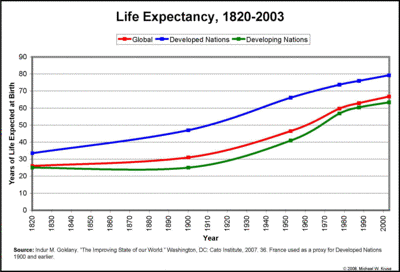
As the world embraced free market policies in the late 20th century, living standards rose sharply; life expectancy, education and democracy improved and absolute poverty declined. Xavier Sala-I-Martin and Maxim Pinkovskiy (2010) found that between 1970 and 2006, poverty fell by 86% in South Asia, 73% in Latin America, 39% in the Middle East and 20% in Africa. The percentage of people living on less than $1 a day (in PPP-adjusted 2000 dollars) fell from 26.8% in 1970 to 5.4% in 2006.
To go further, P.T. Bauer disputed the lack of development in British colonies. Bauer argued that much of British colonial Africa was transformed in the colonial period.

Before British rule, there were no rubber trees in Malaya, no cocoa trees in West Africa, no tea in India:
“…Much of British colonial Africa was transformed during the colonial period. In the Gold Coast there were about 3000 children at school in the early 1900s, whereas in the mid-1950s there were over half a million. In the early 1890s there were in the Gold Coast no railways or roads, but only a few jungle paths…
Before colonialism, Sub-Saharan Africa was a subsistence economy, because of colonialism it became a monetized economy.
Before colonialism, the absence of public security made investment impossible.
After it, investment flowed. So too was scientific agriculture introduced by colonial administrations, or by “foreign private organizations and persons under the comparative security of colonial rule, and usually in the face of formidable obstacles…
In British West Africa public security and health improved out of all recognition… peaceful travel became possible; slavery and slave trading and famine were practically eliminated, and the incidence of the worst diseases reduced..” (P.T. Bauer)
Some colonial powers were better than others. After 500 years of Portuguese rule in East Timor, in 1975, there was one road – to the governor’s house – and the phone number of the Australian consulate was 7! Portugal itself may have not been much better at that time too. Colonial masters are like parents. You must choose them well.
The Chinese capitalist miracle – guest post by Alan Moran
17 Mar 2014 Leave a comment
in development economics, growth miracles, Public Choice, Ronald Coase Tags: How China Became Capitalist, Ning Wang, Ronald Coase
The Chinese economic miracle is the latest and most comprehensive success story since the end of World War II.
Veteran economists Ronald Coase and Ning Wang explain how in the space of three decades one of the world’s poorest countries became the world’s leading manufacturer and investor. They attempt to disentangle the twists and turns of Chinese politics and economics in its voyage to success within a framework which rightly judges that no system other than capitalism (which the book calls the market economy), could ever produce such an outcome.
In retrospect the internal contradictions within Communism (absence of appropriate incentives, attenuated property rights, politicisation of business decisions and prices and so on) made its collapse inevitable. But that was not clear in 1970 or even 1980. Yes, communist economies in both the Soviet bloc and China were stagnating. But there were many believing and hoping that the future was about to emerge to demonstrate that socialism actually does work. Intellectuals in particular thought that socialism, which accorded them the status and perks they considered they richly deserved, with a little more reform would demonstrate that the bourgeoisie were unnecessary.
Though the collapse of Communism took place almost simultaneously across the world, a remarkable contrast is evident between Chinese Communism’s self-control of its demise and the relatively bloodless overthrow of the system in Europe.
The Europeans delegitimised their Communist Parties and ostensibly opted for a western capitalist system that incorporated democracy and liberty-more so in the former satellites than in the USSR successor states. On the other hand, China’s Communist Party continued to maintain its monopoly of political control, vigorously and sometimes brutally suppressing any challenges. Chinese communists adopted capitalism shorn of the democracy and liberty that many considered to be an essential part of its make-up. And in supervising a gradual dismantling of socialism, its raison d’etre, China’s Communist Party watched over the longest and highest rate of economic growth the world has ever seen. One indicator of this is steel production, traditionally a key indicator of industrialisation. Having increased twentyfold in the past 30 years, China’s steel output now accounts for half the world’s supply, up from 7 per cent in 1980.
How did this happen? How did a ruling political party numbering millions of apparently dedicated Marxists-Leninists retain its power in the decades following 1978 while permitting and facilitating an economic development approach totally alien to its proclaimed ideology? And how did that same Party evolve from a proselytising socialist force to one that welcomed diversity? Coase and Wang offer important insights but leave plenty for others to explain. By the late 1950s, Communist China, like underperforming organised societies of yesteryear, was seeking out ways to catch up with the west. Calls for modernisation started to become increasingly insistent on the part of China’s leadership. The first ‘four modernisations’ program was initiated by Premier Zhou Enlai in 1964 and was aborted by the Cultural Revolution of 1971; other modernisations were subsequently endorsed, including in 1978 (Mao died in 1976) by Deng Xiaoping, shortly before one of his downfalls. The catch-up program sought to emulate the successes without adopting the institutions of capitalism-free enterprise, personal ownership, and the rule of law. Progress was therefore transient.
As well as promising a fairer society, socialism had been the supposed key to a more efficient and richer society. But Coase and Wang note early questionings of socialism. By 1984 when Hu Yaobang, as General Secretary of the Communist Party, had taken this further in asking, ‘Since the October revolution (of 1917) more than 60 years have passed. How is it that many socialist countries have not been able to overtake capitalist ones in terms of development? What is it (in socialism) that does not work?’
Hu Yaobang would not have been the first to voice such concerns even though they questioned the party’s core beliefs. Even so, not many people would have had sufficient information to raise such doubts partly because censorship severely limited information-even to senior party members-about the extent of China’s backwardness and how western economies operate. Overseas trips provided rude awakenings as when in 1978, Vice Premier Wang Zhen visited England and found his salary was only one sixth that of a London garbage collector.
While the European Communist systems pursued catch-up by having state enterprises adopt new western technologies and practices, China from the mid-1980s was looking at grafting capitalism itself onto Communism. The proximity of China to the Asian Tigers of Hong Kong, Taiwan, Singapore and South Korea provided an object lesson for success, especially since the entrepreneurial leaders of the first three were the children of uneducated emigrants from China itself. Not only therefore did the Chinese have the failures of socialism as an example but they also could see the astonishing successes of these newly enriched capitalist countries.
Deng Xiaoping was a key player throughout the Chinese transformation process, even eventually managing to persuade the Communist Party that Marxism was a pragmatic ideology willing to try new systems of ownership and trade. Notwithstanding this breathtaking apostasy, the conversion of China to a fully-fledged capitalist economy involved several paths which were only loosely connected.
In the late 1970s, foreign trade and foreign direct investment became the first areas where liberalisation was introduced. Vastly important in this was the Shenzhen (Guangdong) free trade zone adjacent to Hong Kong. As a catalyst for the introduction of free enterprise Shenzhen had its genesis, not as a means of introducing free enterprise, but as a means to halting the flow of economic refugees to Hong Kong. The Communist authorities were involved in considerable expenditures in trying to stop this illegal exodus of the tens of thousands of people each year, an exodus which also involved many hundreds drowning. To their utter astonishment, in examining the cases of refugees who made it to Hong Kong, they learned that they earned one hundred fold as much as those who remained behind.
The establishment of Special Economic Zones (SEZ) operated on capitalist lines in Shenzhen and elsewhere to attract foreign investment which blossomed. Eventually Shenzhen’s SEZ transformed a village of 30,000 people into a vast metropolis which now has 14 million residents.
Agriculture led the way to domestic private enterprise. In 1978, private farming was a criminal activity, but 1976 saw its first secret reintroduction by peasants at a Sichuan village called Nine Dragon Hill. The success of that village and a few others in increasing production was compelling. From 1980 the party instituted a progressive lifting of the ban on private farming. Fairly soon virtually all land had been divided into individual plots, though remaining under state ownership. Productivity soared.
The de-collectivisation also extended to previously moribund village industries. The output of these industries was growing at 20 per cent a year by the end of the 1980s and accounted for 26 per cent of GDP 15 years later. Four-fifths of these enterprises were privately owned, and all of them were subject to the dictates of the market and not any level of government. In 1980, a rural producer and hawker of confectionary, based on watermelon seeds, became one of the first millionaires.
This liberalisation in rural villages took place at the same time as changes in major cities, where unemployment was previously solved by sending youth to rural areas. But the youths started returning in vast numbers from the late 1970s. With little for them to do, the party allowed small businesses to be formed. Elements of the rule of law and contracts were introduced from 1978 initiating the path to the full panoply of property rights law, a process which was not, however, completed until 1988.
An essential attribute of a market-based economy is decontrolled prices for goods and services. Tentative steps were taken towards this in the early 1980s, were reversed in 1983, but soon recommenced and in 1984 most manufactured goods were no longer subject to controls. Nonetheless, even by 1995, 78 per cent of producer goods were transacted at controlled prices (though by then many of these had become much better aligned to market prices).
Share markets are important to facilitate capital accumulation and to allow investments to be traded, but the first stock exchange was opened only in 1986. It was not until 1990 that major stock markets could operate in Shanghai and Shenzhen. Soon after, there commenced a gradual sale to employees of state enterprises, especially those (over half of the total) which were technically insolvent. This was accompanied by reforms that allowed surplus workers to be sacked (an unemployment insurance scheme was introduced at the same time).
Coase and Wang claim that socialism was endorsed by Mao only in the mid-1950s but, if so, this would seem to contradict the basis of the Communist Party. Nor are they systematic in describing the astonishing growth of internal savings (which were 53 per cent of national income in 2010) that propelled industrialisation, and how this was underpinned by property rights laws.
Other intriguing questions with incomplete answers are: how were lumbering and inefficient government-owned firms transformed into the privately owned nimble and highly productive businesses that have led China to dominate world manufacturing? And how was it that the State Owned Enterprises (SOEs) that are still the backbone of heavy industry and infrastructure have, once corporatised, been run at a tolerable level of efficiency without which the private sector propelled growth could not have created the success observed?
Indeed, of the 31 Chinese firms in the Fortune Top 300 in 2011, only one (which is Hong Kong based) did not have majority government ownership. Two of the three biggest were fully government owned.
Though all these firms operate under western type corporate law, according to Coase and Wang, the state firms in monopoly sectors employ 8 per cent of the non-farm workforce but account for 55 per cent of total wages. The inferred high wages in monopoly firms suggests they are less cost-conscious than those facing competition, which, if true, makes the performance of the rest of the economy that much more impressive.
Coase and Wang examine but ultimately dismiss fears of some prominent Chinese about a dearth of entrepreneurs which could stifle growth in the future. They are surely right in this. Similar concerns were voiced by South Koreans when that country’s growth was founded on firms doing the more menial tasks that mature businesses outsourced to them-40 years ago the Samsungs, LGs and Hyundais barely existed. Coase and Wang also note that China is now the largest producer of PhDs in the world, having risen from one of the poorest nations to the second biggest economy.
Chinese Communists, while retaining the name have emasculated and even forgotten the theory on which it rode to power. From Marxist works being virtually the only political books being available in the 1960s, Coase and Wang cite evidence that by 2008 students, even those applying to join the Communist Party, were barely aware of Karl Marx’s Communist Manifesto. The party had become one of many different career paths and was completely shorn of ideology.
In this respect Coase and Wang refer to an interview that China’s Premier Wen Jiabao had with western media where he quoted not only Adam Smith’s Wealth of Nations but the lesser known Theory of Moral Sentiments. Even though the quotation was recruiting Adam Smith in support of measures to combat income inequality in China (a dubious interpretation of Smith’s own view) it is unlikely that any other world statesman would have been adequately versed in Adam Smith in these two guises.
The roots and durability of China’s success remain contentious. Many see the prominence of the SOEs as indicative of strong state guidance or manipulation of the economy.
This is difficult to square with the evidence of economic failures and successes around the world. Government ownership ipso facto has meant poor outcomes for the businesses themselves and eventually, in the case of Eastern Europe, for the economies in which they were housed. Even strong guidance by governments has been associated with failures as was previously the case in the ‘mixed’ pre-1990s Indian economy when government economic manipulation was considerable. Similar guidance and ‘winner picking’ in the West also failed. Where claims have been made of successes from government guidance, as in the case of Japan and Singapore, they have-under closer scrutiny-been found wanting.
Efficiency in China was unleashed by the opening up of the economy to entrepreneurship, the better incentives for productive work and the high rate of savings that followed from a recognition that these are secure from government seizure or wasteful usage. State industry manipulation and even, beyond a point, favouritism by state agencies, would undermine the phenomenal growth that continues to be witnessed.
Since Mao, China has risen from one of the world’s poorest nations to become the second largest economy. It is difficult to see what will stop a continued rise in incomes to levels that may reach or exceed-as some have forecast-as much as 40 per cent of world GDP twenty years from now
An Austrian school economist visits Tacloban
12 Mar 2014 Leave a comment
in Austrian economics, development economics, economics of natural disasters, liberalism Tags: capitalism, development economics, economics of natural disasters, Liberalism, Philippines, Tacloban
When we landed at Tacloban airport just before New Year’s Day, the devastation from Typhoon Haiyan (Yolanda to the locals) was everywhere. Most of the walls of the airport were missing but the supporting beams survived and there was a make-shift roof. We drove for an hour before the damage was no more than lost roofs.
At the airport, there were no barriers between the departure area and the tarmac.
A little known use of those lost walls was stopping the jet engines blasting into the waiting lounge. No photo because I was too busy running.
The Tacloban airport is named after an uncle of Imelda Marcos. The city mayor is her nephew; you may have seen him on CNN. Other relatives of Imelda on the island of Leyte have been congressmen, provincial governors or town mayors in a dynasty that rotates between offices because of term limits.
The café next to the airport where I had breakfast when I was last in Tacloban in January 2012 was washed away, sadly along with its owner.
I remember reading the local newspapers in that café in January 2012. A feature story was about the private armies employed by local politicians. These private armies could be 40 strong. Cronyism and a lack of a rule of law could explain why Leyte is among the poorest islands in the Philippines.
All the surrounding restaurants were wiped out. But the food vendors are back at the airport – the entrepreneurial spirit is very resilient! Tacloban airport was one of the few places where I could get diet coke in all of Leyte.
The only upside of the typhoon was Imelda’s large sea-side walled compound was washed away. There is a god: a vengeful god!?
We dropped in on a friend on the way to my parents-in-law. He had lost power. He said that straight after the typhoon, entrepreneurs were going door to door selling bottled water.
By the time we had arrived, everyone on the island of Leyte had received five-weekly rations of five kilos of rice and other essentials from the town hall. My mother-in-law had no need for this ration so she gave it to less well-off neighbours. Her town was not damaged much at all by the typhoon. They are on the other side of the mountain from Tacloban.
My in-laws living on an island further north of Leyte lost their roof and a wall. Terrifying.
Local merchants must find it hard to rebuild their businesses when everyone is getting food for free from the town hall many weeks after the disaster. This includes areas that suffered little damage.
The consular travel warning for all of Leyte was very ‘high risk’ – one below ‘avoid all travel’. Advised to be self-sufficient and be on guard for bandits, etc.
The owners of a very nice 5-room chalet at the other end of Leyte where my sister-in-law and her family stayed were most unimpressed by the over-inclusive consular travel warnings.There were many cancellations so their business was just ticking over rather than in a profit. Little wonder that the girl behind the makeshift car rental desk in the arrivals lounge at Tacloban airport did not seem to get much business when we arrived.


Recent Comments