Trailblazers: The New Zealand Story – Full Video
29 Apr 2017 Leave a comment
in economic history, economics of regulation, industrial organisation, politics - New Zealand, Public Choice, public economics, rentseeking, survivor principle
Europe is greener now than it was 100 years ago
28 Apr 2017 Leave a comment
in economic history, environmental economics Tags: agricultural economics, Europe
Newer drivers of occupational segregation
26 Apr 2017 Leave a comment
in discrimination, economic history, economics of education, gender, human capital, labour economics, labour supply, occupational choice Tags: College premium, gender, reversing gender gap
There are important drivers of occupational segregation that are not related to either discrimination or a gendered division of labour. These newer drivers are strong enough to explain most of the gender differences in tertiary education attainment. These gender differences in tertiary attainment and the drivers behind them will be important determinates of the future occupational segregation and entry into male dominated professions.
An important driver of occupational segregation is modern technological trends ranging from ICT to the emergence of a larger service sectors that have worked to the comparative advantage of women. Many more service jobs and fewer jobs based on brawn have increased the returns to women of working more in the market. In addition, a range of personality traits and skills work to the advantage of women in some occupations more than others.
Another driver of occupational segregation is women have more occupation choices than men because of different personality traits and superior verbal and readings skills. The superior verbal and reading skills of teenage girls are the equivalent of ½ a year’s extra schooling (OECD 2012). Teenage girls also score higher on personality traits such as persistence. Teenage boys have many more behavioural problems. Boys do especially poorly in broken families (Bertrand and Pan 2013).
Jacob (2002) found that higher non-cognitive skills and larger college premiums for women accounted for 90 percent of the gender gap in higher education. Becker, Hubbard and Murphy (2010) found that differences in the costs of college for women and men are primarily due to differences in the distributions of non-cognitive skills and explain most of the world-wide overtaking of men by women in higher education.
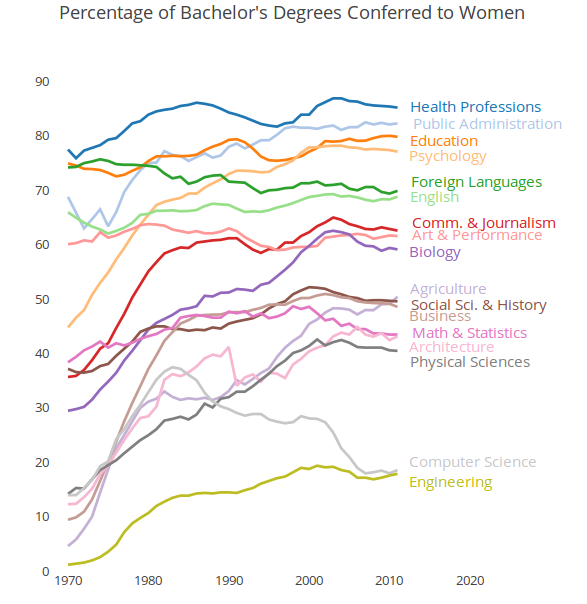
About 64% of recent New Zealand graduates were women but they have personality traits and verbal and reading skills that will be rewarded more in interactive professions and occupations. Women are pursuing these comparative advantages and maximising the rewards on their skills and natural talents. These differences in skills and talents will lead to different occupational and sub-occupational distributions and mixes as compared to men despite any differences arising from the gendered division of labour and effort and costs of care giving.
There are fewer women in STEM occupations because they have better options elsewhere to reward both their mathematical and scientific talents and their superior verbal and reading skills.
The wage premium for STEM occupations for women is much smaller because they have options elsewhere that reward all of their skills, not just their STEM related talents. Young women and well as young men do equally will in the STEM prerequisites. Women have more options is other higher power occupations that make full use of their more diverse talents.
Occupational segregation in the future in part will be driven the same factors behind much higher female tertiary educational attainment. Superior verbal and readings skills and greater persistence and self-organisation among women will make some occupations more rewarding for them as compared to males who have, on average, fewer of these innate talents.
Speaking of the @NZSuperfund -@TaxpayersUnion
24 Apr 2017 Leave a comment
in economic history, financial economics Tags: active investing, passive investing
Divided island: How Haiti and the DR became two worlds
24 Apr 2017 Leave a comment
in development economics, economic history Tags: economics of borders
How the cost of various goods and services have changed since 2000 in the USA
20 Apr 2017 Leave a comment
in economic history Tags: CPI, inflation
More evidence of mass kidnappings of @OxfamNZ @GreenpeaceNZ and other #ODA activists
18 Apr 2017 Leave a comment
in development economics, economic history, energy economics, growth miracles, resource economics
Mass kidnappings is the only explanation for their failure to dance in the streets celebrating the success of the spread of capitalism to developing countries priming The Great Escape of 1 billion people from extreme poverty inside 20 years.
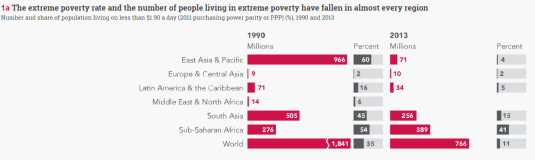
Source: Data | The World Bank.
Growth paths of #LatAm & the Caribbean the South East Tigers: wrld.bg/NCtLt #RiseoftheSouth http://t.co/IFuUOWldox—
World Bank Pubs (@WBPubs) May 31, 2015
The Dutch disease for the benefit of #GarethMorgan @stevenljoyce
18 Apr 2017 1 Comment
in applied price theory, applied welfare economics, economic history, industrial organisation, international economics, politics - New Zealand, Public Choice, rentseeking, survivor principle Tags: Dutch disease, export subsidies, picking winners
I am putting in a Official Information Act request to see if anyone advise ministers that a export promotion target results in a matching increase in imports along with a large appreciation in the New Zealand dollar. Did New Zealand dodge the Dutch disease from this foolhardy export promotion policy? The Dutch Disease story is one of sectoral shifts.
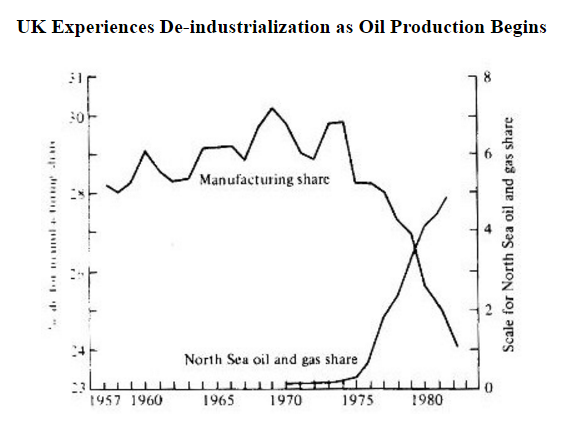
In the 1960s, with fixed exchange rates under the Bretton Woods system, the Netherlands discovered off-shore natural gas. As natural gas was extracted, it increased domestic income and spending. Investment was redirected toward the natural gas sector. Dutch wages and prices began to rise gradually. The Dutch guilder became overvalued in real terms, their industrial products became uncompetitive, and the manufacturing sector shrunk. This phenomenon of de-industrialization in the presence of rich natural resources was called the Dutch disease. They got natural gas but lost manufacturing.
In the late 1970s and early 80s, the UK experienced similar de-industrialization under a floating exchange rate regime. They discovered and exploited the North Sea oil fields. Since the global oil price was rising, the UK was expected to earn a great amount of foreign exchange in the future. But even before these earnings were realized, the British pound appreciated suddenly in both nominal and real terms. This damaged the British manufacturing sector.
Source: MF model – float
If there is an increasing demand for New Zealand exports if the Business Growth Agenda target of increasing New Zealand exports was successful, there is an increase in demand for New Zealand dollars to pay for these exports. This will result in an appreciation of the New Zealand dollar making imports cheaper. This will switch demand for New Zealand competing industries to these imports.
This process of currency appreciation and expenditure switching will continue until export match exports again. There is nothing wrong with an export boom as long as it is based on comparative advantage rather than subsidies.

3 Myths about Capitalism
18 Apr 2017 Leave a comment
in development economics, economic history Tags: The Great Fact
Marxism Explained in 2 Minutes, with Deirdre McCloskey
17 Apr 2017 Leave a comment
in applied price theory, development economics, economic history, history of economic thought, Marxist economics, Public Choice Tags: Deirdre McCloskey
How Capitalism Freed Victorian Women
16 Apr 2017 Leave a comment
in applied price theory, discrimination, economic history, gender, labour economics Tags: engines of liberation



Recent Comments