The real reason there aren’t more female scientists | FACTUAL FEMINIST
08 Mar 2018 Leave a comment
in discrimination, economics of education, gender, human capital, labour economics, occupational choice Tags: gender wage gap, reverse gender gap
How To Not Be Poor
08 Mar 2018 Leave a comment
in economics of education, economics of love and marriage, health economics, human capital, labour economics, occupational choice, poverty and inequality, unemployment, welfare reform Tags: child poverty, family poverty
Intersectional Feminism: What is it? | FACTUAL FEMINIST
23 Feb 2018 Leave a comment
in discrimination, economics of education, gender Tags: political correctness
Hillary Clinton on sexual assault issues: Crusader or hypocrite? | FACTUAL FEMINIST
23 Feb 2018 Leave a comment
in discrimination, economics of crime, economics of education, gender, law and economics, politics - USA Tags: 2016 presidential election, political correctness
Are gender specific toys a hazard to children? | FACTUAL FEMINIST
20 Feb 2018 Leave a comment
in discrimination, economics of education, gender, labour economics Tags: gender gap, political correctness
Is education worth it?
20 Feb 2018 Leave a comment
in applied price theory, economics of education, economics of information, human capital, labour economics, managerial economics, occupational choice, organisational economics, personnel economics Tags: signalling
Does @_chloeswarbrick believe @PPTAWeb betrays the working class? Are handmaidens of the bosses?
17 Feb 2018 Leave a comment
in economics of education, politics - New Zealand, unions
Unions fight for better playing conditions for their members. Is not that what the class war is all about? Unions are not there to act as management consultants to the employer, working out ways to make their wage slaves profitable – extract more labour surplus.
Please do not mention that the employer of teachers is the state sector. That is an argument against unions in the state sector, a very slippery slope.
When the interests of the union and it is teacher members and the interests of children conflict, the union will do what its mission is which is to protect its members.
The first jobs to be unionised were craft jobs. The craft unions certainly foster the marketability of their members but were keen to suppress competition nonetheless. To quote Charles Baird
Most unions in the private sector are in crafts and industries that have few companies or that are concentrated in one region of the country. This makes sense. Both factors—few employers and regionally concentrated employers—make organizing easier. Conversely, the large number of employers and the regional dispersion of employers sharply limit unionization in trade, services, and agriculture. A 2002 unionization rate of 37.5 percent in the government sector, more than four times the 8.5 percent rate in the private sector, further demonstrates that unions do best in heavily regulated, monopolistic environments. Even within the private sector, the highest unionization rates (23.8 percent) are in transportation (airlines, railroads, trucking, urban transit, etc.) and public utilities (21.8 percent), two heavily regulated industries.
Craft unions opposed unionisation of less skilled workers because it threatens their own ability to extract higher wages as explained in the Wikipedia entry:
The concept of organizing a strong federation on the basis of craft evolved out of conflict between the Knights of Labor (KOL), which organized mass organizations of unskilled, semiskilled and skilled workers by territory, and the American Federation of Labor (AFL), which organized only skilled workers.[1] The craft workers were capable of demanding more from their employers due to their skills, and therefore organized into stronger organizations pursuing narrower interests.[2] The AFL was formed as a direct result of the perceived need by skilled workers to defend their individual craft organizations from poaching by the Knights of Labor.[3] The Knights of Labor believed that skilled workers should dedicate their greater leverage to benefit all workers.[4] Selig Perlman wrote in 1923 that this resulted in “a clash between the principle of solidarity of labor and that of trade separatism.”[2] The trade unions “declared that their purpose was ‘to protect the skilled trades of America from being reduced to beggary’.”[5]… As long as the craft unions were the dominant power in the AFL, they took every step possible to block the organizing of mass production industries. This led to challenges from both inside and outside the Federation.
The craft unions such as teachers unions have more bargaining power because they are difficult to replace on short notice unlike less skilled workers. In addition, teachers are much more difficult to automate away. I am not too sure what the teachers union might think of giving more responsibility to teachers aides?
Gender equality paradox in STEM education
16 Feb 2018 Leave a comment
in discrimination, economics of education, gender, human capital, labour economics, occupational choice Tags: gender wage gap
Still waiting for the growth dividend of the education boom
15 Feb 2018 Leave a comment
in economic growth, economic history, economics of education, human capital, labour economics, macroeconomics Tags: endogenous growth theory

The case for charter schools, in 90 seconds Roland Fryer
12 Feb 2018 Leave a comment
in economics of education Tags: charter schools
Laura Kipnis: Political Correctness is Now Eating the Left Too
11 Feb 2018 Leave a comment
in discrimination, economics of education, gender, law and economics Tags: free speech, political correctness
Can write a PhD in law on any old tripe these days. But how can you find a PhD supervisor who can stay awake reading it?
11 Feb 2018 Leave a comment
in economics of education, law and economics, Marxist economics Tags: Leftover Left
Why I am not sold on @bryan_caplan’s The Case against Education
31 Jan 2018 1 Comment
in economics of education, human capital, labour economics
Bryan Caplan thinks 80% of education is signalling. I think it is no more than 50%. One reason is the times I have worked with managers and colleagues who are not economists doing policy analysis work.
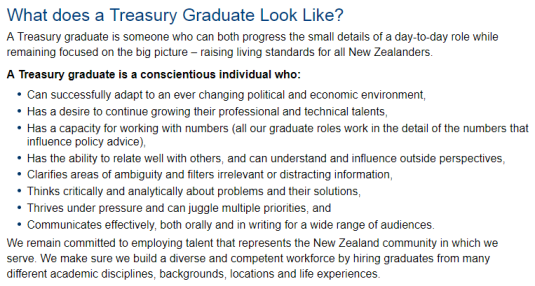
If education is 80% signalling, people from noneconomic backgrounds should be as good as those with economic backgrounds particularly at the more senior levels as they gain experience and the economists forget their university training.
My experience with managers who are not economists at the Treasury, and the Department of Labour was they were difficult to deal with compared to the one manager I had that did have an economics degree. They simply did not know what they were doing on a number of occasions, often substituting their own opinions based on what they would say in the pub for good economic analysis. They did not know any better. They are not gone through microeconomics 101 that showed how many common explanations of things did not work if scrutinised according to the economic way of thinking. They are often resentful of economists as colleagues because they kept pointing out what they could not do or what unintended consequences might spring up.
When the manager had training in economics, considerable more progress could be made both in argument and then working out how to tailor it to a ministerial audience.
As for colleagues who were policy analyst with no economic training, they seem to lack the ability to define what the problem was, develop options and check for unintended consequences. They certainly had no idea how to marshal evidence to support competing options and test the evidence in front of them, much less have a general background knowledge of an area to be able to quickly change their mind away from their private opinions in the light of new arguments and evidence.
Most of all, both the managers and policy analysts who I worked with who did not have economic training did not know what they did not know. It was the Dunning Kruger effect. They did not know there are literatures on this issue and they could not remember even in sketch outline that there was research in this area and many well-known facts and results is what with a well-known uncertainties. They suffered the overconfidence of amateurs.
In time, it got so frustrating that I would ask a Socratic question about that was an interesting question be it about rent control, minimum wages, employment law, exchange rates, industry policy or financial crises, and wonder if anyone had looked into that at universities. Reading econometrics results taught me that if the main result is not in doubt, that there is at least not mixed evidence or a few countervailing studies, the econometricians are not working hard enough for PhD scholarships and academic tenure.
Luke Froeb made considerable progress by simply redefining market failure as a business opportunity, a missing market or missing product. Whenever people talked of the market failure, I would ask who could profit from fixing that market failure.
To be fair, I always thought the quality of economic analysis would double if everyone remembered the first 6 weeks of microeconomics 101. I gained the impression when I was a graduate at the Australian Department of Finance.
Watching non-economists do macroeconomic policies is frightening in that they have no idea how to tell fallacies from good analysis. I spotted that in the prime minister’s department in the mid-1980s in Australia when everyone got deeply concerned about the current account deficit because everyone else was deeply concerned about it and it attracted a lot of newspaper headlines saying it was a problem.
Also, I noticed as I got older, ideas rejected 10-20 years ago were recycled. Because I understood the economics behind those ideas, I remembered them in their new disguises and remembered the relevant literature that developed since their last appearance.
I also worked with many econometricians in the public sector. I learnt enough econometrics to the graduate level to be able to talk to them. I never pretended I could do their job and most of their job was based on what they learnt at University and then refined in the workplace.
Finally, I found out in the kitchen at parties in Canberra in the 1980s and 1990s that strangers would come up and abuse you as soon as they found out there is an economist about. They would tell me how ignorant economists were and did not know anything about this, that and the other. I would then point to the vast literatures on every one of those topics. They still has to be done these days even to academic economists who should know better.
In which #STEM career choice bars are women overrepresented?
30 Jan 2018 Leave a comment
in economics of education, gender, human capital, occupational choice
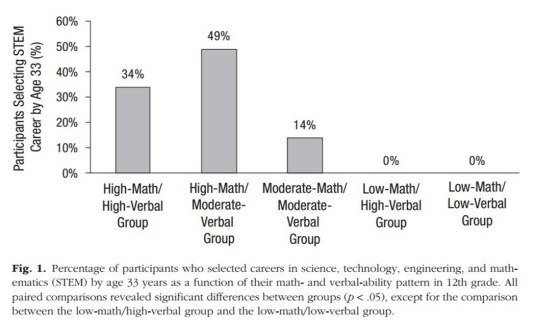
Source: “Not Lack of Ability but More Choice: Individual and Gender Differences in Choice of Careers in Science, Technology, Engineering, and Mathematics,” by Ming-Te Wang, Jacquelynne S. Eccles, and Sarah Kenny,
 Utopia, you are standing in it!
Recent Comments