— EPI Chart Bot (@epichartbot) January 26, 2016
The US gender wage gap by level of education
20 Mar 2016 Leave a comment
in discrimination, economics of education, gender, human capital, labour economics Tags: gender wage gap
The rising marriage premium for power couples
19 Mar 2016 Leave a comment
in economics of education, economics of love and marriage, economics of marriage, labour economics, population economics, poverty and inequality
Source: Four Forces Watch | askblog.
Pizza and Conversation with James Heckman
19 Mar 2016 Leave a comment
in applied price theory, applied welfare economics, economics, economics of education, human capital, labour economics, labour supply, poverty and inequality Tags: James Heckman
New Zealand physical and human capital (by a skill level), 1986 – 2001
17 Mar 2016 Leave a comment
in applied welfare economics, economic history, economics of education, entrepreneurship, human capital, labour economics, politics - New Zealand, poverty and inequality Tags: pension fund socialism, top 1%, Withering away of the proletariat
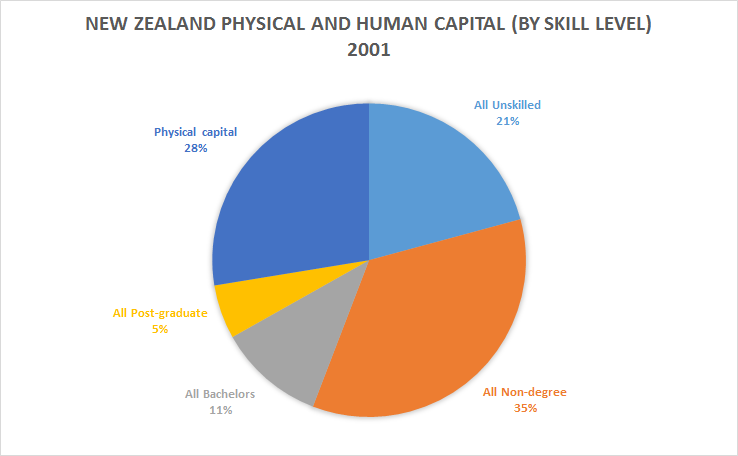
New Zealand working class is wealthier than the entire capitalist class. Their human capital, shown in the chart below as the human capital of the unskilled and non-degree workers, far exceeds the value of the physical capital stock of New Zealand.
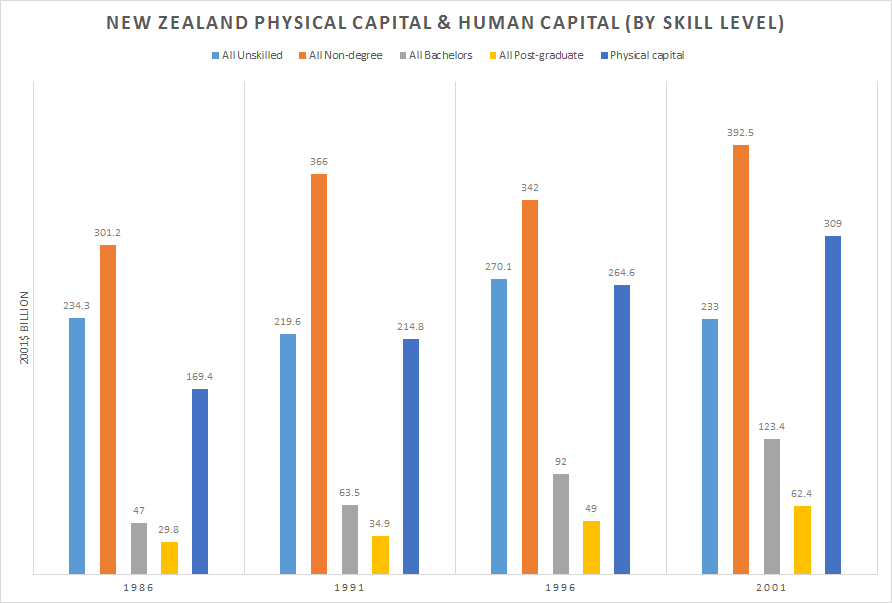
Source: Lˆe Thi. Vˆan Tr`ınh, Estimating the monetary value of the stock of human capital for New Zealand, University of Canterbury PhD thesis (September 2006).
Only part of this physical capital stock is owned by the capitalist class given we live in the era of pension fund socialism. About a 3rd of that physical capital stock is owner occupied homes.
Source: Lˆe Thi. Vˆan Tr`ınh, Estimating the monetary value of the stock of human capital for New Zealand, University of Canterbury PhD thesis (September 2006).
The only reason that the share of unskilled and non-degree workers is in any way declining is the withering away of the proletariat. More and more people are joining the middle-class and going on to higher education.
Andrew Little is looking to update Labour's definition of the 'working class': stuff.co.nz/national/polit… http://t.co/AQ9mJL7CQf—
NZ Stuff Politics (@NZStuffPolitics) November 30, 2014
.
The value of New Zealand owner occupied homes, net capital stock and human capital stock since 1987
17 Mar 2016 Leave a comment
in applied welfare economics, economic history, economics of education, entrepreneurship, human capital, labour economics, politics - New Zealand, poverty and inequality, urban economics Tags: household wealth, housing prices, pessimism bias, top 1%
Tring Le found that the human capital stock was consistently 2.6 times the value of the physical capital stock of New Zealand.
I decided to apply that ratio to the net capital stock of New Zealand estimates of Statistics New Zealand back to 1987 to see what we get. It is pretty standard for the value of human capital to be two to two and one-half times the value of physical capital.

Source: National Accounts (Industry Benchmarks): Year ended March 2013 and Lˆe Thi. Vˆan Tr`ınh, Estimating the monetary value of the stock of human capital for New Zealand, University of Canterbury PhD thesis (September 2006), Table 4.8: Human and physical capital stocks.
All the above chart says it is most wealth in New Zealand is held by ordinary people either as their human capital or the value of their homes.
An Economic Approach to School Integration: Public Choice with Tie-ins
12 Mar 2016 Leave a comment
in applied price theory, constitutional political economy, discrimination, economics of education, economics of media and culture, rentseeking
Thomas Borcherding “An Economic Approach to School Integration: Public Choice with Tie-ins.” Public Choice, 1977, argues that a reason for racial or ethnic discrimination in the public sector is politics encourages the coercive transfer of income from the racial, religious or ethnic group to those with more political influence.
Race can be used as a means of organizing coalitions to lobby for fiscal and economic discrimination in favour of even a previously unprejudiced group.
Preferences of each group to locate in a common geography and the severe control over entry or exit from the group that such things as skin colour, language, caste, and religious dogma impose make the organization of racial or ethnic coalitions by political entrepreneurs fairly cheap and minimises free riding and defection.
Prejudice may reinforce the solidarity of each group and help to monitor via custom, mores, and folkways the behavior of those that would attempt to bring persons of other groups into the former coalition. Further, prejudice may also serve as a device to rationalize exploitation of another group by fiscal or other means.

Borcherding argues that integration, racial balancing, quotas, and busing of school children take on a new logic when income transfers can be tied to fairly immutable characteristics such as race.
Mixing of children by race reduces the ability of a white dominated school board to differentially favour its own partisans’ children and to discriminate against those of blacks.
This paper anticipated Becker’s point that the competition among pressure groups for political influence for looks for lower cost ways of redistributing wealth so as to as much as possible limits the largess as much as possible to the pressure groups that lobby for it and their allies.

@GdnHigherEd the greatest generation leaving their safe space
12 Mar 2016 Leave a comment
in economics of education, liberalism

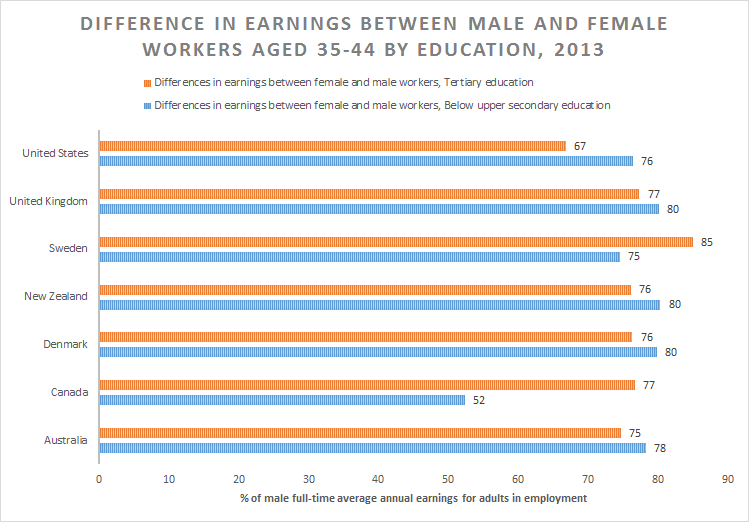
The gender pay gap for high school leavers and graduates aged 35-44 in the US, UK, Canada, Denmark, Sweden, Australia and New Zealand
10 Mar 2016 Leave a comment
in discrimination, economics of education, gender, human capital, labour economics, labour supply, occupational choice Tags: compensating differentials, education premium, female labour force participation, gender wage gap, graduate premium, maternal labour force participation
The USA, the gender pay gap gets worse if you go to college. By contrast, in Sweden and especially Canada the gender pay gap is much less for graduates than for those with a high school education.
Data extracted on 09 Mar 2016 22:28 UTC (GMT) from OECD.Stat.
In most countries in the chart above, going on to university and graduating does not reduce the gender pay gap by the time you reach your late 30s and early 40s. Best explanation for that is that part of the graduate wage premium is traded for work-life balance.
Is Education Signaling or Skill Building?
10 Mar 2016 Leave a comment
in applied price theory, economics, economics of education Tags: signalling
James Heckman on what money cannot buy including a universal basic income
08 Mar 2016 Leave a comment
in economics of education, politics - New Zealand, population economics, poverty and inequality, welfare reform

Source: The Economics of Human Development and Social Mobility, James J. Heckman, Stefano Mosso, NBER Working Paper No. 19925, February 2014.
Best single defence of charter schools ever
03 Mar 2016 Leave a comment
in economics of education, politics - New Zealand, politics - USA


How to deal with science denialists
03 Mar 2016 Leave a comment
in economics of education, economics of information, economics of media and culture, energy economics, environmental economics, global warming, health economics Tags: antiscience left, climate alarmism, growth of knowledge, philosophy of science, quackery, Quacks
Most climate alarmists do not separate the policy issues, the economic issues, from the science of global warming as suggested in this flowchart. Specifically, they do not ask what is the economic and social cost of global warming.
@Maori_Party New Zealanders aged 25 to 34 with NCEA level 4 or above qualifications by ethnicity
26 Feb 2016 Leave a comment
in economic history, economics of education, politics - New Zealand Tags: education premium, Maori economic development
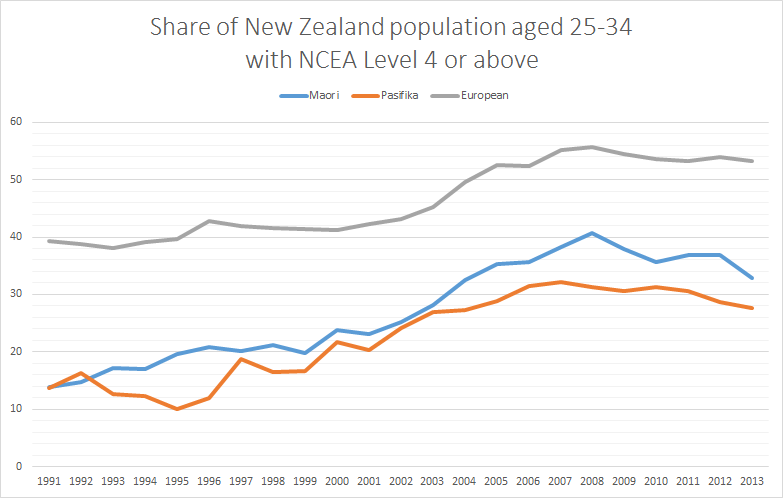
Source: OECD Economic Survey New Zealand 2015.
 Utopia, you are standing in it!
Recent Comments