The war on smoking, in one chart i100.io/6f3d2uj http://t.co/mlajmx68yq—
i100 (@thei100) November 26, 2014
More and more countries still think smokers don’t know the risks of cancer sticks
02 Jun 2015 Leave a comment
in economics of information, economics of media and culture, economics of regulation, health economics Tags: economics of smoking, nanny state, Other people are stupid fallacy, paternalism, risk trade-offs
Homeopathy explained
14 May 2015 Leave a comment
in economics of information, health economics Tags: homeopthay, Quacks
The Ten Pillars of Economic Wisdom
10 May 2015 Leave a comment
in applied price theory, applied welfare economics, Austrian economics, comparative institutional analysis, constitutional political economy, development economics, economic history, economics of education, economics of information, economics of media and culture, economics of regulation, energy economics, entrepreneurship, financial economics, health economics, history of economic thought, industrial organisation, survivor principle Tags: David Anderson, evidence-based policy, offsetting behaviour, pretence to knowledge, The fatal conceit, unintended consequences
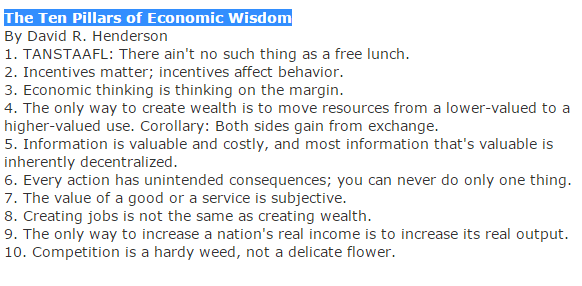
via The Ten Pillars of Economic Wisdom, David Henderson | EconLog | Library of Economics and Liberty.
Media bias is not new
09 May 2015 Leave a comment
in applied price theory, economic history, economics of information, economics of media and culture, Public Choice, rentseeking Tags: media bias
Organic farming is a rebranding of pre-industrial revolution agriculture
09 May 2015 Leave a comment
in economics of information, economics of media and culture, economics of regulation, health economics, technological progress Tags: agricultural economics, consumer fraud, industrial revolution, organic farming, quackery, The Great Enrichment, The Great Escape
Organic farms use a lot of pesticides
09 May 2015 Leave a comment
in economics of information, economics of media and culture, environmentalism Tags: agricultural economics, organic farming
Product disclosure by medical quacks
07 May 2015 Leave a comment
in economics of information, economics of media and culture, health economics Tags: alternative lifestyles, antiscience left, natural medicine, Quacks
China’s languages mapped
06 May 2015 Leave a comment
in economics of information, economics of media and culture Tags: China, economics of language

Palm Reading explained
05 May 2015 Leave a comment
in economics of information, economics of media and culture, health economics Tags: Palm Reading, quackery
A lot of people look up their health on their smartphones, suspiciously so
04 May 2015 Leave a comment
in applied welfare economics, economics of information, economics of media and culture Tags: marketing research, response bias, statistical bias, survey bias
When I studied marketing research as a undergraduate, I studied television watching habits. None of the people we interviewed would admit watching the most popular programs including the soapies. Seeing us in our bright red University of Tasmania blazers at Salamanca Place in Hobart, they all said they watched the news and documentaries. That taught me a bit about response bias in marketing that stays with me to this day.
Evolution explained
04 May 2015 Leave a comment
in economics of information, economics of media and culture Tags: conjecture and refutation, DNA evolution, evolution
Creative destruction in advertising revenue
04 May 2015 Leave a comment
in economics of information, economics of media and culture, environmental economics, industrial organisation, survivor principle Tags: creative destruction, economics of advertising, entrepreneurial alertness, Google, legacy media, markets selection, The meaning of competition
 Utopia, you are standing in it!
Recent Comments