How Do You Deal With Painful Truths? Left vs. Right
02 May 2016 Leave a comment
in applied price theory, applied welfare economics, comparative institutional analysis, constitutional political economy, economics of media and culture Tags: expressive voting, rational irrationality
Los Lobos – Come on, Let’s Go
02 May 2016 Leave a comment
in economics of media and culture, Music Tags: Los Lobos
The 3 keys to school choice success
02 May 2016 Leave a comment
in applied price theory, economics of education, economics of media and culture Tags: School choice
The four seasons of Egypt and Libya: spring promise, glorious summer, fall reality, winter of discontent
02 May 2016 Leave a comment
in economics of media and culture

President Obama intervened in 2011 to destabilize the leaders of two confirmed United States allies, Libya in North Africa and Egypt in the Middle East. He achieved his objectives with the brutal assassination of Colonel Gaddafi and the caged trial of Hosni Mubarak. Events have followed precisely predictable paths since the initiation of hostilities against these two pro-Western leaders.
Gaddafi’s Libya could not possibly expect to survive the combined assault of NATO forces, even given the ragtag, undisciplined rebels that rose up against his regime. Mubarak could not outbid the United States in its successful effort to deploy taxpayers’ monies in bribing a corrupt Egyptian military to shift allegeiance in favor of the Muslim Brotherhood and its anti-Western collaborators. So spring promise inevitably turned into glorious summer for those who seek chaos in the Middle East.
Glorious summer, however, turned out to be brief indeed. Predictably, the fall has brought reality, in the…
View original post 354 more words
The countries that Britons like and dislike most
02 May 2016 1 Comment
in economics of media and culture Tags: British politics
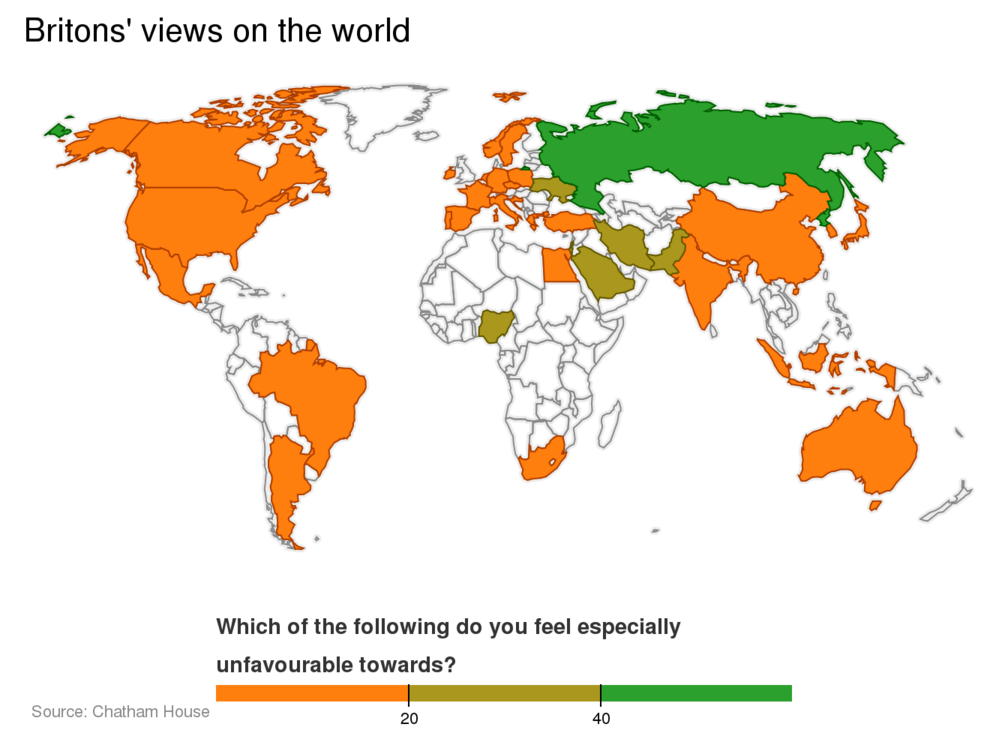
Source: 19 thought-provoking maps that will change how you see the world.
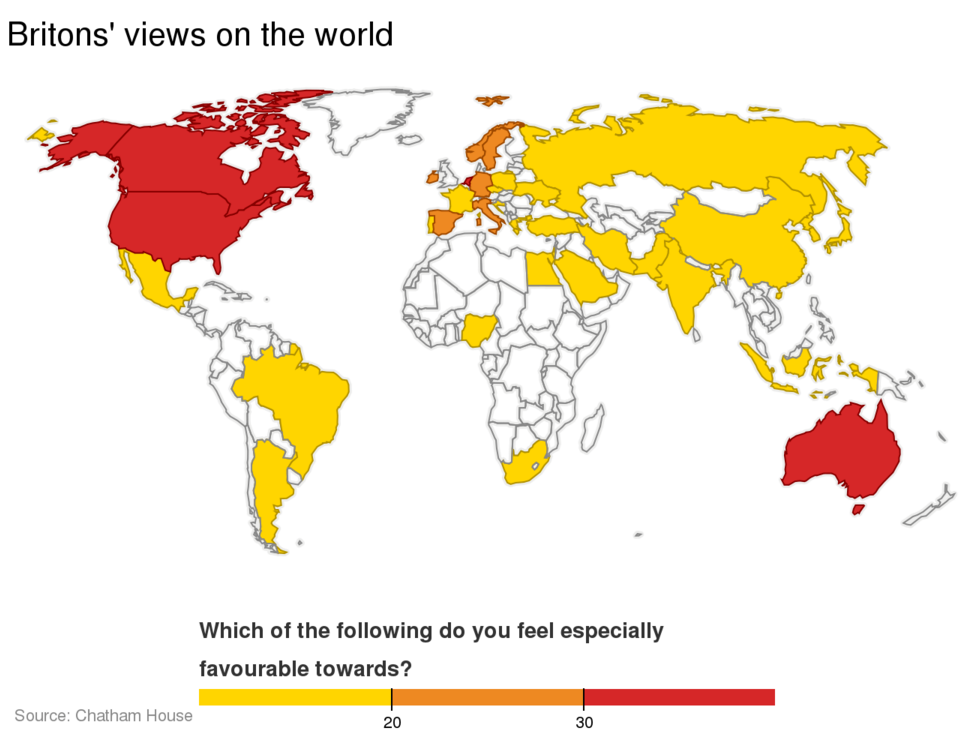
Source: 19 thought-provoking maps that will change how you see the world.
The Left’s problem with Anti-Semitism
02 May 2016 Leave a comment
in economics of media and culture

Let’s be very clear – many on the British far-left (and far too many Muslims unfortunately) don’t believe the state of Israel should exist.
They think it is a racist state akin to apartheid South Africa and it needs to be destroyed. They believe the displacement of Palestinians as the state was created is an historic injustice that can only be righted by – one way or another – abolishing the Jewish state.

(The picture is me [left] as part of an NUS Executive delegation that visited Israel/Palestine in 1978 – also in the picture are Trevor Phillips and David Aaronovitch)
View original post 1,034 more words
“Star Spangled Scapegoat”
01 May 2016 Leave a comment
in economics of media and culture

I just read a great op-ed by Tim Padgett called “Without The U.S. To Scapegoat, Latin America Discovers Its Inner Godzillas.” Padgett argues that President Maduro is running out of scapegoats to blame for the debacle that is currently the Venezuelan economy:
“When a U.S. president is eating ropa vieja in Havana and dancing tango in Buenos Aires, Latin American leaders can’t seem to find their handy Star-Spangled Scapegoat anywhere in their desk drawers. Instead, from the Río Grande to the Río de la Plata, Washington’s new and less imperialista engagement with Latin America has helped expose the region’s inner Godzillas.”
As for the region’s “inner Godzillas,” Padgett is referring to a recent meme about Venezuela’s electricity crisis. Here is his description:
“A new Internet meme offers him a culprit: Godzilla! It shows the slimy monster destroying Venezuela’s power lines under a caption that reads: “Government Finds Out…
View original post 27 more words
Leland Yeager wrote the best monetarist (text)book
01 May 2016 Leave a comment
in economics of media and culture

In my recent post about Keynes’ “A Tract on Monetary Reform” I quoted Brad Delong for saying that Tract is the best monetarist book ever written. I also wrote that I disagreed with Brad on this.
That led Brad to respond to me by asking: “What do you think is a better monetarist book than the Tract?”
I think that is a very fair question, which I tried to answer in the comment section of my post, but I want to repeat the answer here. So here we go (the answer has been slightly edited):
One could of course think I would pick something by Friedman and I certainly would recommend reading anything he wrote on monetary matters, but in fact my pick for the best monetarist book would probably be Leland Yeager’s “Fluttering Veil”.
In terms of something that is very readable I would clearly choose Friedman’s
View original post 381 more words
Long and variable leads and lags
01 May 2016 Leave a comment
in economics of media and culture
Scott Sumner yesterday posted a excellent overview of some key Market Monetarist positions. I initially thought I would also write a comment on what I think is the main positions of Market Monetarism but then realised that I already done that in my Working Paper on Market Monetarism from last year – “Market Monetarism – The Second Monetarist Counter-revolution”.
My fundamental view is that I personally do not mind being called an monetarist rather than a Market Monetarist even though I certainly think that Market Monetarism have some qualities that we do not find in traditional monetarism, but I fundamentally think Market Monetarism is a modern restatement of Monetarism rather than something fundamentally new.
I think the most important development in Market Monetarism is exactly that we as Market Monetarists stress the importance of expectations and how expectations of monetary policy can be read directly from market pricing. At…
View original post 968 more words
Krugman finally acknowledges that it is all about monetary policy
01 May 2016 Leave a comment
in economics of media and culture
Paul Krugman has a very interesting blog post on the relative economic performance of the US and the euro zone.
Krugman starts out with this graph.

Krugman then goes on to give a complete (Market) Monetarist explanation for this development:
Things really go off track only in 2011-2012, when the U.S. recovery continues but Europe slides into a second recession…
…What was happening in 2011-2012? Europe was doing a lot of austerity. But so, actually, was the U.S., between the expiration of stimulus and cutbacks at the state and local level. The big difference was monetary: the ECB’s utterly wrong-headed interest rate hikes in 2011, and its refusal to do its job as lender of last resort as the debt crisis turned into a liquidity panic, even as the Fed was pursuing aggressive easing.
This is of course what Market Monetarists have been saying forever – we even have a…
View original post 693 more words
Merv Hughes and Kerry O’Keeffe – Bloopers reel during the making of their recent TV Ad for West Indies Tour
01 May 2016 Leave a comment
in cricket, economics of media and culture Tags: economics of advertising
Denmark Slashes Wind Power Subsidies to Curb Runaway Power Costs
01 May 2016 Leave a comment
in economics of media and culture


When the wind industry and its worshippers start chanting their mantras about the ‘wonders’ of wind, it isn’t long before they start preaching about the examples purportedly set by the Europeans; and, in particular, the Nordic nations.
That the great wind power fraud was driven by Denmark’s struggling turbine maker, Vestas probably has a fair bit to do with the worshippers’ fanatic-cult-like veneration of Scandinavia.
But, hold the phone?
It seems that economics works in precisely the same fashion in Denmark, Sweden, Finland and Norway, as just about everywhere else (save Cuba and North Korea, say?).
When you’re trying to sell a ‘product’ with NO commercial value, the ‘business’ – for want of a better word – can only be about what you can extract from gullible/compliant governments (and unwitting power consumers), in the form of massive and endless subsidies.
Now, in the wind industry’s heartland, the Danes…
View original post 2,104 more words
Review: Prime Suspect, Series 3
01 May 2016 Leave a comment
in economics of media and culture

by Les Chappell
Prime Suspect
Series 3, Parts 1 & 2
Original airdates: Dec. 15 and 16, 1992
When I started doing this project to review the entire run of Prime Suspect, one of my major objectives was to understand the series’ impact on other cop shows. And after three installments, it’s impossible not to see its fingerprints on the two decades worth of police procedurals, its commitment to the realism and mechanics of an investigation offering an alternative to the more populist, cowboy style of poolice work. The recently concluded The Closer has been the most frequent comparison made with both shows having a tough female investigator at the center of the show, but most any show that has such a character owes something to the force with which Jane Tennison puts herself at the center of an investigation. It’s also easy to see its fingerprints on David…
View original post 2,365 more words
Political corruption on the docket for the last case of the SCOTUS term
01 May 2016 Leave a comment
in economics of media and culture

By Cara L. Gallagher, weekend contributor
Oral arguments for the last case of the Supreme Court’s term were this week. The case, McDonnell v. U.S., was about ethics and potential corruption between a donor and the former governor of Virginia. The timeliness of this case is not lost on this citizen of Illinois, where we should probably consider putting links to contribute to our candidates’ legal defense funds on our ballots. That’d be funny if their chances of going to jail for ethics violations or corruption weren’t actually greater than fifty percent. Four out of the last seven governors have been imprisoned. But at least our criminal governors make it easy on the courts! Dear Children’s Memorial Hospital, I won’t release your $8 million of state funding until you give me a $50,000 campaign contribution. Sincerely, Gov. Rod Blagojevich.
But what would it mean if for “the…
View original post 1,129 more words


Recent Comments