What is television for – facts, confirmation or infotainment?
12 Nov 2014 Leave a comment
in economics of media and culture, Karl Popper, liberalism Tags: conjecture and reputation, The Age of Enlightenment, the growth of knowledge
Bill Murray – somewhere in New Zealand
10 Nov 2014 Leave a comment
in economics of media and culture Tags: Bill Murray

One World Trade Center is finally open for business. All 12 years of construction in one gif!
07 Nov 2014 Leave a comment
in economics of media and culture, politics - USA, urban economics Tags: World Trade Center
That Catcalling Video and Why “Research Methods” is such an Exciting Topic (Really!) — The Message — Medium
07 Nov 2014 1 Comment
in discrimination, economics of media and culture, gender, labour economics Tags: research design, sex discrimination, sexual harassment
The filmmakers claim to have shot this video while walking the streets of Manhattan for 10 hours, but over half of the shots in the video are actually taken from just one street, namely 125th St. in Harlem.

Woody Allen vs William Buckley
07 Nov 2014 Leave a comment
in economics of media and culture, liberalism Tags: William F. Buckley, Woody Allen
Britain is a world leader in exporting creeps » Nick Cohen
05 Nov 2014 Leave a comment
in economics of media and culture, liberalism, politics Tags: Jihadist, Nick Cohen, political correctness
The British recruits who have joined Isis are not exceptions. They flourish in a culture in which it is so commonplace to offer support to authoritarian regimes and movements that few bother to condemn it.
Free speech ought to mean the freedom to challenge and criticise in all except the most tightly defined circumstances. Instead in Britain tolerance has become indifference; a lazy desire to live in our comfortable bubbles.
The dominant culture views vigorous criticism as rude or insensitive – or, to use that popular and completely meaningless school-prefect putdown, “inappropriate.” More often that not, criticism is taken down and used as evidence of the critic’s failings, his or her obsessions and phobias.
We cannot be bothered to challenge fanatics. We say we don’t want to ‘force our views on others’ – as if argument were physical coercion. And if those others leave England to enslave Kurdish women, or applaud kleptomaniac dictators, we are not responsible. We never concerned ourselves with their affairs, nor argued with them for a moment.
Many poisonous plants have bloomed in this dank climate.
via Britain is a world leader in exporting creeps » Spectator Blogs.
A New Measure of Suspense
03 Nov 2014 Leave a comment
in economics of media and culture, health economics Tags: sport
Sporting suspense as measured by the number of heart attacks during world cup finals.

In our paper, Alex Frankel, Emir Kamenica and I argue that soccer is among the most suspenseful sports according to our theoretical measure. Now, via Matt Dickenson, comes an empirical validation of this finding using German cardiac arrest data:
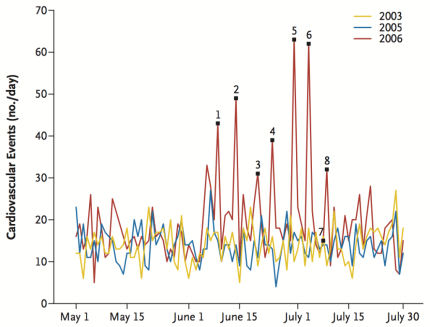
The red line shows the spike in heart attacks on the dates of 2006 World Cup matches involving the German national team. Note that point 7 is the third place match against Portugal after Germany had been eliminated in their semi-final match against Italy (point 6.)
Pop Stars Actually Do Die Too Young – The Atlantic
30 Oct 2014 Leave a comment
in economics of media and culture, health and safety, labour economics, occupational choice Tags: compensating differentials, labour economics, music


The role of Bollywood in the fall of the Permit Raj and emergence of the Indian economic miracle
30 Oct 2014 Leave a comment

‘Killing Bigfoot’: Sad days for poor Sasquatch – LA Times
29 Oct 2014 Leave a comment
in cats, economics of media and culture
Rubbish programs like this are destroying the animal planet channel. Why are there not more programs about kittens
via ‘Killing Bigfoot’: Sad days for poor Sasquatch – LA Times.





Recent Comments