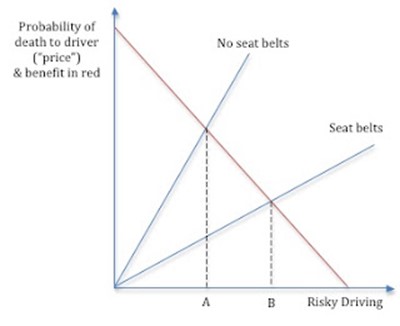
Stronger road safety laws kill more pedestrians

File:USA annual VMT vs deaths per VMT.png

Sam Peltzman likes to point out the road fatalities in the USA fell pretty much at a steady rate of 3% for the entire 20th century. There was no break in trend with the drop in fatalities  after major road safety legislation was passed by Congress in 1966.

The composition of who died changed: Peltzman found fewer drivers and passengers died but the more pedestrians were killed because drivers drove faster and with less care. Alma Cohen and Linan Einav (2003) found that seat-belt laws, in the absence of any behavioural response, were expected to save three times as many lives as were in fact saved. This shortfall because of greater risk taking is the Peltzman effect:

the hypothesized tendency of people to react to a safety regulation by increasing other risky behaviour, offsetting some or all of the benefit of the regulation.

The dead are many – the U.S. Food and Drug Administration (FDA)

I found that the unregulated market was very quickly weeding out ineffective drugs prior to 1962. Their sales declined rapidly within a few months of introduction, and there was thus little room for the regulation to improve on market forces . . . most of the subsequent academic research reached conclusions similar to mine . . .

The carnage from this regulation, I regret to assure you, will continue for a long time . . . the deaths of which I speak are counterfactual deaths, not deaths that can be directly connected to any regulatory malfeasance . . .

the actual victims of the regulation did not swallow a bad FDA-approved pill. They merely failed to swallow a good one in time and never knew what they had missed.

Sam Peltzman 2005, 15–6

Sam Peltzman and the great restraint in the growth of government, 1980-2007

From 1950 to 1980 the size of government doubled in the developed world and then stopped dead in 1980. This great restraint on the growth of government happened everywhere. It was not just Thatcher’s Britain or Reagan’s America. It was everywhere, in France and Germany, and even in Scandinavia.

Peltzman’s data below has government spending double between 1950 and 1980, and then nothing much happened in between 1980 and 2007 – the size of government is pretty flat as a share of GDP for 27 years.
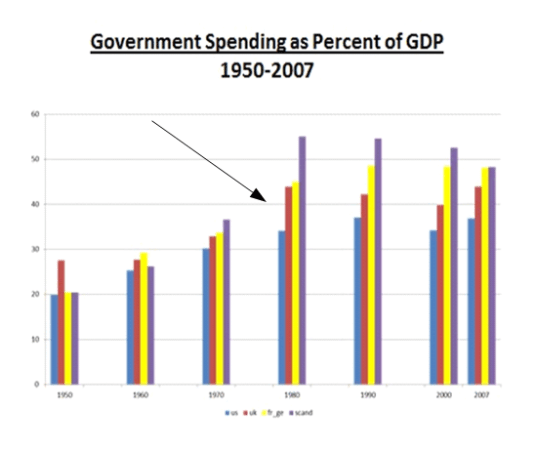
Source: Sam Peltzman, The Socialist Revival? (2012).

There is a noticeable reduction in the size of government spending in Scandinavia. Reagan and Thatcher had nothing on those Social Democrats in Scandinavia when it comes to cutting the size of government.

Governments everywhere hit a brick wall in terms of their ability to raise further tax revenues. Political parties of the Left and Right recognised this new reality.

Government spending grew in many countries in the 20th century because of demographic shifts, more efficient taxes, more efficient spending, a shift in the political power from those taxed to those subsidised, shifts in political power among taxed groups, and shifts in political power among subsidised groups.

The median voter in all countries was alive to the power of incentives and to not killing the goose that laid the golden egg.

After 1980, the taxed, regulated and subsidised groups had an increased incentive to converge on new lower cost modes of redistribution.

More efficient taxes, more efficient spending, more efficient regulation and a more efficient state sector reduced the burden of taxes on the taxed groups.

Most subsidised groups benefited as well because their needs were met in ways that provoked less political opposition.

Gary Becker made this warning about the political repercussions of tax reform and economic reform in general for the size of government:

…the greater efficiency of a VAT and its ease of collection is a two-edged sword.

On the one hand, it would raise a given amount of tax revenue efficiently and cheaply.

Since economists usually evaluate different types of taxes by their efficiency and ease of collecting a given amount of tax revenue, economists typically like value added taxes.

The error in this method of evaluating taxes is that it does not consider the political economy determinants of the level of taxes.

From this political economy perspective, the value added tax does not look so attractive, at least to those of us who worry that governments would spend and tax at higher levels than is economically and socially desirable.


Reforms ensued after 1980 led by parties on the Left and Right, with some members of existing political groupings benefiting from joining new political coalitions.

The deadweight losses of taxes, transfers and regulation limit inefficient policies and the sustainability of redistribution.

Peltzman likes to note that at the start of the 20th century, the United States government was about 8% of GDP. The two largest programs were education and highways. The post office was as big as the military.

Government is about five times that now with defence, health, education and income security accounting for 70% of this total. Peltzman makes the very interesting point that:

There is no new program in the political horizon that seems capable of attaining anything like the size of any of these four.

For the time being the future government rest on the extent of existing mega programs.

Health and income security account for 55% of total government spending in the OECD. It is in these two programs where the future of the growth of government lie.

The pressure for that growth in government will come from the elderly. Governments will have to choose between high taxes on the young to fund these programs for the elderly or find other options.

Regular pardons for speeding offences, accident rates and the Peltzman effect

The French and Korean president every election or so pardons all minor traffic offences. The accident rate goes up on the eve of this pardon.

Despite the obvious incentive effect of safer cars on risk taking, I have argued with people until they were black and blue where they were denying that accident rates respond to incentives and risks. My interlocutor even denied that his driving habits would change if seat belts were banned. Oddly enough, he did believe that people acted on better information about risks. I do not know why he thought they had an incentive to act on new information.

I mentioned this French pardon in another conversation. He mentioned that when he lived in Paris, he would save up his traffic and parking tickets in anticipation of the pardon.

Armen Alchian’s famous solution to speeding was to put a jagged spike in car wheels to make sure the driver died if he had an accident. This would ensure that everyone drives very carefully, assuming that anyone every got into a car ever again.

People have considerable control over the risk of accidents. When Sweden changed from driving on the left to driving on the right, motor insurance claims fell 40% for six weeks; fatalities took two years to return fully to previous levels.

The Peltzman effect was named after Sam Peltzman’s findings in “The Effects of Automobile Safety Regulation”, Journal of Political Economy August 1975 about the impact of mandatory safety devices on the accident rates for passengers and pedestrians.

Peltzman found that enough extra pedestrians were mowed down by drivers who were driving faster because they were safer that the increase in these deaths offset the fewer number of drivers and passengers dying in accidents.

Peltzman never said that the behavioural offset to greater safety and reduced risk would always be complete in all cases. Many subsequent studies found at least a partial offsetting effect of greater safety on risk taking, including an increased risk of accidents for others.

Sports economists even found the Peltzman effect in NASCAR racing. A major new safety rule led to more on-track accidents and an increased risk to both spectators and pit crew members. Greg Mankiw pointed to an Australian news report that 4WD drivers were almost four times more likely than other drivers to be using a mobile phone. Maybe they fell safer in accidents. I drive a Toyota Corolla.

The Peltzman effect is a simple point that many still resist. The whole point of safety equipment is to allow us to undertake riskier activities. When more safety equipment becomes available or is mandated, people will undertake more of the risky activity because it is now safer to do so.

HT: http://correctionspageone.blogspot.co.nz/2010/09/seatbelts-are-lifesavers-in-your-car.html for graphics

Next Newer Entries

Bassett, Brash & Hide

Celebrating humanity's flourishing through the spread of capitalism and the rule of law

Truth on the Market

Scholarly commentary on law, economics, and more

The Undercover Historian

Beatrice Cherrier's blog

Matua Kahurangi

Celebrating humanity's flourishing through the spread of capitalism and the rule of law

Temple of Sociology

Celebrating humanity's flourishing through the spread of capitalism and the rule of law

Velvet Glove, Iron Fist

Celebrating humanity's flourishing through the spread of capitalism and the rule of law

Why Evolution Is True

Why Evolution is True is a blog written by Jerry Coyne, centered on evolution and biology but also dealing with diverse topics like politics, culture, and cats.

Down to Earth Kiwi

Celebrating humanity's flourishing through the spread of capitalism and the rule of law

NoTricksZone

Celebrating humanity's flourishing through the spread of capitalism and the rule of law

Homepaddock

A rural perspective with a blue tint by Ele Ludemann

Kiwiblog

DPF's Kiwiblog - Fomenting Happy Mischief since 2003

The Dangerous Economist

Celebrating humanity's flourishing through the spread of capitalism and the rule of law

Watts Up With That?

The world's most viewed site on global warming and climate change

The Logical Place

Tim Harding's writings on rationality, informal logic and skepticism

Doc's Books

A window into Doc Freiberger's library

The Risk-Monger

Let's examine hard decisions!

Uneasy Money

Commentary on monetary policy in the spirit of R. G. Hawtrey

Barrie Saunders

Thoughts on public policy and the media

Liberty Scott

Celebrating humanity's flourishing through the spread of capitalism and the rule of law

Point of Order

Politics and the economy

James Bowden's Blog

A blog (primarily) on Canadian and Commonwealth political history and institutions

Science Matters

Reading between the lines, and underneath the hype.

Peter Winsley

Economics, and such stuff as dreams are made on

A Venerable Puzzle

"The British constitution has always been puzzling, and always will be." --Queen Elizabeth II

The Antiplanner

Celebrating humanity's flourishing through the spread of capitalism and the rule of law

Bet On It

Celebrating humanity's flourishing through the spread of capitalism and the rule of law

History of Sorts

WORLD WAR II, MUSIC, HISTORY, HOLOCAUST

Roger Pielke Jr.

Undisciplined scholar, recovering academic

Offsetting Behaviour

Celebrating humanity's flourishing through the spread of capitalism and the rule of law

JONATHAN TURLEY

Res ipsa loquitur - The thing itself speaks

Conversable Economist

Celebrating humanity's flourishing through the spread of capitalism and the rule of law

The Victorian Commons

Researching the House of Commons, 1832-1868

The History of Parliament

Articles and research from the History of Parliament Trust

Books & Boots

Reflections on books and art

Legal History Miscellany

Posts on the History of Law, Crime, and Justice

Sex, Drugs and Economics

Celebrating humanity's flourishing through the spread of capitalism and the rule of law

European Royal History

Exploring the Monarchs of Europe

Tallbloke's Talkshop

Cutting edge science you can dice with

Marginal REVOLUTION

Small Steps Toward A Much Better World

NOT A LOT OF PEOPLE KNOW THAT

“We do not believe any group of men adequate enough or wise enough to operate without scrutiny or without criticism. We know that the only way to avoid error is to detect it, that the only way to detect it is to be free to inquire. We know that in secrecy error undetected will flourish and subvert”. - J Robert Oppenheimer.

STOP THESE THINGS

The truth about the great wind power fraud - we're not here to debate the wind industry, we're here to destroy it.

Lindsay Mitchell

Celebrating humanity's flourishing through the spread of capitalism and the rule of law

Alt-M

Celebrating humanity's flourishing through the spread of capitalism and the rule of law

croaking cassandra

Economics, public policy, monetary policy, financial regulation, with a New Zealand perspective

The Grumpy Economist

Celebrating humanity's flourishing through the spread of capitalism and the rule of law

International Liberty

Restraining Government in America and Around the World