In under seven years.
"Uber is now valued higher than 80% of the companies in the S&P 500"https://t.co/HhKDxuMWHG pic.twitter.com/M9m2eUaftW— Subrahmanyam KVJ (@SuB8u) December 8, 2015
Uber is now valued higher than 80% of the companies in the S&P 500
09 Dec 2015 Leave a comment
in entrepreneurship, financial economics, industrial organisation, survivor principle Tags: creative destruction, entrepreneurial alertness, Uber
@cjsbishop @NZGreens Are fossil fuels a good investment? @GreenpeaceNZ @RusselNorman
03 Dec 2015 Leave a comment
in economic history, energy economics, environmental economics, environmentalism, financial economics
Why does Housing New Zealand pay dividends? @chrishipkins @metiria
23 Oct 2015 Leave a comment
in applied price theory, economics of bureaucracy, financial economics, industrial organisation, managerial economics, organisational economics, politics - New Zealand
The current controversy over payment of dividends by Housing New Zealand is misplaced because of the subtle connections between payment of dividends and greater value for money.
By paying dividends, the investment priorities of Housing New Zealand are subject to additional ministerial scrutiny. Its capital program is scrutinised in greater detail by the Cabinet because ministers must fund it against competing bids across the entire budget and parliamentary scrutiny process.
Each budget bid is championed by a minister, each of whom must make their case every year against all-comers. This annual competition for a central pool of capital filters out lower value investment bids.
If dividends were not paid but were instead retained as free cash flows in the agency, there would be less ministerial scrutiny of Housing New Zealand because it would have a smaller role in annual budget rounds. Ministers and the Parliament sit up and pay attention when money is to be spent, as they should, and the larger is the sum in the budget, the more attention is paid to value for the money sought. Funding projects with retained dividends may reduce ministerial and parliamentary scrutiny.
Payment of dividends does not reduce the ability of Housing New Zealand to engage in new capital spending. If the dividends were not paid, the amount of new capital spending from budget appropriations would be reduced dollar for dollar.

The commercial valuation of the New Zealand state-owned enterprises portfolio since 2007 with and without Solid Energy and KiwiRail
29 Sep 2015 Leave a comment
in economic history, energy economics, financial economics, industrial organisation, politics - New Zealand, survivor principle, transport economics Tags: KiwiRail, privatisation, Solid Energy, state owned enterprises, suppressing voting
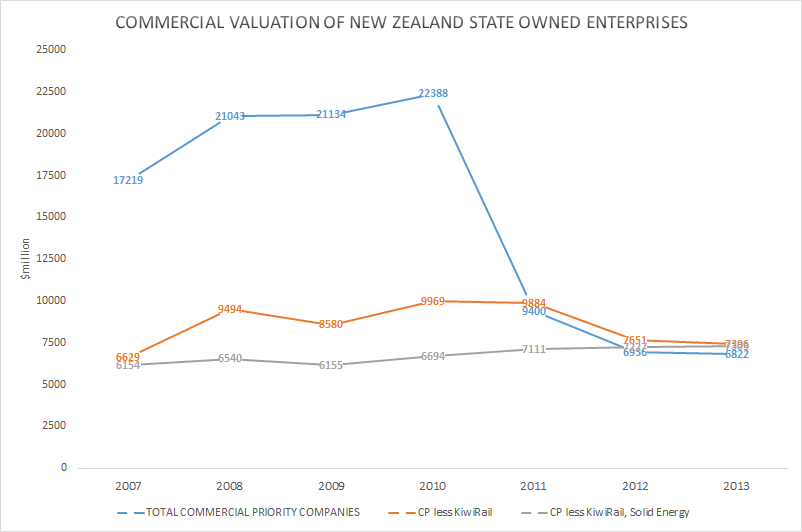
Source: The New Zealand Treasury – data released under the Official Information Act.
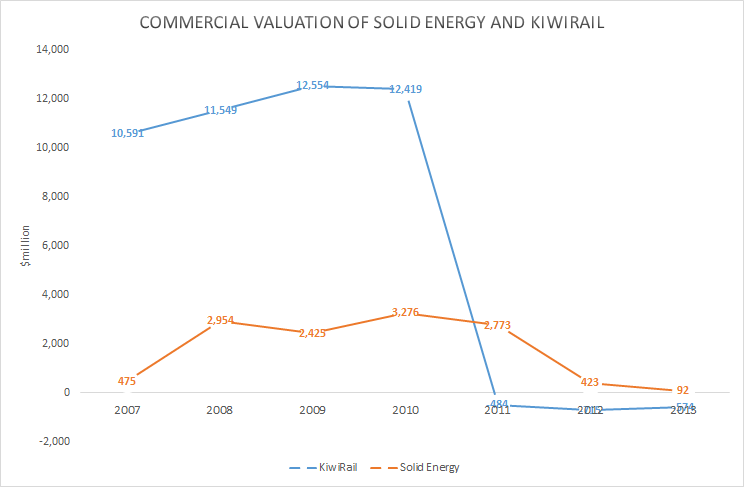
Source: The New Zealand Treasury – data released under the Official Information Act.
@nzlabour @NZGreens New Zealand state-owned enterprises dividends paid and capital injections since 2007
25 Sep 2015 Leave a comment
in financial economics, industrial organisation, politics - New Zealand, public economics, rentseeking, survivor principle, transport economics Tags: government ownership, KiwiRail, privatisation, rational ignorance, rational rationality, state owned enterprises, suppressive voting
The New Zealand Labour Party and New Zealand Greens both make much of the fact that when you privatise a state-owned enterprise the taxpayer is no longer entitled to dividends from the privatised business. The fact that the sale price is the net present value of those future dividends is a rating fallacy that is not the subject of this post.
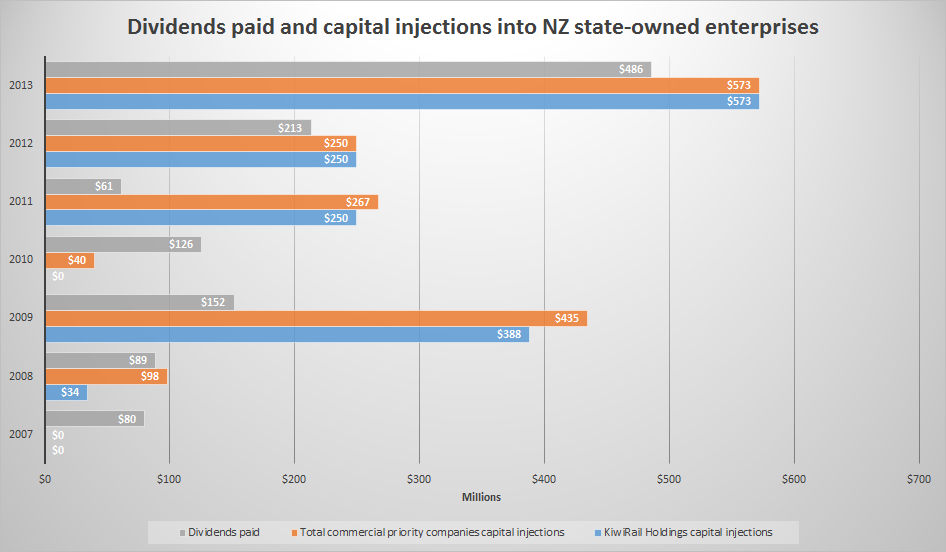
Source: New Zealand Treasury – data released under the Official Information Act.
What is the subject of this post is whether there are indeed any dividends paid to taxpayers after capital injections. 2007 was the last year in which dividends to the taxpayer exceeded capital injections. The reason was that dog called KiwiRail.
@nzlabour @NZGreens Adjusted return to equity on the New Zealand state owned enterprises portfolio since 2008
24 Sep 2015 2 Comments
in financial economics, politics - New Zealand, Public Choice, public economics Tags: expressive voting, government ownership, privatisation, state owned enterprises
I asked for information from the Treasury for as far back as 2000 but could only get information back to 2008 on the return on equity of the portfolio of state-owned enterprises to the taxpayer.
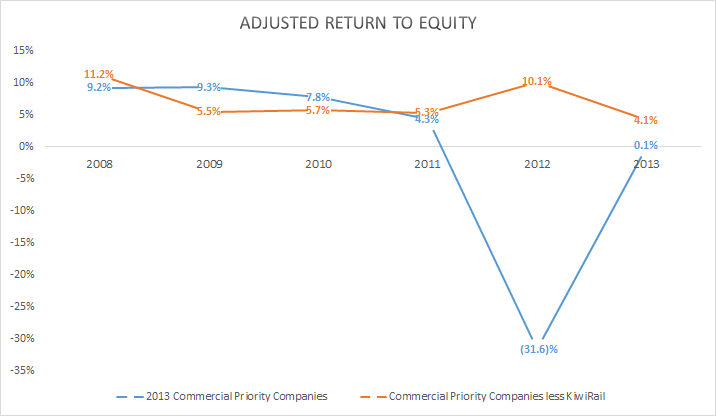
Source: New Zealand Treasury – released under Official Information Act.
Apparently, long-term information on the performance of the state-owned enterprise portfolio is not available. Anyone wanting to know the performance of an individual or group of listed companies simply looks at the share price was far back as they want. The prices of individual shares reflect market expectations of future dividends and future price movements, and they go up and down as new information is revealed. The history of a share price indicates the ups and downs of a company in one number far better than any other available indicator.
I also included the adjusted rate of return on equity taking out the two dogs in the portfolio: Solid Energy and KiwiRail.

Source: New Zealand Treasury – released under Official Information Act.
Biggest stockmarket falls in economic history
23 Sep 2015 Leave a comment
in economic history, financial economics Tags: sharemarket crashes
Biggest stockmarket falls in economic history economist.com/blogs/graphicd… http://t.co/Ja79M23uzf—
Charles Read (@EconCharlesRead) August 24, 2015
A history of interest rates
07 Sep 2015 Leave a comment
in business cycles, economic history, financial economics, macroeconomics, monetary economics Tags: central banking
Creative destruction in the S&P 500
04 Sep 2015 Leave a comment
in economic history, entrepreneurship, financial economics, industrial organisation, survivor principle Tags: creative destruction
How frequent are simultaneous financial crises in one country?
04 Sep 2015 Leave a comment
in business cycles, currency unions, development economics, economic growth, economic history, Euro crisis, financial economics, global financial crisis (GFC), great depression, great recession, growth disasters, growth miracles, law and economics, macroeconomics, monetary economics, property rights Tags: bank runs, banking crises, banking panics, currency crises, current account crises, debt crises, pseudo financial crises, real financial crises, sovereign debt crises, sovereign default
 Utopia, you are standing in it!
Recent Comments