Gary Becker and George Stigler on continuity in economic thinking

gary-becker-2013-580.jpeg

this recession had got a lot worse, we would have seen two major changes: much more government intervention in the economy, and a lot more concentration in economics in trying to understand what went wrong.

Assuming I’m right and, fundamentally, the recession is over—a severe recession but maybe not much greater than the 1981 recession, or those in the nineteen-seventies—I think you are not going to see a huge increase in the role of government in the economy.…

Economists will be struggling to understand how this crisis happened and what you can do to head another one off in the future, but it will be nothing like the revolution in the role of government and in thinking that dominated the economics profession for decades after the Great Depression.

If the problems of economic life changed frequently and radically, and lacked a large measure of continuity in their essential nature, there could not be a science of economics.

An essential element of a science is the cumulative growth of knowledge, and that cumulative character could not arise if each generation of economists faced fundamentally new problems calling for entirely new methods of analysis…

[Economics] will continuously be confronted with new circumstances which call for more than a routine application of standard knowledge. Thus the energy crisis of the nineteen-seventies has provided much employment to economists, but it has not called for important changes in economic science…

The responsiveness of economics to environmental problems will naturally be more complete and more prompt, the more urgent the problems of the day. The response will also be more complete, the less developed the relevant body of economic analysis.

The responsiveness of macroeconomics to contemporary events is notorious. Keynes’s conquest in the nineteen-thirties was due to the fact that the neoclassical theory could not account for the persistent unemployment of that decade. A generation later, persistent inflation even with less than full employment was equally decisive in ending Keynes’s supremacy. If and when macroeconomics produces a good theory of the business cycle, its responsiveness to environmental changes will diminish sharply
Sam Peltzman and the great restraint in the growth of government, 1980-2007

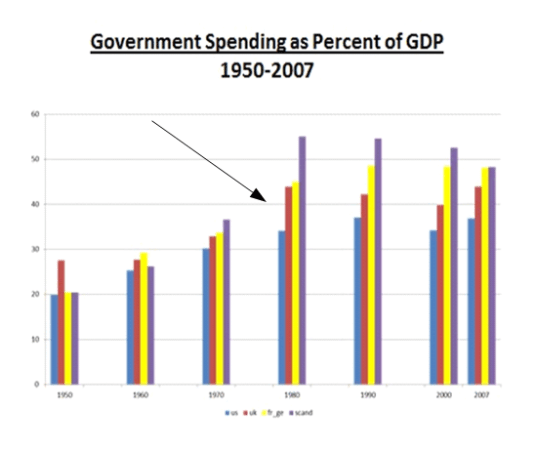
From 1950 to 1980 the size of government doubled in the developed world and then stopped dead in 1980. This great restraint on the growth of government happened everywhere. It was not just Thatcher’s Britain or Reagan’s America. It was everywhere, in France and Germany, and even in Scandinavia.

Peltzman’s data below has government spending double between 1950 and 1980, and then nothing much happened in between 1980 and 2007 – the size of government is pretty flat as a share of GDP for 27 years.

Source: Sam Peltzman, The Socialist Revival? (2012).

There is a noticeable reduction in the size of government spending in Scandinavia. Reagan and Thatcher had nothing on those Social Democrats in Scandinavia when it comes to cutting the size of government.

Governments everywhere hit a brick wall in terms of their ability to raise further tax revenues. Political parties of the Left and Right recognised this new reality.

Government spending grew in many countries in the 20th century because of demographic shifts, more efficient taxes, more efficient spending, a shift in the political power from those taxed to those subsidised, shifts in political power among taxed groups, and shifts in political power among subsidised groups.

The median voter in all countries was alive to the power of incentives and to not killing the goose that laid the golden egg.

After 1980, the taxed, regulated and subsidised groups had an increased incentive to converge on new lower cost modes of redistribution.

More efficient taxes, more efficient spending, more efficient regulation and a more efficient state sector reduced the burden of taxes on the taxed groups.

Most subsidised groups benefited as well because their needs were met in ways that provoked less political opposition.

Gary Becker made this warning about the political repercussions of tax reform and economic reform in general for the size of government:

…the greater efficiency of a VAT and its ease of collection is a two-edged sword.

On the one hand, it would raise a given amount of tax revenue efficiently and cheaply.

Since economists usually evaluate different types of taxes by their efficiency and ease of collecting a given amount of tax revenue, economists typically like value added taxes.

The error in this method of evaluating taxes is that it does not consider the political economy determinants of the level of taxes.

From this political economy perspective, the value added tax does not look so attractive, at least to those of us who worry that governments would spend and tax at higher levels than is economically and socially desirable.


Reforms ensued after 1980 led by parties on the Left and Right, with some members of existing political groupings benefiting from joining new political coalitions.

The deadweight losses of taxes, transfers and regulation limit inefficient policies and the sustainability of redistribution.

Peltzman likes to note that at the start of the 20th century, the United States government was about 8% of GDP. The two largest programs were education and highways. The post office was as big as the military.

Government is about five times that now with defence, health, education and income security accounting for 70% of this total. Peltzman makes the very interesting point that:

There is no new program in the political horizon that seems capable of attaining anything like the size of any of these four.

For the time being the future government rest on the extent of existing mega programs.

Health and income security account for 55% of total government spending in the OECD. It is in these two programs where the future of the growth of government lie.

The pressure for that growth in government will come from the elderly. Governments will have to choose between high taxes on the young to fund these programs for the elderly or find other options.

Gary Becker on crony capitalism in Latin America

One legitimate reason for the opposition to capitalism in Latin America is that it frequently has been "crony capitalism" as opposed to the competitive capitalism that produces desirable social outcomes.

Crony capitalism is a system where companies with close connections to the government gain economic power not by competing better, but by using the government to get favoured and protected positions.

These favours include monopolies over telecommunications, exclusive licenses to import different goods, and other sizeable economic advantages. Some cronyism is found in all countries, but Mexico and other Latin countries have often taken the influence of political connections to extremes.

…The excesses of cronyism have provided ammunition to parties of the left that are openly hostile to capitalism and neo-liberal policies. Yet when these parties come to power they usually do not reduce the importance of political influence but shift power to groups that support them.

…Leftist ideologies take advantage of the discontent this causes among intellectuals and the poor, and promise a redistribution of assets and better education opportunities for the poor.

Promises of redistribution have figured prominently in the speeches of Chavez, Lula, Morales, Peronists in Argentina, and Andres Manuel Lopez Obrador, former mayor of Mexico City and a leading candidate to be Mexico’s next president.

When it is discovered that left wing governments usually do not end up helping the poor very much, they tend to be voted out of office.

… The overall trend during the past several decades in practically all countries of this region has been toward more open economies with greater competition within industries, with much more reliance on private enterprise, and with a reduced role for government mandates, government-run enterprises, and cronyism.

Since these policies have provided greater benefits to all classes than the socialist policies of a Fidel Castro or a Hugo Chavez, the vast majority of people that live under such leaders will be, or in Cuba have been, disappointed by the unfulfilled promises. They are likely to come back to parties that support more market policies as long as free elections are preserved.

Gary Becker 2006

Next Newer Entries

Bassett, Brash & Hide

Celebrating humanity's flourishing through the spread of capitalism and the rule of law

Truth on the Market

Scholarly commentary on law, economics, and more

The Undercover Historian

Beatrice Cherrier's blog

Matua Kahurangi

Celebrating humanity's flourishing through the spread of capitalism and the rule of law

Temple of Sociology

Celebrating humanity's flourishing through the spread of capitalism and the rule of law

Velvet Glove, Iron Fist

Celebrating humanity's flourishing through the spread of capitalism and the rule of law

Why Evolution Is True

Why Evolution is True is a blog written by Jerry Coyne, centered on evolution and biology but also dealing with diverse topics like politics, culture, and cats.

Down to Earth Kiwi

Celebrating humanity's flourishing through the spread of capitalism and the rule of law

NoTricksZone

Celebrating humanity's flourishing through the spread of capitalism and the rule of law

Homepaddock

A rural perspective with a blue tint by Ele Ludemann

Kiwiblog

DPF's Kiwiblog - Fomenting Happy Mischief since 2003

The Dangerous Economist

Celebrating humanity's flourishing through the spread of capitalism and the rule of law

Watts Up With That?

The world's most viewed site on global warming and climate change

The Logical Place

Tim Harding's writings on rationality, informal logic and skepticism

Doc's Books

A window into Doc Freiberger's library

The Risk-Monger

Let's examine hard decisions!

Uneasy Money

Commentary on monetary policy in the spirit of R. G. Hawtrey

Barrie Saunders

Thoughts on public policy and the media

Liberty Scott

Celebrating humanity's flourishing through the spread of capitalism and the rule of law

Point of Order

Politics and the economy

James Bowden's Blog

A blog (primarily) on Canadian and Commonwealth political history and institutions

Science Matters

Reading between the lines, and underneath the hype.

Peter Winsley

Economics, and such stuff as dreams are made on

A Venerable Puzzle

"The British constitution has always been puzzling, and always will be." --Queen Elizabeth II

The Antiplanner

Celebrating humanity's flourishing through the spread of capitalism and the rule of law

Bet On It

Celebrating humanity's flourishing through the spread of capitalism and the rule of law

History of Sorts

WORLD WAR II, MUSIC, HISTORY, HOLOCAUST

Roger Pielke Jr.

Undisciplined scholar, recovering academic

Offsetting Behaviour

Celebrating humanity's flourishing through the spread of capitalism and the rule of law

JONATHAN TURLEY

Res ipsa loquitur - The thing itself speaks

Conversable Economist

Celebrating humanity's flourishing through the spread of capitalism and the rule of law

The Victorian Commons

Researching the House of Commons, 1832-1868

The History of Parliament

Articles and research from the History of Parliament Trust

Books & Boots

Reflections on books and art

Legal History Miscellany

Posts on the History of Law, Crime, and Justice

Sex, Drugs and Economics

Celebrating humanity's flourishing through the spread of capitalism and the rule of law

European Royal History

Exploring the Monarchs of Europe

Tallbloke's Talkshop

Cutting edge science you can dice with

Marginal REVOLUTION

Small Steps Toward A Much Better World

NOT A LOT OF PEOPLE KNOW THAT

“We do not believe any group of men adequate enough or wise enough to operate without scrutiny or without criticism. We know that the only way to avoid error is to detect it, that the only way to detect it is to be free to inquire. We know that in secrecy error undetected will flourish and subvert”. - J Robert Oppenheimer.

STOP THESE THINGS

The truth about the great wind power fraud - we're not here to debate the wind industry, we're here to destroy it.

Lindsay Mitchell

Celebrating humanity's flourishing through the spread of capitalism and the rule of law

Alt-M

Celebrating humanity's flourishing through the spread of capitalism and the rule of law

croaking cassandra

Economics, public policy, monetary policy, financial regulation, with a New Zealand perspective

The Grumpy Economist

Celebrating humanity's flourishing through the spread of capitalism and the rule of law

International Liberty

Restraining Government in America and Around the World