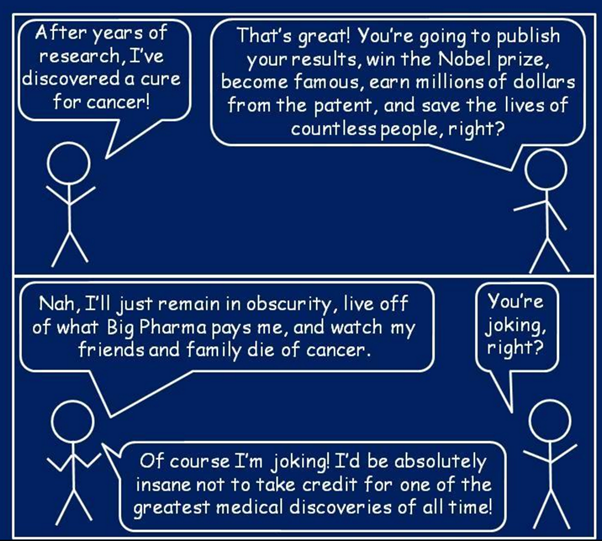
.
Celebrating humanity's flourishing through the spread of capitalism and the rule of law
08 Aug 2016 Leave a comment
in economics of media and culture, health economics Tags: conspiracy theories, conspiracy theorists, cranks, political psychology, Quacks
.
04 Aug 2016 Leave a comment
in economic history, health economics Tags: cancer survival rates, life expectancies, The Great Escape
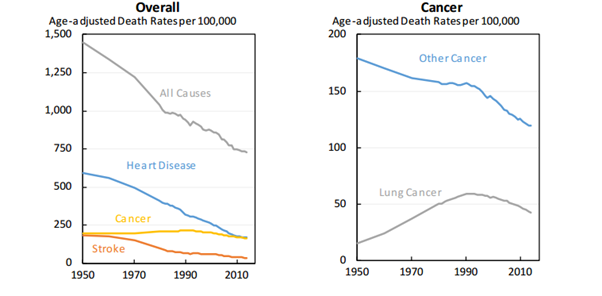
Source: Jason Furman speaking at the World Bank via Incentives in Action – Marginal REVOLUTION.
01 Aug 2016 2 Comments
in economics of regulation, environmental economics, global warming, health economics, politics - New Zealand, Public Choice, rentseeking Tags: Anti-Science left, anti-vaccination movement, climate alarmism, fluoridation, global warming, GMOs, New Zealand Greens, vaccinations, vaccines
One out of four for accepting the consensus position in the sciences of climate change, GMOs, vaccines and fluoridation. A rather disappointing scoreboard for the New Zealand Greens.
Let us start with the good: the position on climate science from the Greens policy platform:
We must act according to credible science on climate change, which demands urgent action to reduce greenhouse gas emissions as soon as possible, and sustained action to safely remove excess greenhouse gas from the atmosphere.
Let us move on to the bad which is GMOs, quoting from their platform
The Green Party believes that Genetic engineering should occur within a contained laboratory setting only. Our food and our environment must be kept GE Free. To this end, the Green Party will:
Ban the commercial release and field trials of GE organisms.
Prohibit field-testing or production of GE foods within New Zealand.
Work towards a ban on GE food imports.
Require safety testing for any imported GE food or commodity that is allowed to enter the New Zealand food supply.
Allow gene technology in secure containment to continue to be used subject to assessment by the Environmental Risk Management Agency.
Now let us move on to the ugly which is vaccinations, again quoting from their platform, which is not to mention it at all. Greens health spokesman Kevin Hague said
Our official position is influenced by the fact that we do not have a firm policy on it as we don’t have consensus from our members. However there are some key points on which we all do agree;
- Immunisation is an individual medical choice, and should never be mandatory. Nor should it be promoted in a way that makes people feel pressured into being immunised, or immunising their children.
- Parents should have access to impartial information which provides them with information about the risks and benefits of immunisation, so that all individuals (and parents in the case of children) can make an informed decision about immunisation.
- Parents should not be penalised for not immunising their children, nor should there be incentive payments or rewards or access to other goods and services, or any linking of immunisation to benefit entitlement.
- Some parents will choose to have their child immunised against some diseases, but not others. No parents should be forced to make a decision between their child having all immunisations or having none.
That strike two so now let us move on to the decidedly ugly which is fluoridation
The presumption that parents know the best interests of their children requires very strong evidence before it is overturned. Of course, you do not have too tolerate their unvaccinated children coming to school to infect your children. It is another thing for the Green Party of New Zealand to see both sides of the fluoridation argument:
C. Fluoridation of Community Water Supplies
The issue of fluoridating community water supplies requires a difficult balance between the public health effects and the rights of individuals to opt out altogether or avoid excessive intake. The Party membership has indicated that when considering fluoridation proposals, the Green Party caucus shall:
- Have particular regard to the public health benefits of fluoridated community water supplies.
- Have particular regard to the potential public health risks of excessive fluoride consumption via community water supplies.
- Have regard for the ability of individuals to opt out.
The Green Party will:
- Support the use of ‘opt-out’ options by local authorities for residents living in areas with fluoridated public water supplies, where shown to be feasible.
- Commission an independent study on the impacts of fluoridation to public health.
- Support education initiatives to advise caregivers of the potential for babies to develop dental fluorosis when mixing formula with fluoridated water
One out of four is not good enough considering how prissy this Greens are about scientific consensus on climate change.

29 Jul 2016 Leave a comment
in economics, environmental economics, health economics Tags: Anti-Science left, GMOs
27 Jul 2016 Leave a comment
in financial economics, health economics
There was a bit of a hiatus in the mid-20th century but since then, Ben Bernanke’s decision to invest only in tobacco shares was a wise choice.
During the transition period, 1947-1965, shares in the tobacco industry underperformed by 3 percent per year in the USA.
Still, it was a temporary trend and the decades from the 1960s to the 2000s, when the health impact of tobacco was well known, saw tobacco companies outperforming comparable firms by over +3 percent per year.

Source: Responsible Investing: Does It Pay to Be “Bad”? – Credit Suisse.
20 Jul 2016 Leave a comment
in defence economics, economics, growth disasters, health economics Tags: Ebola
Celebrating humanity's flourishing through the spread of capitalism and the rule of law
Celebrating humanity's flourishing through the spread of capitalism and the rule of law
Celebrating humanity's flourishing through the spread of capitalism and the rule of law
Celebrating humanity's flourishing through the spread of capitalism and the rule of law
Celebrating humanity's flourishing through the spread of capitalism and the rule of law
Celebrating humanity's flourishing through the spread of capitalism and the rule of law
Celebrating humanity's flourishing through the spread of capitalism and the rule of law
Celebrating humanity's flourishing through the spread of capitalism and the rule of law
A History of the Alt-Right
Econ Prof at George Mason University, Economic Historian, Québécois
Celebrating humanity's flourishing through the spread of capitalism and the rule of law
Scholarly commentary on law, economics, and more
Beatrice Cherrier's blog
Celebrating humanity's flourishing through the spread of capitalism and the rule of law
Celebrating humanity's flourishing through the spread of capitalism and the rule of law
Celebrating humanity's flourishing through the spread of capitalism and the rule of law
Why Evolution is True is a blog written by Jerry Coyne, centered on evolution and biology but also dealing with diverse topics like politics, culture, and cats.
Celebrating humanity's flourishing through the spread of capitalism and the rule of law
A rural perspective with a blue tint by Ele Ludemann
DPF's Kiwiblog - Fomenting Happy Mischief since 2003
Celebrating humanity's flourishing through the spread of capitalism and the rule of law
The world's most viewed site on global warming and climate change
Tim Harding's writings on rationality, informal logic and skepticism
A window into Doc Freiberger's library
Let's examine hard decisions!
Commentary on monetary policy in the spirit of R. G. Hawtrey
Thoughts on public policy and the media
Celebrating humanity's flourishing through the spread of capitalism and the rule of law
Politics and the economy
A blog (primarily) on Canadian and Commonwealth political history and institutions
Reading between the lines, and underneath the hype.
Economics, and such stuff as dreams are made on
"The British constitution has always been puzzling, and always will be." --Queen Elizabeth II
Celebrating humanity's flourishing through the spread of capitalism and the rule of law
Celebrating humanity's flourishing through the spread of capitalism and the rule of law
WORLD WAR II, MUSIC, HISTORY, HOLOCAUST
Undisciplined scholar, recovering academic
Celebrating humanity's flourishing through the spread of capitalism and the rule of law
Res ipsa loquitur - The thing itself speaks
In Hume’s spirit, I will attempt to serve as an ambassador from my world of economics, and help in “finding topics of conversation fit for the entertainment of rational creatures.”
Researching the House of Commons, 1832-1868
Articles and research from the History of Parliament Trust
Reflections on books and art
Posts on the History of Law, Crime, and Justice
Celebrating humanity's flourishing through the spread of capitalism and the rule of law
Exploring the Monarchs of Europe






Recent Comments