Homeopathy explained
14 May 2015 Leave a comment
in economics of information, health economics Tags: homeopthay, Quacks
Radiation from nuclear power in perspective
14 May 2015 Leave a comment
in energy economics, health and safety, health economics Tags: atomic energy
xkcd's Radiation Dose Chart that puts the risks of #Nuclear energy in perspective. http://t.co/arhQqSxCZc—
Max Roser (@MaxCRoser) May 10, 2015
The Great Escape – child mortality since 1950
14 May 2015 Leave a comment
in development economics, growth disasters, growth miracles, health economics Tags: child mortality, infant mortality, The Great Escape
Child mortality rate down across the globe via @UNICEF
statista.com/chart/3410/glo… http://t.co/SAYPhFMIC0—
Statista (@StatistaCharts) April 17, 2015
The Great Escape = a big increase in life expectancy inequality
13 May 2015 Leave a comment
In 1800 the global average life expectancy was 32.
Global health inequality was low – no country had over 40 years! http://t.co/BRpzvw9XJA—
Max Roser (@MaxCRoser) May 11, 2015
@MaxCRoser Now over the last decades many caught up – and inequality is declining. While average is now much higher. http://t.co/NDmWzivrhs—
Max Roser (@MaxCRoser) May 11, 2015
Whatever happened to chickenpox?
13 May 2015 Leave a comment
in health economics Tags: anti-vaccination movement, chickenpox, vaccines
Endurance obviously has evolutionary survival value
12 May 2015 Leave a comment
in health economics, survivor principle Tags: evolution, The Great Escape
The crazy mixed up priorities of climate alarmists-in-chief
12 May 2015 Leave a comment
in development economics, environmental economics, environmentalism, global warming, growth disasters, growth miracles, health economics Tags: climate alarmism, doomsday prophets, The Great Enrichment, The Great Escape, The Great Fact, Twitter left
Leaving the Left Exposed. James Hansen: dld.bz/dBnyq http://t.co/ZQsKSJxlr1—
The Left, Exposed (@leftexposed) April 23, 2015

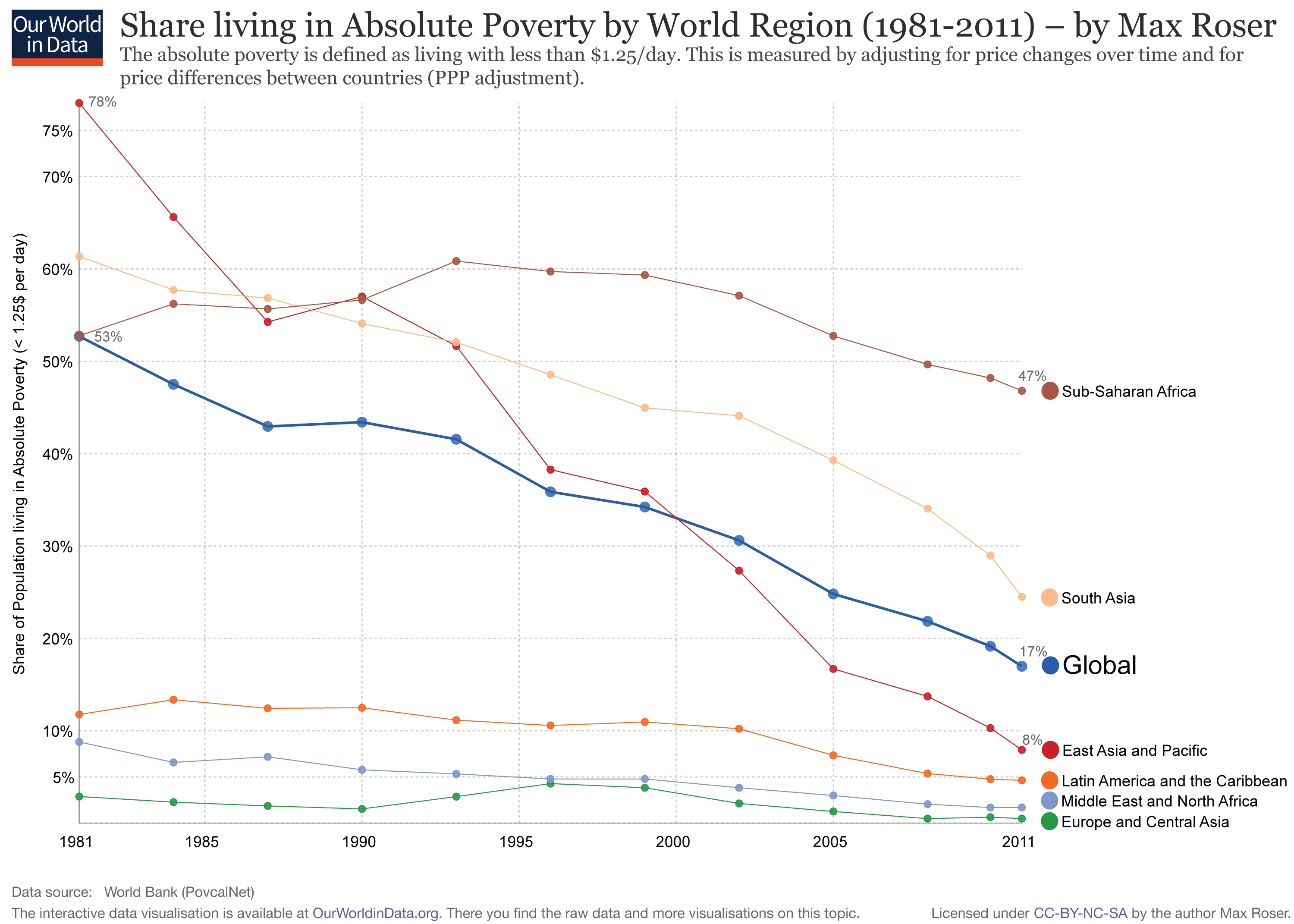


The Great Escape – Child mortality is falling in Africa
12 May 2015 Leave a comment
Child mortality is decreasing throughout Africa.
From my project: bit.ly/1IfQSjg http://t.co/jqA30V6GWq—
Max Roser (@MaxCRoser) April 26, 2015
The crusade to ban e-cigarette had the predictable effect among teens
12 May 2015 Leave a comment
in environmental economics, health economics Tags: do gooders, economics of smoking, meddlesome preferences, nanny state, offsetting behaviour, The fatal conceit, The pretence to knowledge, unintended consequences
Teen e-cigarette consumption has surpassed conventional smoking in 2014 #vaping via @CDCgov
statista.com/chart/3417/eci… http://t.co/RnZz1nbj5X—
Statista (@StatistaCharts) April 22, 2015
The killer air pollution that the Greens never mention
12 May 2015 Leave a comment
4.3 million die every year. Indoor air pollution is the least reported problem of the world. bit.ly/1BfMiZg http://t.co/CDhafWSbj8—
Max Roser (@MaxCRoser) May 07, 2015
Who are the tallest?
11 May 2015 Leave a comment
in economic history, health economics Tags: economics of physiology, The Great Escape
How American men ceased to be the world's tallest, while the Dutch sprouted. randalolson.com/2014/06/23/why… http://t.co/IOmJCd8wuu—
Richard V. Reeves (@RichardvReeves) October 13, 2014
At the epidemic’s peak, AIDS affected…
11 May 2015 Leave a comment
in development economics, growth disasters, health economics Tags: Africa, AIDS
At the epidemic's peak, AIDS affected half of people aged 15-49 in Middle Africa. Today? <20%. buff.ly/1EVz4Wo http://t.co/koHasDe2EX—
HumanProgress.org (@humanprogress) May 10, 2015
An early film clip on the announcement of a successful polio vaccine
11 May 2015 Leave a comment
in economics of media and culture, health economics Tags: polio, vaccines
Americans and scientists agree more on vaccines than on other hot button issues
11 May 2015 Leave a comment
in economics of media and culture, environmental economics, global warming, health economics Tags: Anti-Science left, anti-vaccination movement, climate alarmism, global warming, vaccinations, vaccines
Americans and scientists agree more on vaccines than on other hot button issues. 53eig.ht/1CWsmPq http://t.co/M7eeDWgQoL—
(@FiveThirtyEight) February 07, 2015
The Ten Pillars of Economic Wisdom
10 May 2015 Leave a comment
in applied price theory, applied welfare economics, Austrian economics, comparative institutional analysis, constitutional political economy, development economics, economic history, economics of education, economics of information, economics of media and culture, economics of regulation, energy economics, entrepreneurship, financial economics, health economics, history of economic thought, industrial organisation, survivor principle Tags: David Anderson, evidence-based policy, offsetting behaviour, pretence to knowledge, The fatal conceit, unintended consequences
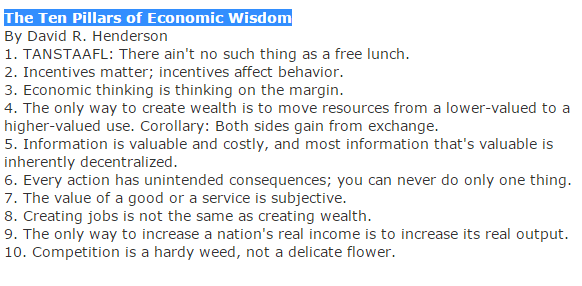
via The Ten Pillars of Economic Wisdom, David Henderson | EconLog | Library of Economics and Liberty.


Recent Comments