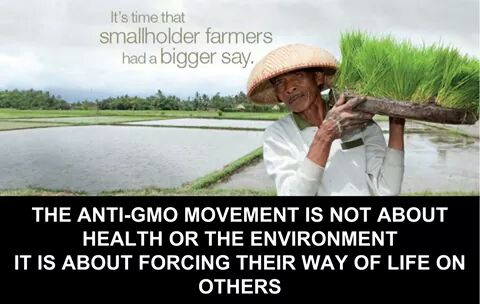
Anti-GMO bingo
11 Dec 2014 Leave a comment
in environmental economics, environmentalism, health economics Tags: Anti-Science left, Quacks
Anti-science Left alert: GMOs have already escaped into the environment
10 Dec 2014 1 Comment
in health economics Tags: Anti-Science left, GMOs, Quacks
Poverty and Behavior: Bryan Caplan
09 Dec 2014 Leave a comment
in applied price theory, applied welfare economics, health economics, human capital, labour economics, labour supply, poverty and inequality, welfare reform Tags: causes of poverty, economics of personality, poverty and inequality
- alcoholism: Alcohol costs money, interferes with your ability to work, and leads to expensive reckless behavior.
- drug addiction: Like alcohol, but more expensive, and likely to eventually lead to legal troubles you’re too poor to buy your way out of.
- single parenthood: Raising a child takes a lot of effort and a lot of money. One poor person rarely has enough resources to comfortably provide this combination of effort and money.
- unprotected sex: Unprotected sex quickly leads to single parenthood. See above.
- dropping out of high school: High school drop-outs earn much lower wages than graduates. Kids from rich families may be able to afford this sacrifice, but kids from poor families can’t.
- being single: Getting married lets couples avoid a lot of wasteful duplication of household expenses. These savings may not mean much to the rich, but they make a huge difference for the poor.
- non-remunerative crime: Drunk driving and bar fights don’t pay. In fact, they have high expected medical and legal expenses. The rich might be able to afford these costs. The poor can’t.
Yet as Charles Murray keeps reminding us, all of the pathologies on my list are especially prevalent among the poor.
Anti-science Left alert: Biotech and global warming
09 Dec 2014 Leave a comment
in environmental economics, global warming, health economics Tags: Anti-Science left, biotechnology, climate alarmism, GMOs, Quacks
Behind on my anti-GMO movement blogging
08 Dec 2014 2 Comments
in health economics Tags: anti-GMO movement, Anti-Science left
New drug lags versus laboratory federalism
07 Dec 2014 Leave a comment
in applied welfare economics, economics of regulation, health economics Tags: drug lags, federalism, laboratory federalism
Have We Lost the War on Drugs? – Gary Becker and Kevin Murphy – WSJ 2013
29 Nov 2014 Leave a comment
in economics of crime, economics of regulation, Gary Becker, health economics, law and economics, liberalism

One moderate alternative to the war on drugs is to follow Portugal’s lead and decriminalize all drug use while maintaining the illegality of drug trafficking. Decriminalizing drugs implies that persons cannot be criminally punished when they are found to be in possession of small quantities of drugs that could be used for their own consumption.
Decriminalization would reduce the bloated U.S. prison population since drug users could no longer be sent to jail.
Decriminalization would make it easier for drug addicts to openly seek help from clinics and self-help groups, and it would make companies more likely to develop products and methods that address addiction…
A study published in 2010 in the British Journal of Criminology found that in Portugal since decriminalization, imprisonment on drug-related charges has gone down; drug use among young persons appears to have increased only modestly, if at all; visits to clinics that help with drug addictions and diseases from drug use have increased; and opiate-related deaths have fallen.
Some quacks and con artists are a bit lazy in their promotional material
27 Nov 2014 Leave a comment
in health economics Tags: con artists, Quacks
Environmental and Urban Economics: Do Demographers Really Predict Future Population Trends Without Incorporating Women’s Economic Incentives?
26 Nov 2014 Leave a comment
in discrimination, economics of love and marriage, gender, health economics, human capital, labour economics
To my amazement, this work does not discuss how women’s potential earnings in the labor market correlates with fertility decisions.
At least in the Demography paper linked to above, the word “incentives” does not appear in the paper and nobody makes a choice based on the costs and benefits of fertility.
Without incorporating such factors, how can a statistical model yield a credible prediction?
Behind on my food snob blogging
24 Nov 2014 Leave a comment
in health economics, liberalism Tags: expressive voting, food snobs organic food
An organ shortage kills 30 Americans every day. Is it time to pay donors? – The Washington Post
24 Nov 2014 Leave a comment
in applied welfare economics, Austrian economics, health economics Tags: organ donation

via An organ shortage kills 30 Americans every day. Is it time to pay donors? – The Washington Post.

Recent Comments