@TelasonGetachew och vad är det för fel på det budskapet? Är det fel att partier som KD ändrar sig? @Budoarstamning http://t.co/56rL7slJJg—
Old Whig (@aClassicLiberal) July 28, 2015
My favourite John Maynard Keynes quote
10 Aug 2015 1 Comment
in history of economic thought Tags: conjecture and refutation, growth of knowledge, John Maynard Keynes
Karl Marx died today for the first time
07 Aug 2015 Leave a comment
in history of economic thought, Marxist economics Tags: Karl Marx
Did fiscal austerity in 2010 have credible academic support?
05 Aug 2015 1 Comment

#Greece austerity gauge. Greek government spending has fallen 20% since 2008. In UK and Italy it's up. #GreekCrisis http://t.co/WMQBxxVFqq—
RBS Economics (@RBS_Economics) July 07, 2015
One measure of the scale of austerity in Greece…and other advanced economies. http://t.co/PxCLagdd3L—
RBS Economics (@RBS_Economics) July 06, 2015
The employment level in #Greece is back to where it was in 1985. It's the equivalent of the UK losing 6 million jobs. http://t.co/AAWHMEFwfK—
RBS Economics (@RBS_Economics) July 06, 2015
Did the GFC catch modern macroeconomists by surprise?
03 Aug 2015 Leave a comment
in budget deficits, business cycles, currency unions, economic growth, Euro crisis, fiscal policy, global financial crisis (GFC), great depression, great recession, history of economic thought, law and economics, macroeconomics, monetary economics Tags: bank panics, bank runs, banking crises, currency crises, Thomas Sargent

@sjwrenlewis The stimulus package ignored what we have learned in the last 60 years of macroeconomic research
02 Aug 2015 Leave a comment
in budget deficits, business cycles, economic growth, fiscal policy, global financial crisis (GFC), great recession, history of economic thought, macroeconomics, monetarism, monetary economics Tags: Brad Delong, fiscal multiplier, fiscal stimulus, Larry Summers, New Keynesian macroeconomics, Thomas Sargent


It’s Milton Friedman’s birthday
31 Jul 2015 1 Comment
in history of economic thought, liberalism, Milton Friedman
The genius of Milton Friedman… http://t.co/560386cnJB—
The Econ Brothers (@EconBrothers) November 09, 2014
Friedman in the finer points of freedom and equality… http://t.co/DNyn8NPL2V—
The Econ Brothers (@EconBrothers) July 08, 2014
Do you agree? http://t.co/F38DNWmJ0v—
ESFL (@ESFLiberty) June 11, 2015
The genius of Milton Friedman… http://t.co/PZUlj1FCZp—
The Econ Brothers (@EconBrothers) November 01, 2014
The origin of the concept of Human Capital
31 Jul 2015 1 Comment
in history of economic thought, human capital, labour economics, personnel economics Tags: human capital
Human Capital. http://t.co/rSwMFjOcEl—
Gem Reucroft (@HR_Gem) July 17, 2015
In a paper I wrote some years ago I explained the origin of that concept of human capital as follows:
The term ‘human capital’ was initially controversial, but the analytical concept was not. The analysis of human capital has many famous parents and grandparents (Kiker 1966).
Sir William Petty published the first analysis of the value of human capital in 1690. There were sophisticated analyses of investments in education and training and their implications for wage differentials, labour productivity and occupational choice by Adam Smith in 1776, Alfred Marshall in 1890 and Milton Friedman and Simon Kuznets in 1945.
Richard Cantillon, John Locke, John Stuart Mill, Adam Smith and Karl Marx all proposed that training rather than natural ability was more important in understanding occupational wage differentials. Adam Smith and Alfred Marshall referred to education and training as capital investments in human beings.
Irving Fisher in 1912 and Arthur Pigou in 1928 pioneered the explicit use of the term ‘human capital’. Jacob Mincer, Theodore Shultz and Gary Becker popularised the use of the term in the mid-20th century. See Kiker (1966) for a history of the concept of human capital.
Deirdre McCloskey on the Samaritan’s dilemma
30 Jul 2015 Leave a comment
in applied price theory, applied welfare economics, comparative institutional analysis, constitutional political economy, development economics, economic history, economics of regulation, entrepreneurship, growth disasters, growth miracles, history of economic thought, income redistribution, industrial organisation, liberalism, Public Choice, rentseeking, survivor principle Tags: Age of Innovation, bourgeoisie deal, capitalism and freedom, Deirdre McCloskey, The Great Enrichment, The Great Escape, The Great Fact

From wisdom to conviction – Paul Krugman on the Card–Kruger study of minimum wages (1998 and now)
18 Jul 2015 1 Comment
in economics of regulation, history of economic thought, labour economics, minimum wage, politics - USA, poverty and inequality Tags: evidence-based policy, living wage, Paul Krugman
This first screenshot is from the New York Times today of Paul Krugman’s current recollection of his interpretation of the Card – Kruger study of minimum wages in restaurants when that study was published all those years ago.
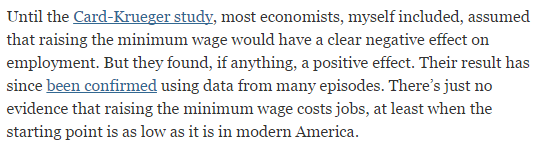
Paul Krugman in his review of Living Wage: What It Is and Why We Need It By Robert Pollin and Stephanie Luce in 1998 was far wiser.
So what are the effects of increasing minimum wages? Any Econ 101 student can tell you the answer: The higher wage reduces the quantity of labour demanded, and hence leads to unemployment. This theoretical prediction has, however, been hard to confirm with actual data.
Indeed, much-cited studies by two well-regarded labour economists, David Card and Alan Krueger, find that where there have been more or less controlled experiments, for example when New Jersey raised minimum wages but Pennsylvania did not, the effects of the increase on employment have been negligible or even positive.
Exactly what to make of this result is a source of great dispute. Card and Krueger offered some complex theoretical rationales, but most of their colleagues are unconvinced; the centrist view is probably that minimum wages “do,” in fact, reduce employment, but that the effects are small and swamped by other forces.
What is remarkable, however, is how this rather iffy result has been seized upon by some liberals as a rationale for making large minimum wage increases a core component of the liberal agenda–for arguing that living wages “can play an important role in reversing the 25-year decline in wages experienced by most working people in America” (as this book’s back cover has it).
Clearly these advocates very much want to believe that the price of labour–unlike that of gasoline, or Manhattan apartments–can be set based on considerations of justice, not supply and demand, without unpleasant side effects.
This will to believe is obvious in this book: The authors not only take the Card-Krueger results as gospel, but advance a number of other arguments that just do not hold up under examination.
The Card– Kruger results have gone from rather iffy in the mind of Paul Krugman to the basis of public policy that, if wrong, costs a lot of low paid workers their jobs. Krugman was well aware in 1998 what a risky path minimum wage increases were:
Now to me, at least, the obvious question is, why take this route? Why increase the cost of labour to employers so sharply, which–Card/Krueger notwithstanding–must pose a significant risk of pricing some workers out of the market, in order to give those workers so little extra income?
Why not give them the money directly, say, via an increase in the tax credit?
Studies of tiny increases in the minimum wage are being used to justify far larger increases in the minimum wage. Krugman was right to be suspect of that in 1998.
Venn Diagram: 1998 Paul Krugman v. 2015 Paul Krugman on the Minimum Wage tinyurl.com/q58ftug @WilliamOccam2 http://t.co/c4DdxqTvwK—
Mark J. Perry (@Mark_J_Perry) July 18, 2015
Krugman’s statements today in the New York Times about the low starting point in modern America for any minimum wage increases is still keeping that slightly cautious tone in his analysis. Few who read his analysis will carry that passing nuance into their own policy advocacy.
Paul Krugman in 1998 was quite astute as to why people want to believe the minimum wage can be increased without any cost to jobs:
One answer is political: What a shift from income supports to living wage legislation does is to move the costs of income redistribution off-budget. And this may be a smart move if you believe that America should do more for its working poor, but that if it comes down to spending money on-budget it won’t.
Indeed, this is a popular view among economists who favour national minimum-wage increases: They will admit to their colleagues that such increases are not the best way to help the poor, but argue that it is the only politically feasible option.
Nor in 1998 was Krugman blind to the expressive politics, the ideological blindness of those who advocate minimum wage increases and living wages:
But I suspect there is another, deeper issue here–namely, that even without political constraints, advocates of a living wage would not be satisfied with any plan that relies on after-market redistribution.
They don’t want people to “have” a decent income, they want them to “earn” it, not be dependent on demeaning hand-outs…
In short, what the living wage is really about is not living standards, or even economics, but morality. Its advocates are basically opposed to the idea that wages are a market price–determined by supply and demand, the same as the price of apples or coal.
It is most unwise to say there is no evidence of minimum wage increases causing unemployment. That sets a low bar of having to find only one or two studies to refute the claim:
1. Taking his claims as true, why do small businesses lobby against raising the minimum wage?
2. Why did Tom Holmes find in his seminal 1999 JPE paper that manufacturing clusters on the Right to Work Side of state borders and avoids the union side of the border?
3. Why did Erin Mansur and I find the same result in our 2013 paper where we build on Holmes’ paper and show that labour intensive manufacturing industries are even more likely to avoid the union side of the border as they are more likely to locate in the adjacent county in the Right to Work State?
4. The Card-Krueger study is certainly important but the variation they used to estimate their effect is tiny relative to the upcoming doubling of the minimum wage up to $15 in cities such as LA and San Fran. How is Dr. Krugman so sure that he can “extrapolate out of sample” to a policy that has never been tried before? Does he have a valid structural model that he can use to conduct such extreme policy counter-factuals?
Karl Popper would be proud of Krugman’s bold and risky prediction that strictly forbids the existence of any studies showing adverse unemployment effects of minimum wage increases.
The thing to remember is, if there is not doubt in the literature, if there are not some mixed results, the econometricians are simply not trying hard enough to win tenure, secure promotion and be published on the top journals.
Capitalism and The Great Fact in China
17 Jul 2015 Leave a comment
in applied price theory, applied welfare economics, comparative institutional analysis, development economics, economic history, economics of education, economics of regulation, entrepreneurship, environmental economics, growth disasters, growth miracles, history of economic thought, industrial organisation, Marxist economics, Public Choice Tags: capitalism and freedom, China, fall of communism, Leftover Left, transitional economies
As China grew freer economically, its poverty rate fell. buff.ly/1KohOxS http://t.co/OpaxOzNdNs—
HumanProgress.org (@humanprogress) June 29, 2015
Matt Ridley on the Pope and The Great Fact
06 Jul 2015 Leave a comment
in applied price theory, applied welfare economics, development economics, economic history, economics of regulation, energy economics, entrepreneurship, environmental economics, financial economics, growth disasters, growth miracles, health economics, history of economic thought, human capital, industrial organisation, labour economics, liberalism, survivor principle Tags: doomsday prophecies, Matt Ridley doomsday prophets, Papal economics, The Great Enrichment, The Great Escape, The Great Fact
See which way the data points for yourself, like @mattwridley. buff.ly/1HsZxgx #health #progress http://t.co/B3KbUJOn05—
HumanProgress.org (@humanprogress) June 30, 2015
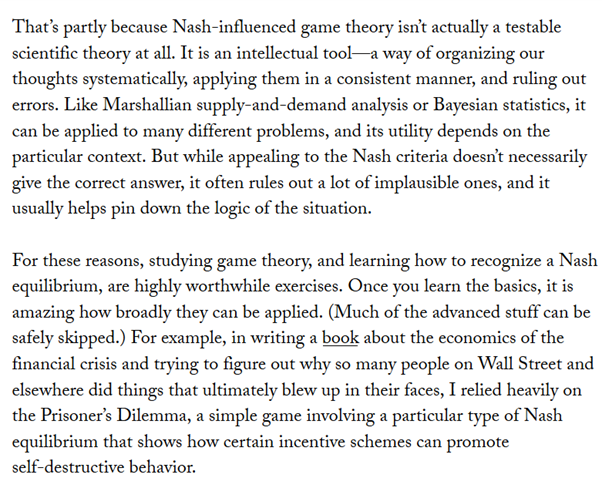
The Triumph (and Failure) of John Nash’s Game Theory – The New Yorker
29 May 2015 Leave a comment
in applied price theory, history of economic thought, Public Choice Tags: conjecture and refutation, game theory, John Nash, methodology of economics, philosophy of science, philosophy of social sciences
 Utopia, you are standing in it!
Recent Comments