Labor Ethics | Political Philosophy with Jason Brennan
24 Oct 2018 Leave a comment
in applied price theory, development economics, economic history, economics of bureaucracy, economics of crime, health and safety, human capital, income redistribution, labour economics, labour supply, law and economics, minimum wage, occupational choice, politics - USA, poverty and inequality, Public Choice, public economics, rentseeking
Steven Pinker Defends James Damore Against Dishonest Slanderer
23 Oct 2018 1 Comment
in discrimination, economics of education, gender, human capital, industrial organisation, labour economics, law and economics, occupational choice, politics - USA, survivor principle Tags: employment law, gender wage gap
The Current Financial Crisis and the Great Depressions of the 20th Century” by Prof. Timothy J. Kehoe
23 Oct 2018 Leave a comment
in applied price theory, business cycles, great depression, labour economics, labour supply, macroeconomics
The 30 Mile Zone That Explains Why Hollywood Exists
23 Oct 2018 Leave a comment
in labour economics, law and economics, movies, television, unions
Everybody Hates Chris S03E08 – Everybody Hates #MinimumWage
22 Oct 2018 Leave a comment
in labour economics, minimum wage, unemployment
Submission to Select Committee on Equal Pay Amendment Bill
21 Oct 2018 Leave a comment
in discrimination, economics of education, gender, human capital, industrial organisation, labour economics, labour supply, occupational choice, politics - New Zealand
This submission is made up of 6 attachments because that is the maximum I could load.

Attachments 1 and 2 are the main part of submission and argue that pay equity is unfair to fair employers. An employer can hire and promote on merit, pay the going wage and still be successfully sued. Their name blackened forever. As a question of social justice, it is wrong to sue someone as a discriminating employer, when there is nothing they could do to right the supposedly wrong they were successfully sued. Barnardo’s can no longer compete with social workers because of the pay equity settlement in the public sector. It relies on donations and tendering for public contracts. It has no capacity to raise wages but could be successfully sued and driven out of business.
Attachments 3 to 5 explains that the gender pay gap is the result of the work-life balance choices of women interacting with some professions penalising an inability to work specific hours or long hours much more than. Pay equity will address none of these issues.
Attachment 6 explains how more than 40 years ago Solomon Polachek found that the gender pay gap was driven by factors such as the number and spacing of children. Employers cannot discriminate against women because they do not know this information and it is now unlawful to ask. It is a strange misogyny that employers hire single women on merit but have a bias against mothers who have several children whose birthdates on widely spaced apart.
To conclude this overview, as attachment 3 shows in a graphic, the gender pay gap for women at the bottom and middle of the labour market is barely 3-5%. It is rather odd to be offering 30% pay rises for a group of women whose pay gap with men at the bottom and middle of the labour market is not more than 5%. Clearly the comparable worth methodology misses something.
Sex, Gender and Bullshit Part 1: Dr. Debra Soh on James Damore and the Google Memo
20 Oct 2018 Leave a comment
in discrimination, gender, health economics Tags: political correctness
I blame rising inequality
20 Oct 2018 Leave a comment
in economic history, economics of crime, politics - USA, poverty and inequality

The Problem With #MeToo’s Agenda
20 Oct 2018 Leave a comment
in discrimination, economics of crime, gender, law and economics, politics - USA
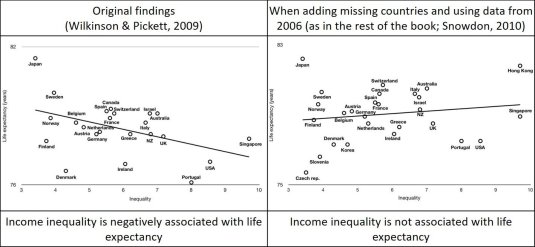
Data manipulation in The Spirit Level
19 Oct 2018 Leave a comment
in applied price theory, applied welfare economics, development economics, econometerics, economics of information, economics of media and culture, poverty and inequality Tags: top 1%


Recent Comments