#Marx200 The private sector net labour share has been stable for decades in NZ! Our local top 1% should be drummed out of the international ruling class for just not trying, much less succeeding in any way in extracting more labour surplus to ensure the rich get richer and the poor get poorer
09 May 2018 Leave a comment
in economic history, politics - New Zealand, poverty and inequality
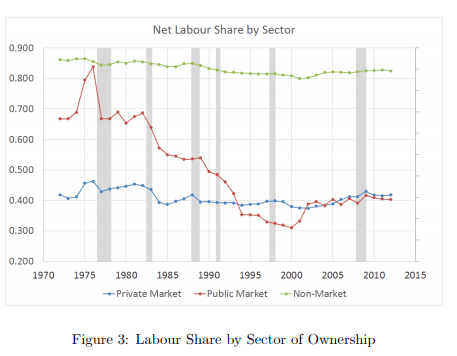
Source: Benjamin Bridgman & Ryan Greenaway-McGrevy (2016) The fall (and rise) of labour share in New Zealand, New Zealand Economic Papers, DOI: 10.1080/00779954.2016.1219763
To quote their abstract
The share of national income going to labour in New Zealand fell substantially between the 1970s and the end of the century. Approximately half of this decline was then recovered in the following decade. In this paper, we argue that the decline from the mid-1980s onwards is due to public sector reforms. Corporatisation re-orientated the public trading enterprises away from a broad range of social and trading objectives towards generating profits, while increased fiscal discipline in non-market government departments reduced payroll costs. Consistent with this hypothesis, we show that most of the decline in aggregate labour share from the mid-1980s onwards can be attributed to a significant fall in the labour share of the public sector. To more formally analyse the effects of the reforms, we build a simple model of structural transition. The model yields several predictions that are consistent with observed trends in sectoral labour share. First, there is a large and permanent decline in public sector labour share after the reforms. Second, there is a smaller, short-run decline in private sector labour share that is reversed over the long run. The model can, therefore, explain not only the decline in aggregate labour share from the mid-1980s onwards; it can also explain the partial recovery in labour share beginning in 2002.
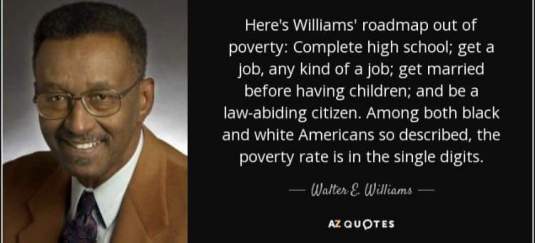
Discrimination and Disparities with Thomas Sowell
09 May 2018 Leave a comment
in applied price theory, discrimination, economic history, economics of education, economics of regulation, human capital, labour economics, labour supply, occupational choice, poverty and inequality Tags: Thomas Sowell
Was Karl Marx right? | The Economist
05 May 2018 Leave a comment
in applied price theory, business cycles, development economics, economic history, economics of bureaucracy, entrepreneurship, history of economic thought, industrial organisation, labour economics, macroeconomics, Marxist economics, poverty and inequality, Public Choice, public economics Tags: economics of socialism
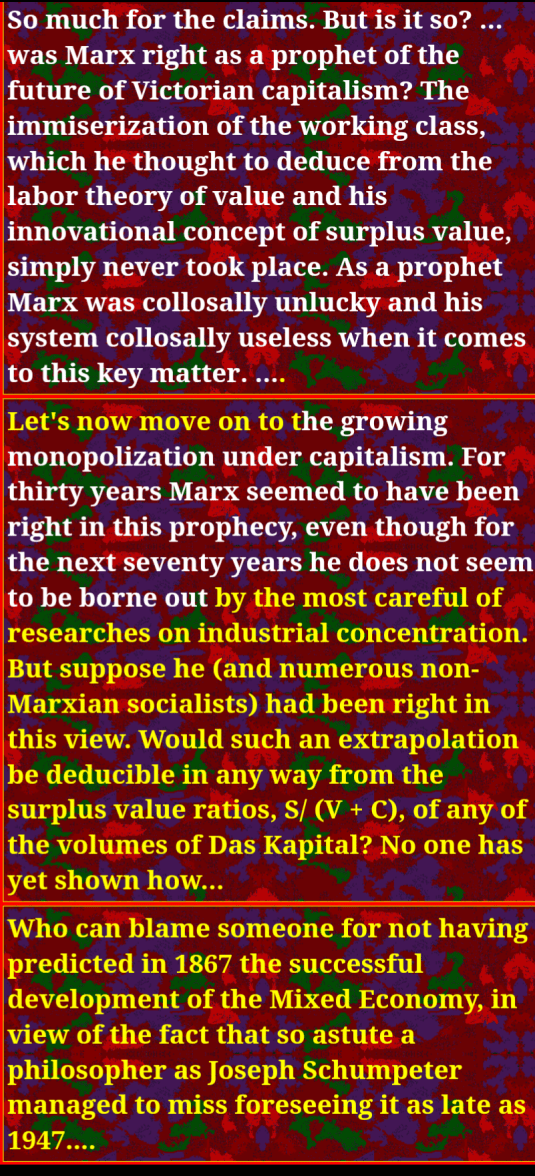
From Paul Samuelson’s essay on marxist economics
.@GuardianWorld exaggerates NZ homeslessness by ten-fold
04 May 2018 Leave a comment
in labour economics, politics - New Zealand, poverty and inequality, urban economics Tags: homelessness


Income Inequality: The Role of Markets & Government (Sam Peltzman and Bruce Meyer)
01 May 2018 Leave a comment
in applied price theory, applied welfare economics, economic history, labour economics, labour supply, poverty and inequality, Sam Peltzman
In “$2.00 a day: living on almost nothing on America”, Edin and Shaefer argued welfare reform led to a surge in extreme poverty, families living in ‘extreme destitution’!
29 Apr 2018 Leave a comment
in labour economics, politics - USA, poverty and inequality Tags: 1996 federal welfare reforms, child poverty, family poverty

Are the rich getting richer according to labour shares?
27 Apr 2018 Leave a comment
in applied welfare economics, econometerics, poverty and inequality

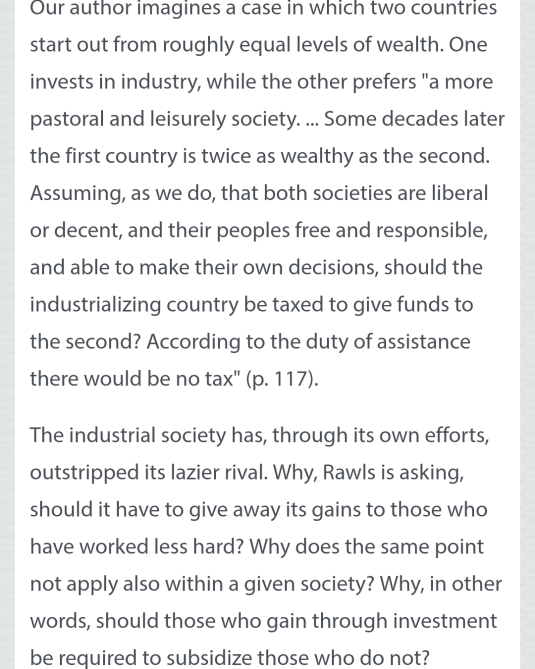
John Rawls on the duty to assist loafers
26 Apr 2018 Leave a comment
in development economics, international economics, labour supply, poverty and inequality, Rawls and Nozick
Sociologists blame inequality for trends in crime? Murders down from 100 per year to zero so far this year
23 Apr 2018 Leave a comment
in economics of crime, labour economics, law and economics, politics - USA, poverty and inequality Tags: law and order

Inequality: Should We Be Worried?
22 Apr 2018 1 Comment
in economics, labour economics, poverty and inequality
Deirdre McCloskey Liberalism is the way forward
20 Apr 2018 Leave a comment
in applied price theory, development economics, economic history, liberalism, poverty and inequality, Public Choice Tags: Deirdre McCloskey, The Great Enrichment
Simon Chapple found something similar for Maori in a 2000 paper of his
20 Apr 2018 Leave a comment
in discrimination, labour economics, poverty and inequality Tags: Maori economic development, racial discrimination

Is not Peter Singer making the case for the Berlin Wall to stop flight from a worker’s paradise
19 Apr 2018 Leave a comment
in comparative institutional analysis, income redistribution, Marxist economics, poverty and inequality, Public Choice, Rawls and Nozick

From http://www.nybooks.com/articles/1975/03/06/the-right-to-be-rich-or-poor/ 1975 review of Anarchy, State and Utopia.
 Utopia, you are standing in it!
Recent Comments