
British top 1% really have dropped the ball, left labour surplus on the table
11 Jan 2017 Leave a comment
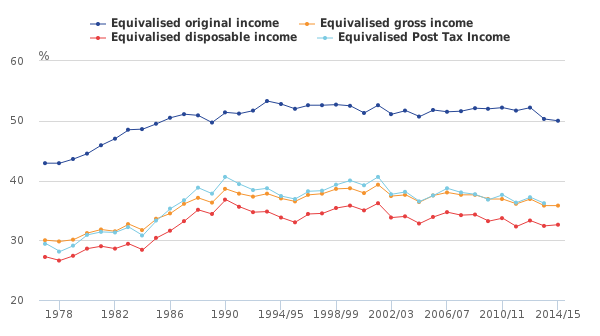
Richard Epstein’s lecture on Piketty
05 Jan 2017 Leave a comment
in applied price theory, economic history, entrepreneurship, industrial organisation, labour economics, poverty and inequality, Richard Epstein
Deirdre McCloskey summarises Rawls and Nozick on unequal incomes
02 Jan 2017 Leave a comment
in applied price theory, applied welfare economics, comparative institutional analysis, constitutional political economy, development economics, economic history, Gordon Tullock, growth miracles, history of economic thought, James Buchanan, James Buchanan, labour economics, law and economics, poverty and inequality, property rights, Public Choice, Rawls and Nozick Tags: creative destruction, Deirdre McCloskey, industrial revolution, John Rawls, Robert Nozick, The Great Enrichment, The Great Escape, The Great Fact, top 1%, veil of ignorance, veil of uncertainty
Source: Review of Michael J. Sandel’s What Money Can’t Buy: The Moral Limit of Markets by Deirdre McCloskey August 1, 2012. Shorter version published in the Claremont Review of Books XII(4), Fall 2012 via Deirdre McCloskey: editorials.
Child poverty and top 1% income shares seems to have been stable for 20 years, more or less
21 Dec 2016 Leave a comment
in economic history, politics - New Zealand, poverty and inequality
Thomas Sowell – Black Lives and Social Policy
08 Dec 2016 Leave a comment
in applied price theory, discrimination, economics of education, human capital, labour economics, minimum wage, occupational choice, poverty and inequality, unemployment Tags: economics of families, racial discrimination, Thomas Sowell
Why doesn’t the Left want us to be more like low tax Japan, not high-tax Sweden?
07 Dec 2016 Leave a comment
in applied welfare economics, comparative institutional analysis, population economics, poverty and inequality
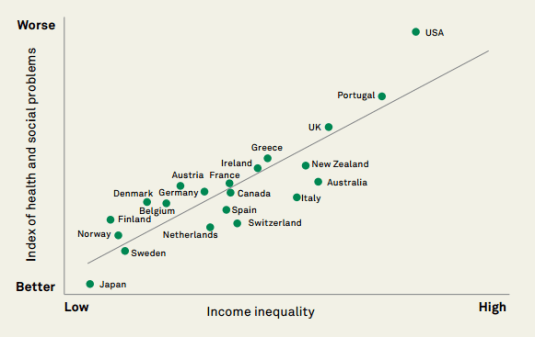
Why did poverty start falling noticeably in the 1990s in the USA?
06 Dec 2016 Leave a comment
in economic history, labour economics, labour supply, politics - USA, poverty and inequality, welfare reform
Capitalism in the United States is ruthless—to the rich
27 Nov 2016 Leave a comment
in economic history, entrepreneurship, industrial organisation, poverty and inequality, survivor principle Tags: top 1%
Is inequality just getting worse and worse in #NewZealand?
23 Nov 2016 Leave a comment
in applied welfare economics, economic history, politics - New Zealand, poverty and inequality

Source: New Zealand Treasury Long-Term Fiscal Projections 2016.
More on the scourge of neoliberalism
18 Nov 2016 Leave a comment
in economic history, politics - USA, poverty and inequality, welfare reform
Roland Fryer | Education, Inequality, & Incentives
11 Nov 2016 Leave a comment
in applied price theory, applied welfare economics, economics of education, human capital, labour economics, labour supply, poverty and inequality Tags: child poverty, family poverty
.@JudithCollinsMP showed that @JacindaArdern does not know when to stop digging
13 Oct 2016 Leave a comment
in economics of crime, law and economics, politics - New Zealand, poverty and inequality, welfare reform Tags: crime and punishment, family poverty, law and order, New Zealand Labour Party
Judith Collins today in Question Time showed that Jacinda Ardern does not know when to stop digging. Ardern quoted a snippet of the question put to the police minister at the recent police conference.
That selectivity allowed Collins to right to quote the conference question in full and her full answer, which was not just about money poverty but also about
“… a poverty of ideas, a poverty of parental responsibility, a poverty of love, a poverty of caring …”.
Later Collins said she does not agree with Labour saying today that poverty causes crime.
The Labour Party showed that it is no longer rooted in working class values when it argues that poverty is not linked to a poverty of responsibility and of parental love.
There are plenty of poor people who do not resort to crime and who despise those that do, in part because they often make them the victims of their crimes including burglary.
The rise of a working rich in Australia
12 Oct 2016 Leave a comment
in economic history, human capital, industrial organisation, labour economics, labour supply, politics - Australia, poverty and inequality, survivor principle Tags: superstar wages, superstars, top 1%, top incomes
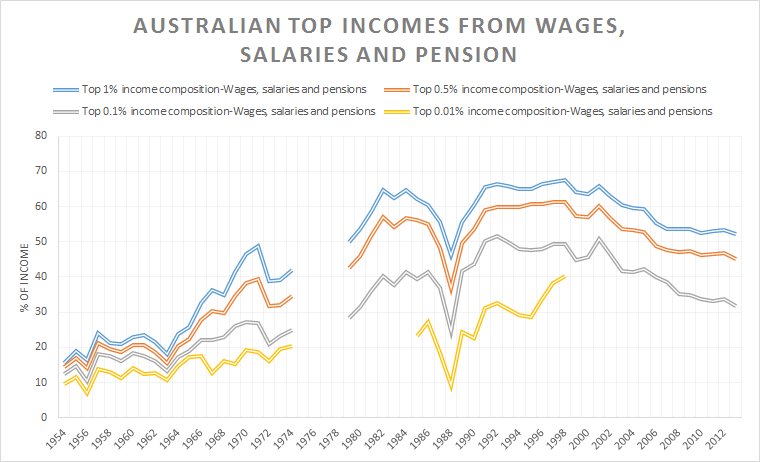
Source: The World Wealth and Income Database.
#homeslessnessinquiry champions contracting-out @NZLabour @NZGreens @Maori_Party
10 Oct 2016 Leave a comment
in economics of bureaucracy, politics - New Zealand, poverty and inequality Tags: homelessness
Did they swallow a dead rat! After complaining bitterly about the privatisation of social housing and the contracting out of government services and in particular social services generally, the New Zealand Labour Party, the New Zealand Greens and the Maori Party all accepted that part of the solution to better emergency housing services to the homelessness is to fund community housing providers to build them houses. A greater role for the private sector, be it the NGO sector, in solving pressing social problems.
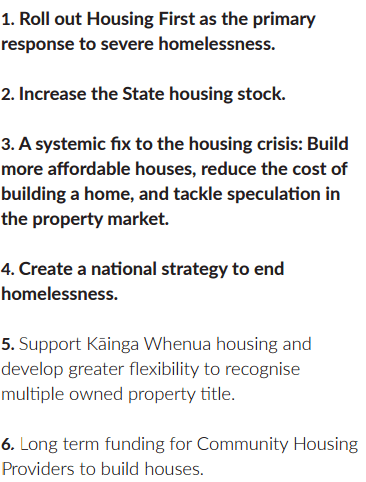
Source: Cross-party enquiry into homelessness.
It is pious to say that NGOs should build new social housing but existing social housing should not be sold to them to administer better than the bureaucrats.
The private sector has always been the last line of the defence for the social safety net for the homeless. Hotels and motels are used for emergency housing. There are plenty of them and it takes very little time to book into one as long as WINZ sends along the documentation to guarantee payment.
The report of Labour, the Greens and the Maori Party included reference to the Kate Amore data on homelessness which comfirms its credibility. That data shows that homelessness has fallen significantly in NZ since 2001 and 2006.
Homelessness is a by-product of bureaucratic inefficiency. So few people are actually sleeping rough or in shelters on any one night that is really an issue of why are those people are not in a shelter or permanent social housing.
The problem of homelessness is the efficiency of the bureaucracy in identifying these people, putting them in temporary quarters be at a hotel or motel if necessary, and then moving them into social housing.
No one is surprised at a homelessness shelter is run by a church or charity all with the assistance of government funding. No one seriously expects bureaucrats to be any good at running homeless shelters or the hotels or motels where the homeless are occasionally booked in.
 Utopia, you are standing in it!
Recent Comments