Michael Bassett writes – Have you noticed how contemptuous the Maori Party’s MPs are of democracy? After all, people who self-designate themselves as Maori are only 17% of the population. And amongst them, only a small proportion vote for the Maori Party. The brutal reality is that much higher numbers of Maori support Labour, while […]
The Maori Party thumbs its nose at democracy
The Maori Party thumbs its nose at democracy
10 Jun 2025 Leave a comment
in law and economics, politics - New Zealand, property rights, Public Choice, rentseeking Tags: constitutional law, racial discrimination
Very Expensive Affordable Housing
10 Jun 2025 1 Comment
in applied price theory, economics of regulation, law and economics, politics - USA, property rights, urban economics Tags: housing affordability, offsetting behavior, The fatal conceit, unintended consequences
In my post Affordable Housing is Almost Pointless, I highlighted how point systems for awarding tax credits prioritize DEI, environmental features, energy efficiency, and other secondary goals far more than low cost. A near-comic example comes from D.C., where so-called affordable housing units now cost between $800,000 and $1.3 million dollars each! One such unit […]
Very Expensive Affordable Housing
No Exit, No Entry
05 Jun 2025 Leave a comment
in applied price theory, development economics, economics of bureaucracy, economics of regulation, growth disasters, growth miracles, industrial organisation, labour economics, labour supply, law and economics, property rights, Public Choice, survivor principle Tags: employment law, India
In our textbook, Modern Principles, Tyler and I contrast basic U.S. labor law, at-will employment—where employers may terminate workers for any reason not explicitly illegal (e.g., racial or sexual discrimination), without notice or severance—with Portugal’s “just cause” regime, which requires employers to prove a valid reason, give advance notice, pay severance, and endure extensive regulatory […]
No Exit, No Entry
The Ultra Vires Reach of the Resource Management Act: Te Tiriti Obligations, Private Citizens, and the Erosion of Legal Boundaries
05 Jun 2025 Leave a comment
in economics of bureaucracy, economics of regulation, law and economics, politics - New Zealand, property rights, Public Choice, rentseeking Tags: constitutional law
Zoran Rakovic writes – This essay argues that the New Zealand government has acted ultra vires by interpreting and applying the Resource Management Act 1991 (RMA) in ways that impose Te Tiriti o Waitangi obligations upon private citizens and resource consent applicants without express statutory authority or due compensation. The practice violates foundational principles of […]
The Ultra Vires Reach of the Resource Management Act: Te Tiriti Obligations, Private Citizens, and the Erosion of Legal Boundaries
Again, There is No Right to a Stable Climate
04 Jun 2025 1 Comment
in constitutional political economy, economics of bureaucracy, economics of climate change, economics of regulation, energy economics, environmental economics, environmentalism, global warming, law and economics, politics - USA, property rights, Public Choice, rentseeking, resource economics Tags: climate activists, climate alarmism, nuisance suits

Announced this week was this from Inside Climate News: Trump Executive Orders Violate Young People’s Rights to a Stable Climate, a Lawsuit Alleges. Excerpts in italics with my bolds. Twenty-two young people from across the country sued the Trump administration over the executive orders, which prioritize the expansion of fossil fuels. The complaint, filed Thursday […]
Again, There is No Right to a Stable Climate
SCOTUS Slaps Down Green Overreach: 8-0 Ruling Frees Infrastructure from NEPA Shackles
03 Jun 2025 Leave a comment
in economics of bureaucracy, economics of regulation, environmental economics, environmentalism, law and economics, politics - USA, property rights, Public Choice
he fact that the project might foreseeably lead to the construction or increased use of a separate project does not mean the agency must consider that separate project’s environmental effects
SCOTUS Slaps Down Green Overreach: 8-0 Ruling Frees Infrastructure from NEPA Shackles
The Eminent Domain Racket: New Jersey Move to Condemn Church Could Put Court in a Pickle
31 May 2025 Leave a comment
in law and economics, politics - USA, property rights

This week, The New York Times reported that the town of Toms River, New Jersey, is moving to condemn the Christ Episcopal Church through eminent domain to build pickleball courts and a park. Church members claim that the move was retaliation for a planned homeless shelter at the site. The case could raise one of the […]
The Eminent Domain Racket: New Jersey Move to Condemn Church Could Put Court in a Pickle
Liability for Climate Change: An Inequitable Economic Disaster
29 May 2025 Leave a comment
in economics of climate change, economics of regulation, energy economics, environmental economics, environmentalism, global warming, law and economics, politics - USA, property rights, Public Choice, rentseeking Tags: climate alarmism, nuisance suits
What is already clear are the serious and senseless economic consequences that will follow if states are allowed to punish fossil fuel companies for their lawful past production.
Liability for Climate Change: An Inequitable Economic Disaster
Excusing the Government
22 May 2025 Leave a comment
in applied price theory, applied welfare economics, comparative institutional analysis, constitutional political economy, economics of bureaucracy, economics of regulation, history of economic thought, income redistribution, international economics, labour economics, law and economics, property rights, Public Choice, public economics, rentseeking, urban economics
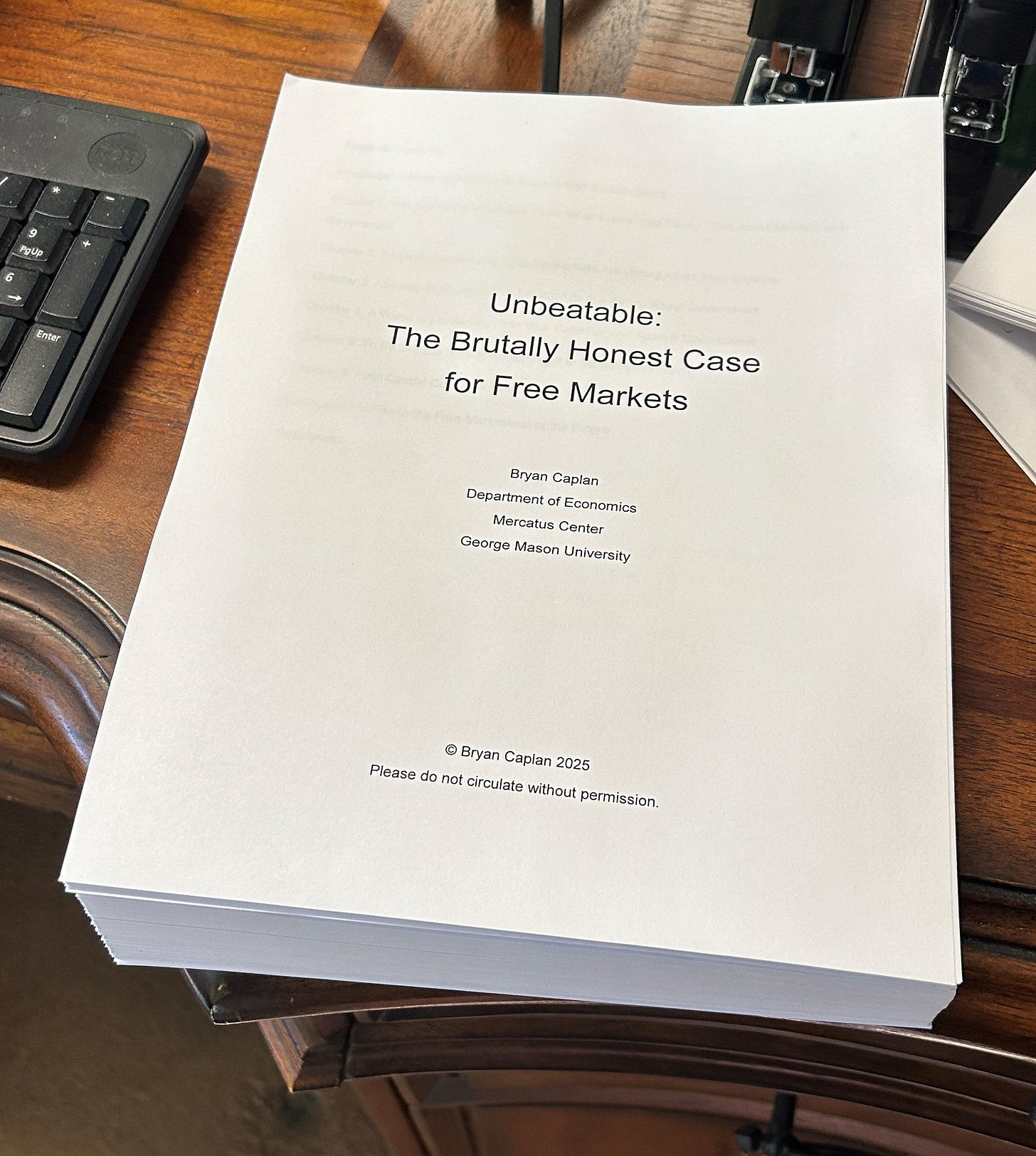
An excerpt from Chapter 3 of *Unbeatable*
Excusing the Government
Pro-Market & Pro-Business: Firms Strive to Satisfy the Customer
22 May 2025 Leave a comment
in applied price theory, comparative institutional analysis, economics of information, economics of regulation, entrepreneurship, history of economic thought, industrial organisation, labour economics, law and economics, property rights
Econ 101 is Underrated: Pharma Price Controls
22 May 2025 Leave a comment
in applied price theory, development economics, economics of regulation, entrepreneurship, health economics, law and economics, politics - USA, property rights Tags: 2024 presidential election, patents and copyrights, price controls, price discrimination
Econ 101 is often dismissed as too simplistic. Yet recent events suggest that Econ 101 is underrated. Take the tariff debate: understanding that a tariff is a tax, that prices represent opportunity costs, that a bilateral trade deficit is largely meaningless, that a so-called trade “deficit” is equally a goods surplus or an investment surplus—these […]
Econ 101 is Underrated: Pharma Price Controls
He should have apologised
19 May 2025 Leave a comment
in law and economics, politics - Australia, property rights Tags: defamation, free speech
The ABC reports: There are concerns that former Victorian Liberal leader John Pesutto will be bankrupted after being ordered to pay costs of $2.3 million after losing his defamation battle with Moira Deeming. … The Federal Court order handed down on Friday morning, raises the prospect Mr Pesutto will be bankrupted and forced out of…
He should have apologised
David Friedman on markets, governments and whether we need either?
19 May 2025 Leave a comment
in applied price theory, comparative institutional analysis, constitutional political economy, David Friedman, defence economics, economics of crime, economics of regulation, environmental economics, history of economic thought, industrial organisation, law and economics, property rights
Once again, pro-Palestinian protestors at the University of Chicago violate campus rules but don’t get punished
19 May 2025 Leave a comment
in economics of crime, economics of education, law and economics, politics - USA, property rights Tags: free speech, Gaza Strip, Israel, Middle-East politics, regressive left

If you’ve read about the various pro-Palestinian and anti-Israel protests across American campuses, one thing you’ll notice is a general reluctance to punish demonstrators when they violate university rules. Of course protests are usually fine if they conform to First Amendment principles (though some schools don’t hold those principles), but they’re never fine when they […]
Once again, pro-Palestinian protestors at the University of Chicago violate campus rules but don’t get punished
Trump Administration Targets State Climate Laws
17 May 2025 Leave a comment
in economics of climate change, energy economics, environmental economics, environmentalism, global warming, law and economics, politics - USA, property rights, Public Choice, rentseeking Tags: climate alarmism, nuisance suits
The Constitution explicitly states that neither the Congress nor any state may pass an “ex post facto Law,” which imposes criminal liability for past actions that weren’t restricted at the time. The Maryland, New York, and Vermont acts all propose to tax companies retroactively for legally producing fossil fuels.
Trump Administration Targets State Climate Laws
 Utopia, you are standing in it!
Recent Comments