The rise of the Swedish welfare state, Swedosclerosis and Director’s Law

Sweden is a common example of a generous welfare state that is compatible with a prosperous society. One interpretation of the UN Development Index is you improve your national ranking by becoming more like Sweden.

Assar Lindbeck has shown time and again in the Journal of Economic Literature and elsewhere that Sweden became a rich country before its highly generous welfare-state arrangements were created

Sweden moved toward a welfare state in the 1960s, when government spending was about equal to that in the United States – less that 30% of GDP.

Sweden could afford this at the end of the era that Lindbeck labelled ‘the period of decentralization and small government’. Sweden was one of the fastest growing countries in the world between 1870 and 1960.

Swedes had the third-highest OECD per capita income, almost equal to the USA in the late 1960s, but higher levels of income inequality than the USA.

By the late 1980s, Swedish government spending had grown from 30% of gross domestic product to more than 60% of GDP. Swedish marginal income tax rates hit 65-75% for most full-time employees as compared to about 40% in 1960.

Swedish economists named the subsequent economic stagnation Swedosclerosis:

  • Economic growth slowed to a crawl in the 1970s and 1980s.
  • Sweden dropped from near the top spot in the OECD rankings to 18th by 1998 – a drop from 120% to 90% of the OECD average inside three decades.
  • 65% of the electorate receive (nearly) all their income from the public sector—either as employees of government agencies (excluding government corporations and public utilities) or by living off transfer payments.
  • No net private sector job creation since the 1950s, by some estimates!

In 1997, Lindbeck suggested that the Swedish Experiment was unravelling.


Sweden is a classic example of Director’s Law of Public Expenditure. Once a country becomes rich because of capitalism, politicians look for ways to redistribute more of this new found wealth.

Studies starting from Sam Peltzman (1980) showed that government grew in line with the growth in the size and homogeneity of the middle class that became organised and politically articulate enough to implement a version of Director’s law. Director’s law augmented by Gary Becker’s 1983 model of competition among pressure groups for political influence explain much of modern public policy.

Government spending grew in many countries in the mid-20th century because of demographic shifts, more efficient taxes, more efficient spending, shifts in the political power from those taxed to those subsidised, shifts in political power among taxed groups, and shifts in political power among subsidised groups.

The Swedish economic reforms from after 1990 economic crisis and depression are an example of a political system converging onto more efficient modes of income redistribution as the deadweight losses of taxes on working and investing and subsidies for not working both grew. Improvements in the efficiency of taxes or spending reduce political pressure to suppress the growth of the welfare state and thus increase or prevent cuts to both total tax revenue and spending.

After the rise of Swedosclerosis, the taxed, regulated and subsidised groups had an increased incentive to converge on new lower cost modes of redistribution. More efficient taxes, more efficient spending, more efficient regulation and a more efficient state sector reduced the burden of taxes on the taxed groups. Most subsidised groups benefited as well because their needs were met in ways that provoked less political opposition.

Reforms ensued led by parties on the Left and Right, with some members of existing political groupings benefiting from joining new political coalitions.

The Nordic median voter was alive to the power of incentives and to not killing the goose that laid the golden egg. The deadweight losses of taxes, transfers and regulation limit inefficient policies and the sustainability of redistribution.

For example, while tax rates are high in Sweden and the rest of Scandinavia, hours worked in Scandinavia are significantly higher than in Continental Europe.

Richard Rogerson found in Taxation and market work: is Scandinavia an outlier? that how the government spends tax revenues imply different rates of labour supply with regard to tax rate increases.

Rogerson considered that differences in the composition of government spending can potentially account for the high rate of labour supply in Sweden and elsewhere in Scandinavia. Specifically, examining the conditions on which how tax revenue is returned to Swedes as income transfers or other conditional payments is central to understanding the labour supply effects of taxes:

  • If higher taxes fund disability payments which may only be received when not in work, the effect on hours worked is greater relative to a lump-sum transfer with no conditions; and
  • If higher taxes subsidise day care for individuals who work, then the effect on hours of work will be less than under the lump-sum transfer with no conditions.

A much higher rate of government employment and greater expenditures on child and elderly care explain the high rates of Swedish labour supply.

Swedes are taxed heavily, but key parts of this tax revenue are then given back to them conditionally if they keep working. Policies that significantly cut the total wealth available for redistribution by Swedish governments were avoided relative to the germane counter-factual, which are other even costlier modes of income redistribution.

Individual tradable birth licences – ecological economics’ finest hour?

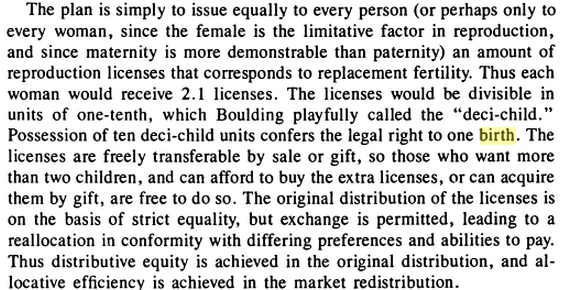
A mate suggested that I look into ecological economics. The self-appointed visionaries of ecological economics were so concerned about the population bomb that they proposed a “choice-based, marketable, birth license plan” or “birth credits” for population control. The Earth’s carrying capacity is a central issue in ecological economics.

Birth credits were promoted by urban designer and environmental activist Michael E. Arth since the 1990s and earlier by economist Kenneth Boulding (1964) and ecological economist Herman Daly (1991). I am not making this up.

Birth credits would allow any woman to have as many children as she wants, as long as she buys a license for any children beyond an average allotment that would result in zero population growth (ZPG). Birth credits are similar to individual tradable quotas for fishing.

  • If the allotment was determined to be 1.1 children, then the first child would be free, and the market would determine the cost of the license or birth credit for each additional child.
  • The units could be sold in units of 1/10th of a credit with each of us getting 1.1 credits each for free, under some proposals.

Being nice members of the middle class, the penalty proposed for an illegal baby would be community service for the parents. I am sure most parents would welcome the time out of the house and the free child care. Obviously, these nice family unfriendly educated middle class ZPG types do not seem to appreciate the seas and oceans that some with cross to have a child.

daly birth licences

Arth, Dally and his fellow prophets were smug enough to think they could see the future and a looming population bomb and food riots, but plainly they got the sign of the demographic crisis wrong.

Sub-replacement fertility is now the demographic crisis. Over half of the world’s population lives in countries with fertility rates at or below replacement level, and nearly all countries will reach low fertility levels in the next decade or two.

A larger population can, as Gary Becker has pointed out, increase the rate of technological progress by increasing the number of creative people working away at inventing new products and ideas. More people means more markets that will reach a critical mass for which people can then profitably invent new products, which further increase innovation and economic growth.

The price of these birth credits would be now lower than an EU carbon credit. You could not give them away.

HT: Steady-State Economics: Second Edition With New Essays – Herman E. Daly – Google Books.

Renegade liberals and the withering away of the proletariat

George Orwell, in his proposed preface of Animal Farm, wrote of the “renegade liberal”. Renegade liberals glorify socialist experiments and disdain middle-class life despite their own pleasant circumstances.

Renegade liberals search the globe for outlaw states and revolutionary movements to support, who, of course, would ship their local versions of these renegade liberals straight to the camps as soon as they won power. Iran, Castro and Hugo Chávez are their latest rebels without a clue.

The revolutionary excesses of the new socialist or Anti-American regimes are excused as the misadventures of ‘liberals in a hurry’, who understandably lost patience with the slow pace of democratic reform. It is all in the name of liberating the proletariat from their misery or throwing off the dead hand of colonial rule.

How is the immiseration of the proletariat going these days?

  • The immiseration of the proletariat is the central prediction of Marxism, the driver of class conflict, and this growing misery and poverty is what will finally push workers to wage a revolution against the capitalists.
  • It is a bit hard to argue that workers are poorer today than in 1848 when the Communist Manifesto was written. The central Marxist prediction is falsified by history.

I agree with G.A. Cohen when he argues that there is no group in advanced industrial societies united by:

  1. being the producers on which society depends;
  2. being exploited;
  3. being, in conjunction with their families, the majority of society; and
  4. being in dire need.

To avoid the inconvenient truth of modern affluence and the move of so many of the proletariat into the middle class, renegade liberals search endlessly for under-developed countries so they can blame their poverty on capitalism.

When they visit them in solidarity, these renegade liberals should read the visa stamp: ‘people’s republic’ or ‘socialist republic’ is so frequently on it. It is still mandatory for all political parties in India to be committed to socialism.

fidel.JPG

Nearly all of Asia (where much of the world’s population lives) has undergone rapid and sustained economic and social progress because they became market economies, starting with the Asian Tigers and recently in previously socialist India and communist China. Latin America adopted the inward economic polices of the mid-20th century that renegade liberals praise so much and they became development disasters.

As the world embraced free market policies in the late 20th century, living standards rose sharply; life expectancy, education and democracy improved and absolute poverty declined. Xavier Sala-I-Martin and Maxim Pinkovskiy (2010) found that between 1970 and 2006, poverty fell by 86% in South Asia, 73% in Latin America, 39% in the Middle East and 20% in Africa. The percentage of people living on less than $1 a day (in PPP-adjusted 2000 dollars) fell from 26.8% in 1970 to 5.4% in 2006.

To go further, P.T. Bauer disputed the lack of development in British colonies. Bauer argued that much of British colonial Africa was transformed in the colonial period.

Peter Bauer

Before British rule, there were no rubber trees in Malaya, no cocoa trees in West Africa, no tea in India:

“…Much of British colonial Africa was transformed during the colonial period. In the Gold Coast there were about 3000 children at school in the early 1900s, whereas in the mid-1950s there were over half a million. In the early 1890s there were in the Gold Coast no railways or roads, but only a few jungle paths…

Before colonialism, Sub-Saharan Africa was a subsistence economy, because of colonialism it became a monetized economy.

Before colonialism, the absence of public security made investment impossible.

After it, investment flowed. So too was scientific agriculture introduced by colonial administrations, or by “foreign private organizations and persons under the comparative security of colonial rule, and usually in the face of formidable obstacles…

In British West Africa public security and health improved out of all recognition… peaceful travel became possible; slavery and slave trading and famine were practically eliminated, and the incidence of the worst diseases reduced..” (P.T. Bauer)

Some colonial powers were better than others. After 500 years of Portuguese rule in East Timor, in 1975, there was one road – to the governor’s house – and the phone number of the Australian consulate was 7! Portugal itself may have not been much better at that time too. Colonial masters are like parents. You must choose them well.

Next Newer Entries

Bassett, Brash & Hide

Celebrating humanity's flourishing through the spread of capitalism and the rule of law

Truth on the Market

Scholarly commentary on law, economics, and more

The Undercover Historian

Beatrice Cherrier's blog

Matua Kahurangi

Celebrating humanity's flourishing through the spread of capitalism and the rule of law

Temple of Sociology

Celebrating humanity's flourishing through the spread of capitalism and the rule of law

Velvet Glove, Iron Fist

Celebrating humanity's flourishing through the spread of capitalism and the rule of law

Why Evolution Is True

Why Evolution is True is a blog written by Jerry Coyne, centered on evolution and biology but also dealing with diverse topics like politics, culture, and cats.

Down to Earth Kiwi

Celebrating humanity's flourishing through the spread of capitalism and the rule of law

NoTricksZone

Celebrating humanity's flourishing through the spread of capitalism and the rule of law

Homepaddock

A rural perspective with a blue tint by Ele Ludemann

Kiwiblog

DPF's Kiwiblog - Fomenting Happy Mischief since 2003

The Dangerous Economist

Celebrating humanity's flourishing through the spread of capitalism and the rule of law

Watts Up With That?

The world's most viewed site on global warming and climate change

The Logical Place

Tim Harding's writings on rationality, informal logic and skepticism

Doc's Books

A window into Doc Freiberger's library

The Risk-Monger

Let's examine hard decisions!

Uneasy Money

Commentary on monetary policy in the spirit of R. G. Hawtrey

Barrie Saunders

Thoughts on public policy and the media

Liberty Scott

Celebrating humanity's flourishing through the spread of capitalism and the rule of law

Point of Order

Politics and the economy

James Bowden's Blog

A blog (primarily) on Canadian and Commonwealth political history and institutions

Science Matters

Reading between the lines, and underneath the hype.

Peter Winsley

Economics, and such stuff as dreams are made on

A Venerable Puzzle

"The British constitution has always been puzzling, and always will be." --Queen Elizabeth II

The Antiplanner

Celebrating humanity's flourishing through the spread of capitalism and the rule of law

Bet On It

Celebrating humanity's flourishing through the spread of capitalism and the rule of law

History of Sorts

WORLD WAR II, MUSIC, HISTORY, HOLOCAUST

Roger Pielke Jr.

Undisciplined scholar, recovering academic

Offsetting Behaviour

Celebrating humanity's flourishing through the spread of capitalism and the rule of law

JONATHAN TURLEY

Res ipsa loquitur - The thing itself speaks

Conversable Economist

Celebrating humanity's flourishing through the spread of capitalism and the rule of law

The Victorian Commons

Researching the House of Commons, 1832-1868

The History of Parliament

Articles and research from the History of Parliament Trust

Books & Boots

Reflections on books and art

Legal History Miscellany

Posts on the History of Law, Crime, and Justice

Sex, Drugs and Economics

Celebrating humanity's flourishing through the spread of capitalism and the rule of law

European Royal History

Exploring the Monarchs of Europe

Tallbloke's Talkshop

Cutting edge science you can dice with

Marginal REVOLUTION

Small Steps Toward A Much Better World

NOT A LOT OF PEOPLE KNOW THAT

“We do not believe any group of men adequate enough or wise enough to operate without scrutiny or without criticism. We know that the only way to avoid error is to detect it, that the only way to detect it is to be free to inquire. We know that in secrecy error undetected will flourish and subvert”. - J Robert Oppenheimer.

STOP THESE THINGS

The truth about the great wind power fraud - we're not here to debate the wind industry, we're here to destroy it.

Lindsay Mitchell

Celebrating humanity's flourishing through the spread of capitalism and the rule of law

Alt-M

Celebrating humanity's flourishing through the spread of capitalism and the rule of law

croaking cassandra

Economics, public policy, monetary policy, financial regulation, with a New Zealand perspective

The Grumpy Economist

Celebrating humanity's flourishing through the spread of capitalism and the rule of law

International Liberty

Restraining Government in America and Around the World