Roger Partridge writes: A new submission to the Committee from banking experts Andrew Body and Simon Jensen provides fresh evidence of these costs. Their analysis shows the Reserve Bank’s capital rules add between 0.25 and 0.375 percentage points to mortgage rates compared with Australia. For a million-dollar mortgage, that means between $2,500 and $3,750 in […]
The cost of Reserve Bank regulation
The cost of Reserve Bank regulation
02 Mar 2025 Leave a comment
in applied price theory, business cycles, economics of bureaucracy, economics of natural disasters, economics of regulation, inflation targeting, macroeconomics, monetary economics, politics - New Zealand, Public Choice Tags: monetary policy
Forty years of floating
01 Mar 2025 Leave a comment
in budget deficits, business cycles, economic growth, economic history, Euro crisis, global financial crisis (GFC), great recession, history of economic thought, inflation targeting, macroeconomics, monetary economics Tags: floating exchange rates

Last year there was an interesting new book out, made up of 29 collected short papers by (more or less) prominent economists given at a 2023 conference to mark Floating Exchange Rates at Fifty. The fifty years related to the transition back to generalised floating of the major developed world currencies in 1973 (think USD, […]
Forty years of floating
The Secretary to the Treasury defending govt fiscal policy
27 Dec 2024 Leave a comment
in budget deficits, economics of bureaucracy, fiscal policy, inflation targeting, macroeconomics, politics - New Zealand, Public Choice

I wasn’t envisaging writing anything more for a while, but….Welllington’s weather certainly isn’t conducive to either the beach or the garden, and the Herald managed to get an interview with Iain Rennie, the new Secretary to the Treasury (not usually the sort of stuff for 27 December either). I’ve always been rather uneasy about heads […]
The Secretary to the Treasury defending govt fiscal policy
Fiscal and monetary policy
27 Aug 2024 Leave a comment
in budget deficits, business cycles, econometerics, economic growth, economic history, financial economics, fiscal policy, history of economic thought, inflation targeting, macroeconomics, monetary economics, politics - New Zealand Tags: monetary policy

Over the last few years, The Treasury seems to have been toying with bidding for a more significant role for fiscal policy as a countercyclical stabilisation tool It seemed to start when Covid hubris still held sway – didn’t we do well? – and the first we saw of it in public was at a […]
Fiscal and monetary policy
Finally, exchange rate models seem to work pretty well
14 Aug 2024 Leave a comment
in budget deficits, business cycles, econometerics, economic history, financial economics, history of economic thought, inflation targeting, macroeconomics, monetary economics, politics - USA Tags: exchange rates, monetary policy
Exchange-rate models fit very well for the U.S. dollar in the 21st century. A “standard” model that includes real interest rates and a measure of expected inflation for the U.S. and the foreign country, the U.S. comprehensive trade balance, and measures of global risk and liquidity demand is well-supported in the data for the U.S. […]
Finally, exchange rate models seem to work pretty well
Treasury says one thing in a speech but quite another in the BEFU
28 Jul 2024 Leave a comment
in budget deficits, business cycles, economic growth, fiscal policy, inflation targeting, labour economics, macroeconomics, monetary economics, politics - New Zealand, unemployment Tags: monetary policy

I picked up The Post this morning to find the lead story headlined “Recession hits homes harder than businesses”, reporting a speech given earlier this week by Treasury’s deputy secretary and chief economic adviser Dominick Stephens. There was an account of the same speech, but with some different material, on BusinessDesk a couple of days […]
Treasury says one thing in a speech but quite another in the BEFU
Still avoiding responsibility
09 Jul 2024 Leave a comment
in business cycles, inflation targeting, macroeconomics, monetary economics, politics - New Zealand Tags: monetary policy

I was away when Reserve Bank chief economist Paul Conway gave his recent speech, “The road back to 2% inflation”, and since I didn’t see any material commentary on it I didn’t bother going back to it when I got home. But my son – honours student researching monetary policy (anyone wanting a young economist […]
Still avoiding responsibility
MPS
22 May 2024 Leave a comment
in budget deficits, business cycles, economic growth, financial economics, fiscal policy, inflation targeting, macroeconomics, monetary economics
Two central banks
18 May 2024 Leave a comment
in economic history, inflation targeting, macroeconomics, monetary economics, politics - Australia, politics - New Zealand Tags: monetary policy
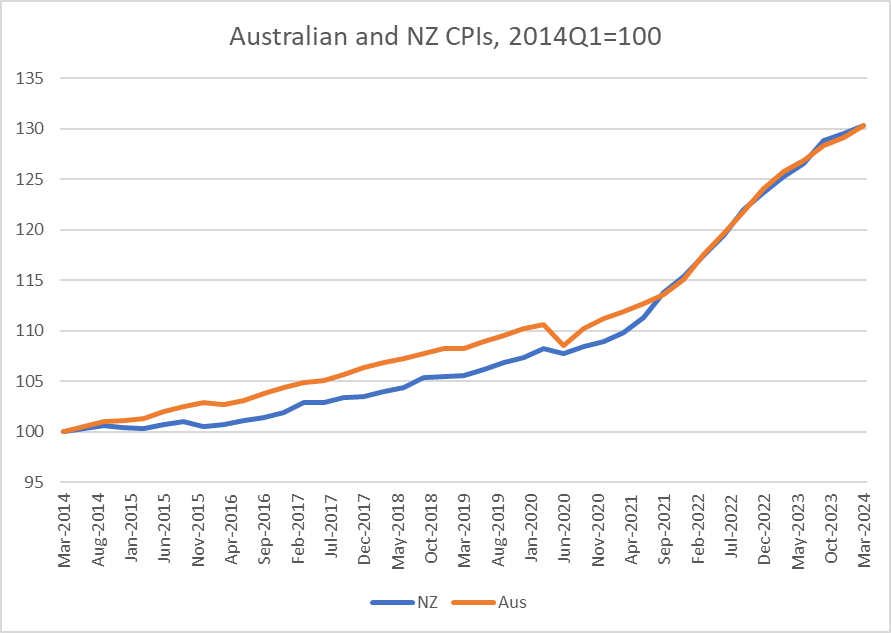
Michael Reddell writes – I got curious yesterday about how the Australia/New Zealand real exchange rate had changed over the last decade, and so dug out the data on the changes in the two countries’ CPIs. Over the 10 years from March 2014 to March 2024, New Zealand’s CPI had risen by 30.3 per cent […]
Two central banks
What’s the Right Interest Rate for the Fed Anyway?
08 Feb 2024 Leave a comment
in business cycles, econometerics, economic growth, inflation targeting, labour economics, macroeconomics, monetary economics, unemployment Tags: monetary policy
Standard models watched by economists at the Federal Reserve and elsewhere suggest that rates should now be lowerBy Justin Lahart of The WSJ. Excerpt:”So where should rates be? There has been a lot of focus recently on the long-term neutral rate—the just-right level of rates for when inflation is at the Fed’s 2% target, and…
What’s the Right Interest Rate for the Fed Anyway?
The Conway speech
08 Feb 2024 Leave a comment
in budget deficits, business cycles, econometerics, economic growth, economic history, economics of bureaucracy, fiscal policy, inflation targeting, labour economics, macroeconomics, monetary economics, politics - New Zealand, Public Choice, unemployment Tags: monetary policy
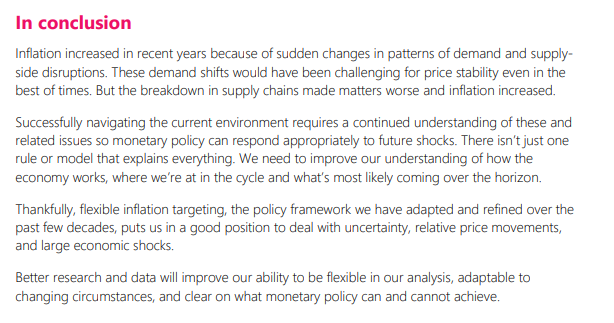
I’ve been rather tied up with other stuff for the last few weeks (including here) which is why I’ve not previously gotten round to writing about the first piece of monetary policy communications from our Reserve Bank this year. That was the “speech” by the Bank’s chief economist (and MPC) member Paul Conway given to […]
The Conway speech
The Euro at 25
03 Feb 2024 Leave a comment
in budget deficits, currency unions, economic history, economics of bureaucracy, Euro crisis, fiscal policy, global financial crisis (GFC), great recession, inflation targeting, macroeconomics, monetary economics, Public Choice Tags: Euro

The euro technically started in 1999, when the 11 founding European members of the currency agreed to keep their exchange rates fixed and to hand over monetary policy to the European Central Bank. The euro then became the actual currency that people and firms used in 2002. I confess that, back in the early 1990s,…
The Euro at 25
40 years on
08 Jan 2024 Leave a comment
in applied price theory, applied welfare economics, comparative institutional analysis, economic growth, economic history, fiscal policy, inflation targeting, international economics, labour economics, macroeconomics, monetary economics, politics - New Zealand
190308 [Webinar] Consistent Economic Policy and Economic Development
29 Dec 2023 Leave a comment
in applied price theory, budget deficits, business cycles, defence economics, economic growth, economic history, economics of information, Euro crisis, fiscal policy, fisheries economics, global financial crisis (GFC), great recession, growth disasters, growth miracles, history of economic thought, human capital, inflation targeting, labour economics, labour supply, macroeconomics, monetary economics, Public Choice, public economics, unemployment
Unconvincing
21 Dec 2023 Leave a comment
in business cycles, economic history, global financial crisis (GFC), great recession, history of economic thought, inflation targeting, macroeconomics, monetary economics, politics - New Zealand Tags: monetary policy

The Herald ran an op-ed yesterday under the heading “Why the Government’s new Reserve Bank mandate may lead to worse outcomes”. It was written by Toby Moore who served as an economic adviser in Grant Robertson’s office while he was Minister of Finance (a fact the Herald chose not to disclose to its readers). I’m more […]
Unconvincing
 Utopia, you are standing in it!
Recent Comments