Milton Friedman: The Last Conservative by Jennifer Burns 592 pages Farrar, Straus and Giroux Published: Nov 2023 Released two weeks ago, Jennifer Burns’s “Milton Friedman: The Last Conservative” is the most significant biography of Friedman ever published. Burns is an associate professor of history at Stanford and a research fellow at the Hoover Institution. She […]
Review of “Milton Friedman: The Last Conservative” by Jennifer Burns
Review of “Milton Friedman: The Last Conservative” by Jennifer Burns
29 Nov 2023 Leave a comment
in budget deficits, business cycles, economic growth, fiscal policy, global financial crisis (GFC), great depression, great recession, history of economic thought, macroeconomics, Milton Friedman, monetarism, monetary economics
The new government and the Reserve Bank
27 Nov 2023 Leave a comment
in business cycles, inflation targeting, macroeconomics, monetary economics, politics - New Zealand Tags: monetary policy

But first a correction. As I noted on Twitter and very briefly on the post itself on Saturday, it seems that the gist of my post on Friday was wrong. The repeal of Labour’s tobacco de-nicotinisation legislation – whatever motivated the parties that championed the change – will leave the flow of tobacco excise revenue […]
The new government and the Reserve Bank
Pro Dollarization
25 Nov 2023 Leave a comment
in development economics, growth disasters, monetary economics

With President Milei’s election in Argentina, dollarization is suddenly on the table. I’m for it. Here’s why. Why not? A standard of valueStart with “why not?” Dollarization, not a national currency, is actually a sensible default. The dollar is the US standard of value. We measure length in feet, weight in pounds, and the value of…
Pro Dollarization
Understanding Fiscal Inflation — Keynote Speech by Eric Leeper
22 Nov 2023 Leave a comment
in budget deficits, business cycles, economic growth, economic history, fiscal policy, global financial crisis (GFC), great depression, great recession, history of economic thought, inflation targeting, macroeconomics, monetary economics Tags: monetary policy
A Libertarian Landslide in Argentina
21 Nov 2023 Leave a comment
in development economics, economic history, growth disasters, liberalism, libertarianism, macroeconomics, Marxist economics, monetary economics Tags: Argentina, dollarisation
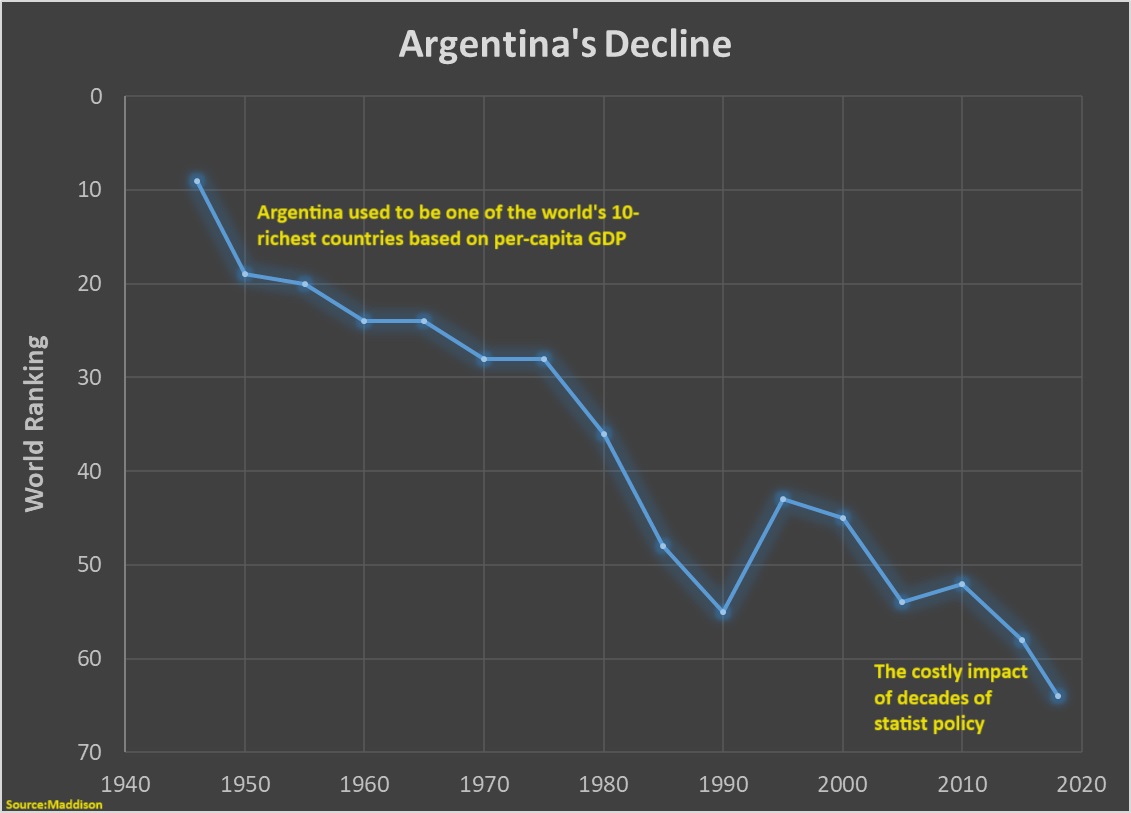
After a libertarian candidate took first place in Argentina’s presidential primary back in August, I wrote that the runoff would be the most important election of 2023 (even more important than the fortunately failed referendum to weaken TABOR in Colorado). Amazingly, Argentinian voters opted for the libertarian by a strong 56-44 margin. To understand President-Elect […]
A Libertarian Landslide in Argentina
George Selgin on the New Deal and Recovery (and Relief and Reform)
18 Nov 2023 Leave a comment
in budget deficits, business cycles, economic growth, economic history, fiscal policy, great depression, labour economics, labour supply, macroeconomics, monetary economics, unemployment
TweetWant to get a few hours’ worth of solid learning in less than 35 enjoyable minutes? Listen to my Mercatus Center colleague David Beckworth’s podcast (from October 2022) with George Selgin on the New Deal. Seriously. It will be 34-plus minutes very well spent. George’s book – False Dawn – is forthcoming from the University…
George Selgin on the New Deal and Recovery (and Relief and Reform)
My Conversation with the excellent Jennifer Burns
17 Nov 2023 Leave a comment
in Austrian economics, business cycles, economics of education, Euro crisis, F.A. Hayek, global financial crisis (GFC), great depression, great recession, history of economic thought, macroeconomics, Milton Friedman, monetarism, monetary economics
Here is the audio, video, and transcript. Here is the episode description: Jennifer Burns is a professor history at Stanford who works at the intersection of intellectual, political, and cultural history. She’s written two biographies Tyler highly recommends: her 2009 book, Goddess of the Market: Ayn Rand and the American Right and her latest, Milton Friedman: The […]
My Conversation with the excellent Jennifer Burns
Quantity theory of money, or fiscal theory of the price level?
16 Nov 2023 Leave a comment
in defence economics, development economics, economic history, growth disasters, history of economic thought, law and economics, macroeconomics, monetary economics, property rights Tags: monetary policy, Somalia
The rebel-controlled Yemeni rial is made up entirely of a fixed supply of notes printed prior to 2016. In the chart below you can see it appreciating in value (the blue line) against the dollar, issued by the world’s most powerful state. pic.twitter.com/vioXHmz2wQ — John Paul Koning (@jp_koning) November 15, 2023
Quantity theory of money, or fiscal theory of the price level?
Shameless central bankers
15 Nov 2023 Leave a comment
in business cycles, economics of bureaucracy, financial economics, fiscal policy, inflation targeting, macroeconomics, monetary economics, Public Choice Tags: monetary policy

It was in mid-August that this particular bit of shameless Reserve Bank spin got going. From a post in late August It proved to be nonsense of course. Once we had access to the short little IMF piece, published at the back of the Fund’s Article IV review, it was clear that it all amounted […]
Shameless central bankers
Milton Friedman: The Last Conservative | Hoover Institution
15 Nov 2023 Leave a comment
in applied price theory, budget deficits, business cycles, economic growth, economic history, fiscal policy, global financial crisis (GFC), great depression, great recession, history of economic thought, inflation targeting, labour economics, macroeconomics, Milton Friedman, monetarism, monetary economics, unemployment Tags: monetary policy
Filling in the Gaps: Next Steps for the Fiscal Theory of the Price Level
15 Nov 2023 Leave a comment
in applied price theory, budget deficits, business cycles, econometerics, economic history, financial economics, fiscal policy, great depression, great recession, history of economic thought, inflation targeting, macroeconomics, monetarism, monetary economics Tags: monetary policy
Jennifer Burns on Milton Friedman 11/13/23
14 Nov 2023 Leave a comment
in applied price theory, Austrian economics, business cycles, comparative institutional analysis, econometerics, economic history, economics of education, economics of regulation, fiscal policy, great depression, history of economic thought, labour economics, liberalism, libertarianism, macroeconomics, Milton Friedman, monetarism, monetary economics Tags: monetary policy
Why Is There Divergence Between the United States and Europe?
11 Nov 2023 Leave a comment
in business cycles, currency unions, economic growth, macroeconomics
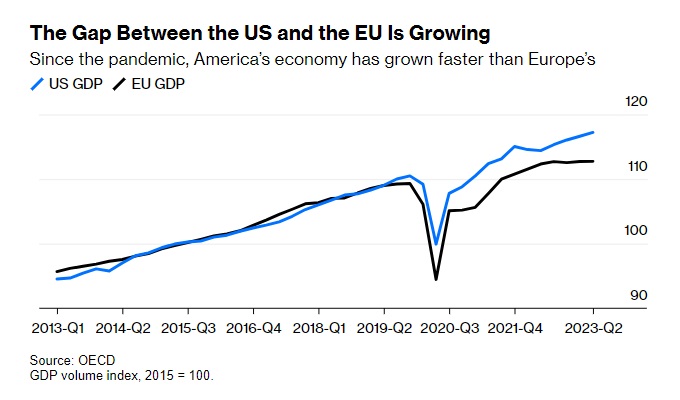
In economics, convergence theory is the common-sense observation that poor countries – in general – should grow faster than rich countries. But a general principle sometimes has exceptions, and that’s why I put together my anti-convergence club. If you look at members of that club, you’ll notice that when rich countries grow faster than poor […]
Why Is There Divergence Between the United States and Europe?
Book Presentation with John Cochrane: “The Fiscal Theory of the Price Le…
09 Nov 2023 Leave a comment
in budget deficits, business cycles, econometerics, economic growth, economic history, Euro crisis, fiscal policy, global financial crisis (GFC), great depression, great recession, history of economic thought, inflation targeting, macroeconomics, Milton Friedman, monetarism, monetary economics, public economics Tags: monetary policy
Reflections on the TCU Capitalism versus Socialism Debate
08 Nov 2023 Leave a comment
in applied price theory, applied welfare economics, comparative institutional analysis, constitutional political economy, development economics, economic growth, economic history, economics of bureaucracy, growth disasters, growth miracles, income redistribution, industrial organisation, labour economics, law and economics, liberalism, libertarianism, Marxist economics, poverty and inequality, privatisation, property rights, Public Choice, public economics Tags: economics of socialism, Sweden

Two days ago at Texas Christian University, I debated Scott Sehon, chair of Bowdoin College’s Philosophy Department, on Capitalism versus Socialism. (Video forthcoming eventually). My opening statement was a slight variation on the one I wrote for an earlier debate on the same topic with Elizabeth Bruenig. Sehon’s opening statement was adapted from his Socialism:…
Reflections on the TCU Capitalism versus Socialism Debate
 Utopia, you are standing in it!
Recent Comments